
Photo by Galen Crout on Unsplash
Demographics of Bastrop, LA
Affluence Level in Bastrop, LA
A low-income area with significant economic hardship. Household wealth and educational attainment are well below national averages.
People of Bastrop, LA
The people of Bastrop, Louisiana, today form a predominantly Black community of 9,408 residents, with 79.2% identifying as Black or African American and 17.1% as White. The city is characterized by a tight-knit, family-oriented population with a low foreign-born share of just 0.2% and a college education rate of 5.2%, reflecting a working-class identity rooted in the region’s agricultural and industrial past. Distinctive markers include a strong sense of local heritage, with many families tracing their roots back multiple generations, and a demographic profile that is notably homogenous compared to the broader state.
How the city was settled and grew
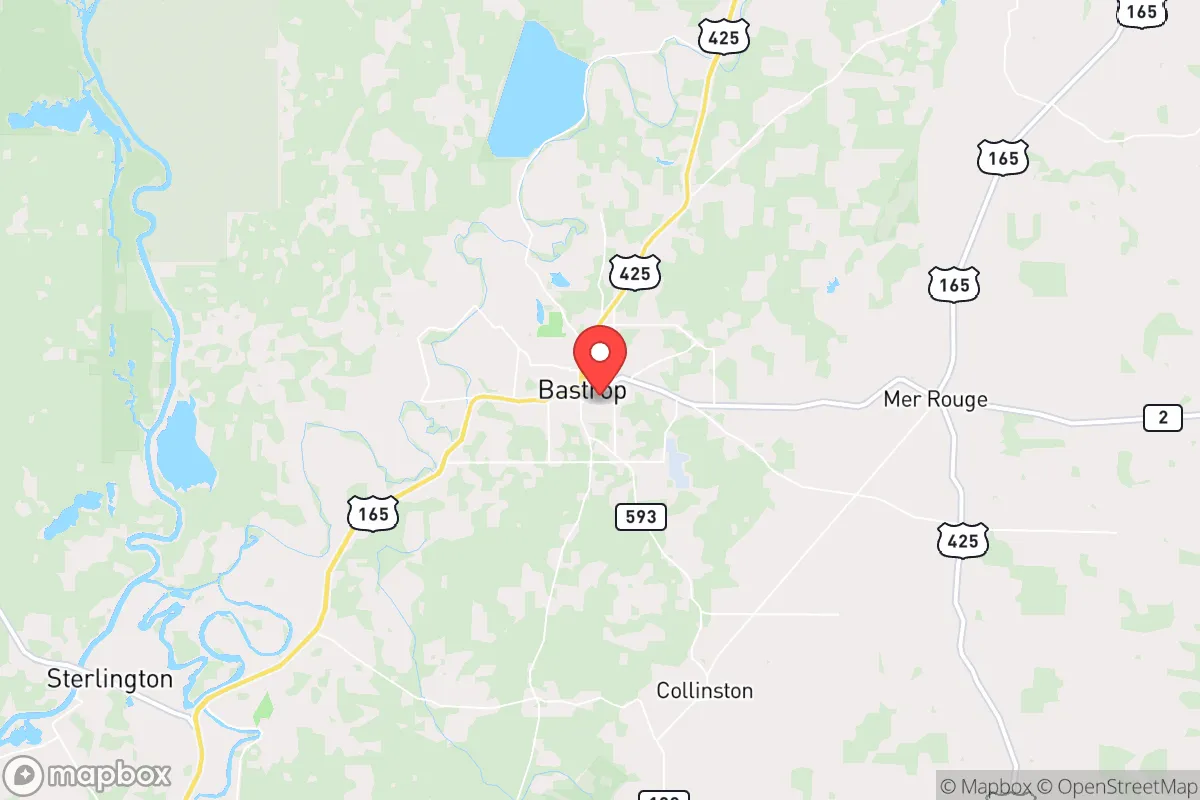
Bastrop was founded in the 1840s as a river port on the Ouachita River, drawing its earliest population of European-American settlers, primarily of English and Scots-Irish descent, who arrived via the Mississippi River system. These families established the town as a cotton and timber hub, with the Downtown Bastrop district—centered around the Morehouse Parish Courthouse—becoming the commercial and civic core. By the late 19th century, the arrival of the railroad spurred a second wave of White settlers, including German and Italian immigrants, who settled in the South Bastrop area near the rail yards. The Black population grew significantly during the Great Migration (1910–1970), as African Americans from rural Louisiana and Mississippi moved to Bastrop for work in the timber mills and cotton fields. They established the North Bastrop neighborhood, historically known as “The Hill,” which became the cultural and religious center of the Black community, anchored by churches like St. Mary Baptist Church. By 1950, Bastrop’s population had swelled to over 12,000, with a roughly equal Black-White split, reflecting the dual labor force of the era.
Modern era (post-1965)
The post-1965 period brought profound demographic shifts. The Immigration and Nationality Act of 1965 had little direct effect on Bastrop—foreign-born residents remain negligible at 0.2%—but domestic migration reshaped the city. White flight accelerated in the 1970s and 1980s as many White families moved to newer subdivisions in West Bastrop (near the Bastrop High School area) or left the city entirely for suburbs like Monroe. This exodus was driven by school desegregation orders and the decline of the timber industry, which reduced economic opportunities. Meanwhile, the Black population consolidated in East Bastrop and North Bastrop, where homeownership rates remained stable. By 2000, the Black share had risen to 65%, and by 2020 it reached 79.2%, while the White share fell from 34% to 17.1%. The Hispanic population grew slightly to 1.5%, concentrated in a small enclave near the Bastrop Industrial Park, where poultry processing plants employ a handful of Latino workers. The Asian and Indian populations remain at 0.0%, reflecting the city’s lack of professional or tech-sector employment that typically attracts these groups.
The future
Bastrop’s population is heading toward further homogenization, with the Black share likely to stabilize around 80–85% as White out-migration continues but slows due to an aging White cohort. The city is not tribalizing into distinct enclaves—neighborhoods like North Bastrop and West Bastrop are becoming more integrated as younger Black families move into formerly White areas. Immigrant communities are not growing; the 0.2% foreign-born share is among the lowest in Louisiana, and no new ethnic enclaves are emerging. The college education rate of 5.2% is a drag on economic diversification, limiting the arrival of educated professionals. Over the next 10–20 years, Bastrop will likely remain a predominantly Black, working-class city with a slowly declining population (down from 12,000 in 1980 to 9,408 today), as younger residents move to Monroe or Baton Rouge for jobs. The city’s future depends on whether local industries—such as the Georgia-Pacific paper mill—can retain employment, or if a new economic anchor emerges to reverse the outflow.
For someone moving in now, Bastrop is a place where deep family roots and community ties define daily life, but economic and educational opportunities are limited. The city is becoming more demographically uniform, not more diverse, and newcomers should expect a close-knit, slow-paced environment where most residents have multi-generational connections to the area. The low cost of living and strong church community appeal to those seeking stability, but the lack of population growth or new industries means the city’s character is unlikely to change significantly in the coming decades.

* Values derived from national, state, county, city and local statistics and may differ in a specific area. Last updated: 2026-05-01T05:15:00.000Z
Narrative content on this page is AI-generated and may contain mistakes. Verify any details that matter before acting on them.
ReloMaps may earn a commission from affiliate links at no extra cost to you.

