 Popular
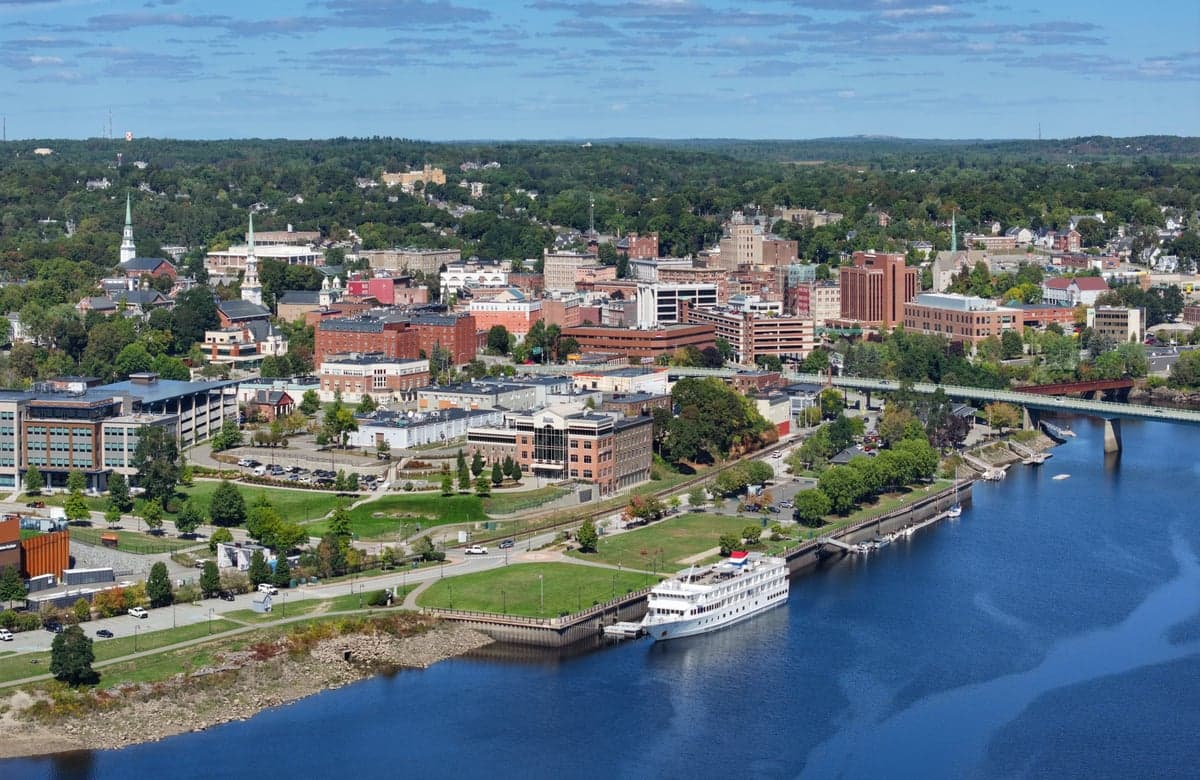
Photo: Wikipedia
Demographics of Bangor, ME
Affluence Level in Bangor, ME
A middle-class area roughly in line with national averages across income, home values, education, and employment.
People of Bangor, ME
Bangor, Maine, is a city of roughly 31,663 residents, characterized by a predominantly white population (86.8%) and a notably low foreign-born share of just 2.5%. It is a compact, historically rooted city where a strong sense of local identity is paired with a modest but growing diversity, primarily through Hispanic (3.2%), Black (2.6%), and East/Southeast Asian (1.7%) communities. The city’s population is older and more settled than the national average, with a college-educated rate of 36.3% that reflects the influence of the University of Maine system and regional healthcare employers.
How the city was settled and grew
Bangor’s human history begins with the Penobscot people, who used the area as a seasonal fishing and trading site along the Penobscot River. European settlement began in earnest in the late 1760s, when the Massachusetts General Court granted land to veterans of the French and Indian War. The city’s explosive growth came in the 19th century as the epicenter of the global timber trade. By the 1830s, Bangor was the world’s leading lumber port, drawing waves of Irish immigrants to work the mills and docks. These Irish laborers settled primarily in the Broadway neighborhood and along the riverfront in the Valley, building the city’s first Catholic parishes. Later, French-Canadian families arrived from Quebec to work in the lumber and shoe industries, establishing a strong presence in the Little City neighborhood (also known as the East Side). Scandinavian immigrants, particularly Swedes, also came for mill work, settling in the Fairmount area. By 1900, Bangor was a bustling, polyglot mill town with a population over 20,000, though its ethnic makeup remained overwhelmingly European.
Modern era (post-1965)
The post-1965 period saw Bangor’s population plateau and then slowly decline, as the timber and shoe industries contracted. The city did not experience the large-scale immigration from Asia or Latin America seen in larger U.S. cities. Instead, the modest demographic shifts came from domestic in-migration. The Chapman Park and Grove Street areas saw an influx of Black families, many connected to the military presence at Bangor Air National Guard Base and the nearby Loring Air Force Base (closed in 1994). The East/Southeast Asian community, primarily of Vietnamese and Cambodian origin, arrived as refugees in the late 1970s and 1980s, settling in the East Side and Little City neighborhoods, where affordable housing and existing French-Canadian networks provided a foothold. The Hispanic population, largely Puerto Rican and Mexican, grew slowly from the 1990s onward, concentrated in the Downtown and Fairmount areas, often working in healthcare, hospitality, and food processing. The Indian subcontinent population remains tiny at 0.2%, with no distinct neighborhood enclave. Suburbanization pulled many white families to neighboring towns like Hampden and Brewer, leaving Bangor’s core older and more working-class. The foreign-born share, at 2.5%, is less than half the national average, reflecting the city’s limited pull for new international migrants.
The future
Bangor’s population is projected to remain stable or decline slightly over the next decade, as the region’s aging demographics and limited economic growth constrain in-migration. The city is not homogenizing into a single identity, but rather tribalizing into distinct enclaves along income and ethnicity lines. The white population is aging and shrinking, while the Hispanic and East/Southeast Asian communities are slowly growing, primarily through births rather than new immigration. The Black population is also stable, with some growth from secondary migration from other New England cities. The Indian subcontinent community is expected to remain negligible. The city’s low foreign-born share means that assimilation is less of a dynamic than in larger metros; instead, the key demographic trend is the concentration of younger, more diverse families in the Downtown and East Side neighborhoods, while older, white residents remain in the Fairmount and Broadway areas. The next 10-20 years will likely see Bangor become slightly more diverse, but it will remain a predominantly white, low-immigration city with a stable population.
For someone moving to Bangor today, the city offers a tight-knit, historically grounded community where change is gradual and neighborhoods retain distinct identities. The low foreign-born share and modest diversity mean that newcomers from outside the region will find a place that is welcoming but not rapidly transforming. The city’s future is one of slow, organic evolution rather than demographic upheaval, making it a stable choice for those seeking a predictable, family-oriented environment in northern New England.

* Values derived from national, state, county, city and local statistics and may differ in a specific area. Last updated: 2026-04-19T09:04:32.000Z
Narrative content on this page is AI-generated and may contain mistakes. Verify any details that matter before acting on them.
ReloMaps may earn a commission from affiliate links at no extra cost to you.

