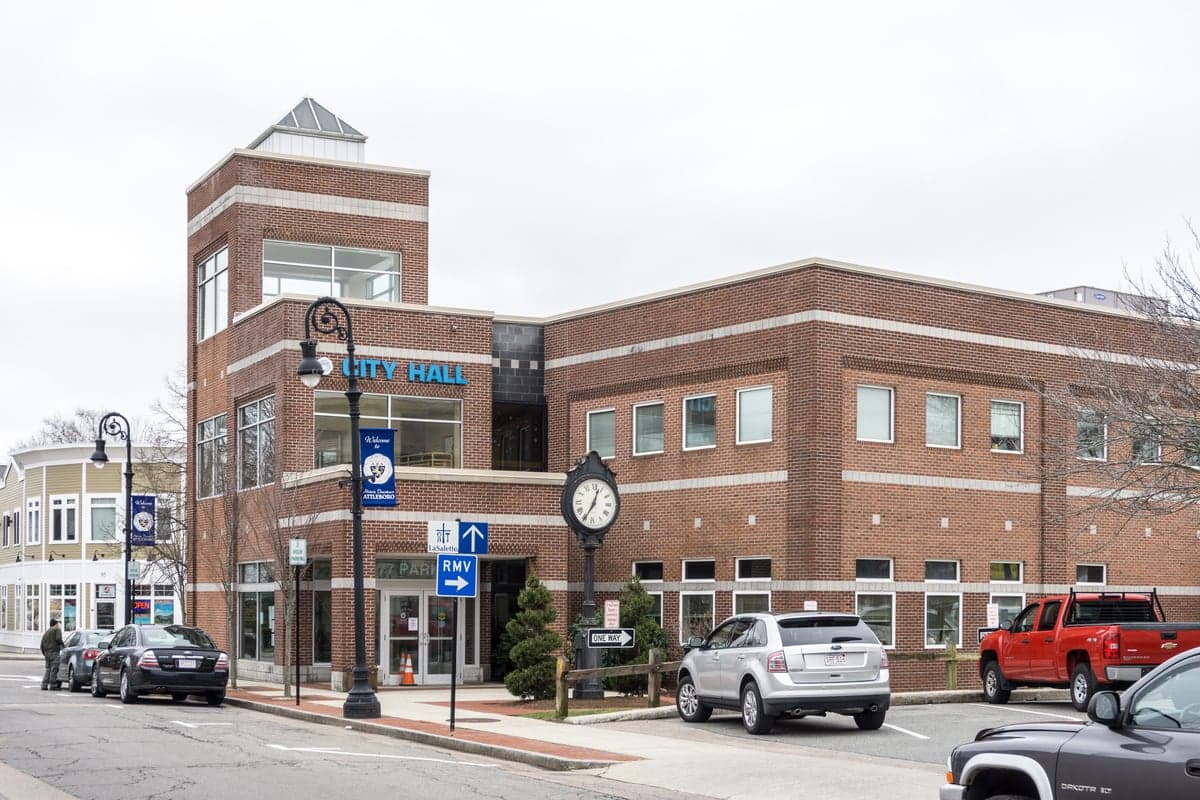
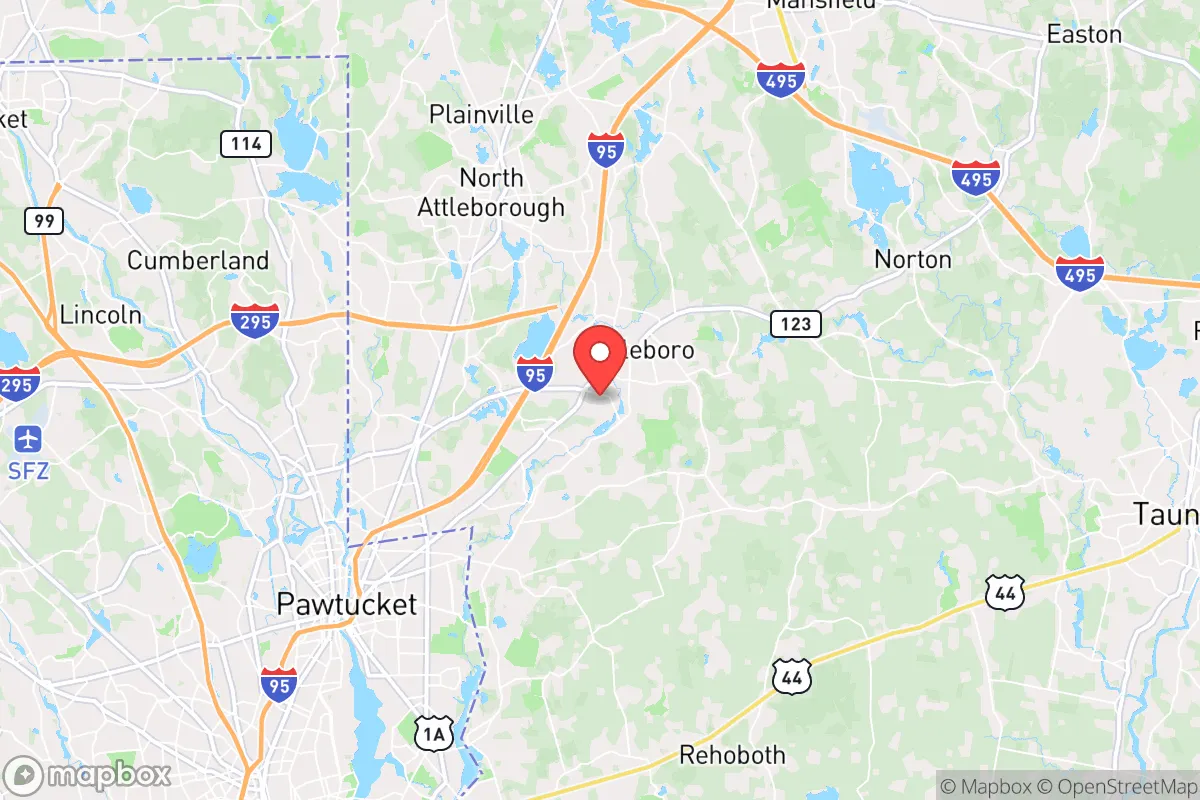
Photo: Wikipedia
Demographics of Attleboro, MA
Affluence Level in Attleboro, MA
A middle-class area roughly in line with national averages across income, home values, education, and employment.
People of Attleboro, MA
The people of Attleboro, MA today number 46,499, forming a predominantly white (77.7%) city with a modest but growing Hispanic (8.7%) and Black (5.6%) presence, alongside distinct East/Southeast Asian (3.0%) and Indian-subcontinent (1.5%) communities. The city’s character is shaped by its historic industrial roots and suburban expansion, with a foreign-born population of just 3.9%—well below the national average—and a college-educated rate of 33.7%. Attleboro’s identity is less a melting pot than a patchwork of established neighborhoods, each tied to specific waves of settlement that have left lasting demographic footprints.
How the city was settled and grew
Attleboro’s original population was English Puritan farmers and artisans who arrived in the 1660s, drawn by land grants from the Plymouth Colony. The town’s industrial transformation began in the early 19th century with the rise of jewelry and silverware manufacturing—by 1900, Attleboro was known as the “Jewelry Capital of the World.” This industry attracted a first major wave of immigrant labor: French-Canadians from Quebec, who settled in the Dodgeville neighborhood, building tight-knit Catholic parishes and working in the mills. A second wave of Irish immigrants arrived during the 1840s famine, clustering in the West End near the railroad and factories. By the early 1900s, Italian and Polish families joined the workforce, establishing themselves in South Attleboro and East Attleboro, where their descendants still form a visible cultural presence. These groups remained largely homogeneous through the mid-20th century, with the city’s population peaking at around 49,000 in 1970.
Modern era (post-1965)
After the 1965 Immigration and Nationality Act, Attleboro saw only modest diversification compared to nearby Providence or Boston. The city’s industrial base began contracting in the 1970s and 1980s, reducing the pull for new immigrant waves. Instead, domestic in-migration from other parts of Massachusetts and Rhode Island drove growth, with families seeking affordable housing in suburban developments like North Attleboro (a separate town) and the Bungay area. The Hispanic population, now 8.7%, began growing in the 1990s, primarily settling in the South Attleboro corridor near I-95, where rental housing is more available. The Black population (5.6%) is concentrated in central Attleboro and the Downtown district, reflecting a mix of African American families from the region and a smaller number of Caribbean immigrants. East/Southeast Asian residents (3.0%) are largely Vietnamese and Chinese families who arrived in the 2000s, often drawn by the city’s lower cost of living compared to Boston; they cluster in the East Side near Route 1. The Indian-subcontinent community (1.5%) is newer, mostly professionals in tech and healthcare who moved in after 2010, settling in newer subdivisions off Route 152. The foreign-born share remains low at 3.9%, indicating that most growth comes from domestic migration rather than international arrivals.
The future
Attleboro’s population is slowly diversifying but remains overwhelmingly white and native-born. The Hispanic and Black shares are projected to grow modestly over the next decade, driven by natural increase and continued domestic migration from higher-cost areas in Rhode Island. The East/Southeast Asian and Indian communities are likely to plateau or grow slowly, as the city lacks the dense ethnic networks and job clusters that sustain rapid growth in larger metros. The white population, while declining as a share, will remain the majority for the foreseeable future. The city is not tribalizing into distinct enclaves—neighborhoods like Dodgeville and South Attleboro are becoming more mixed—but the low foreign-born rate means assimilation is less of a factor than in gateway cities. The biggest demographic shift may be generational: younger families are moving in, drawn by commuter access to Providence and Boston, while older, long-term residents age in place.
For someone moving in now, Attleboro offers a stable, predominantly white, middle-class community with modest diversity and a strong sense of local history. The city is becoming slightly more diverse but at a slow pace, and its neighborhoods retain distinct identities tied to their 19th-century immigrant roots. New arrivals will find a place where change is gradual, and the population’s character remains rooted in its industrial past rather than rapid transformation.

* Values derived from national, state, county, city and local statistics and may differ in a specific area. Last updated: 2026-05-01T11:28:13.000Z
Narrative content on this page is AI-generated and may contain mistakes. Verify any details that matter before acting on them.
ReloMaps may earn a commission from affiliate links at no extra cost to you.

