
Photo: Wikipedia
Demographics of White County
Affluence Level in White County
A below-average socioeconomic profile. Incomes, home values, and educational attainment trail the U.S., with higher poverty and unemployment.
People of White County
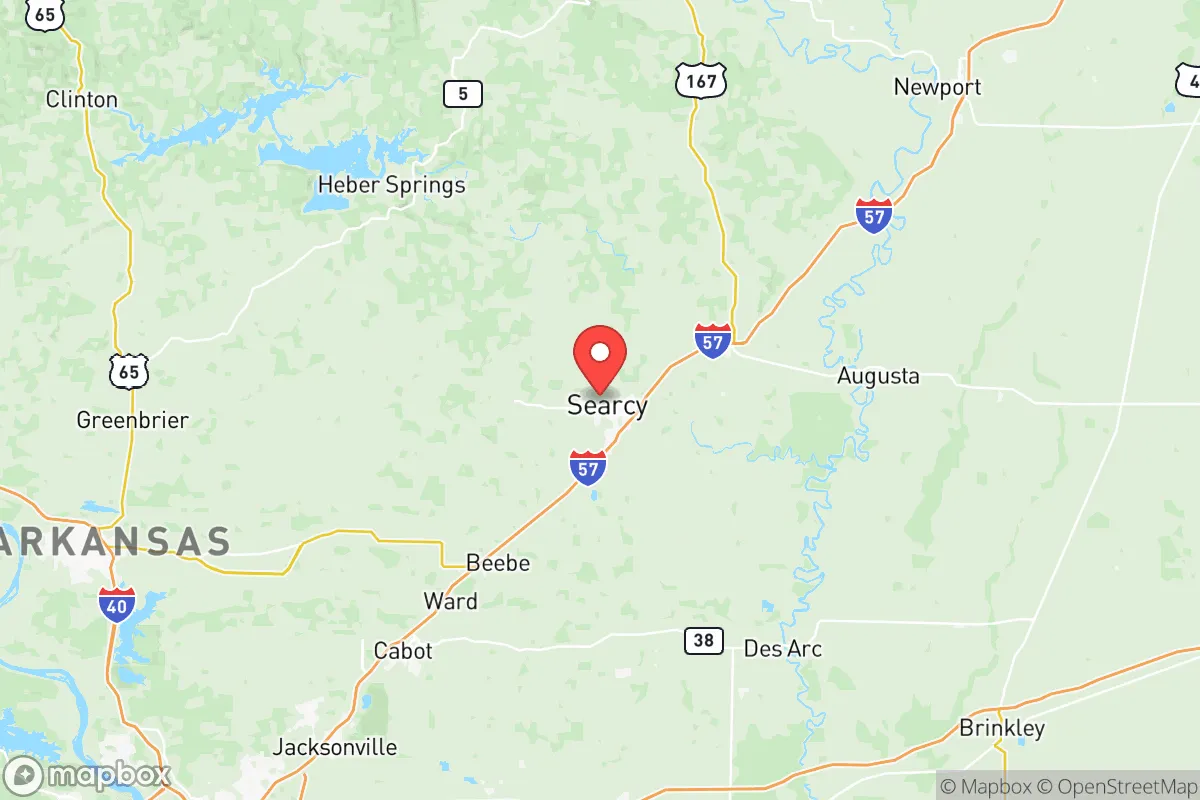
The people of White County, Arkansas, today are predominantly white, native-born, and rural in character, with a population of 77,395 that remains one of the least ethnically diverse in the state. The county is anchored by the twin cities of Searcy and Beebe, where a strong Southern Baptist and Church of Christ religious identity, combined with a low foreign-born rate of just 1.4%, gives the area a distinctly traditional, family-oriented culture. Residents often describe the county as a place where "everyone knows everyone," and the population density of roughly 55 people per square mile reflects a landscape of small towns, farmland, and pine forests that has changed slowly over two centuries.
Settlement & growth (pre-1960)
Before American settlement, the area that is now White County was part of the hunting grounds of the Osage and Quapaw nations, who used the Little Red River and White River valleys for seasonal camps. European contact was minimal until the Louisiana Purchase of 1803 brought the region under U.S. control. The first permanent American settlers arrived in the 1810s and 1820s, primarily Scots-Irish and English families migrating from Tennessee, Kentucky, and the Carolinas. They were drawn by the promise of cheap, fertile bottomland along the White River and its tributaries, and they established small farms and river landings that would become the county's earliest settlements.
White County was formally created in 1835 from portions of Pulaski and Jackson counties, with the town of Searcy (originally called "White Sulphur Springs") designated as the county seat. The early economy was almost entirely agricultural, centered on cotton, corn, and livestock, and the population grew steadily through the antebellum period. By 1860, the county had roughly 7,000 residents, including about 1,200 enslaved Black people who worked the larger cotton plantations along the White River floodplain near present-day Georgetown and West Point. The Civil War and Reconstruction brought economic devastation, but the population rebounded in the 1870s and 1880s as the railroad arrived, connecting Searcy and Beebe to markets in Little Rock and Memphis.
The late 19th and early 20th centuries saw a second wave of settlement, this time by German and Swiss immigrants who were recruited by railroad companies to farm the upland areas. These families established small communities like Pangburn, Letona, and El Paso, where German Lutheran and Catholic churches still stand today. The timber industry also boomed, drawing workers from the Ozarks and the Deep South to mill towns like Judsonia and Kensett. By 1920, the county's population had reached 28,000, and the economy had diversified into timber, cotton ginning, and light manufacturing. The Great Depression hit hard, but the construction of the Greers Ferry Dam in the 1950s and 1960s brought new jobs and tourism to the western part of the county, particularly around the newly created lake and the town of Higginson.
Modern era (post-1965)
The 1965 Hart-Cellar Act had a minimal direct impact on White County, as the area never became a destination for post-1965 immigration. The foreign-born population today stands at just 1.4%, far below the national average of 13.7%, and the county's racial composition has remained overwhelmingly white. The most significant demographic shift since the 1960s has been domestic: the steady outmigration of young adults to larger cities like Little Rock, Fayetteville, and Memphis, offset by the in-migration of retirees and families seeking lower housing costs and a slower pace of life. The Hispanic population, now 4.8%, began to grow in the 1990s and 2000s, driven by work in poultry processing plants in Searcy and Beebe, as well as construction and agricultural labor. This community is concentrated in the southern and eastern parts of Searcy, where a small but growing number of Spanish-language churches and tiendas have appeared.
The Black population, at 4.3%, is largely descended from families who have lived in the county since the 19th century, with historic Black neighborhoods in Searcy (particularly around the "Southside" area) and in the rural communities of West Point and Georgetown. The Asian population, at 0.6%, is almost entirely composed of East and Southeast Asian families—primarily Vietnamese and Filipino—who arrived in the 1980s and 1990s, many working as healthcare professionals at the White County Medical Center in Searcy or as faculty at Harding University. The Indian-subcontinent population is negligible at 0.0%. Suburbanization has been modest, with the most notable growth occurring along the U.S. Highway 67 corridor between Searcy and Beebe, where new subdivisions and strip malls have attracted commuters who work in Little Rock, 50 miles to the south.
The future
White County is projected to grow slowly over the next decade, with the population expected to reach roughly 82,000 by 2035. The county is becoming slightly more diverse, driven primarily by Hispanic in-migration, but the pace is slow, and the area will remain one of the least diverse counties in Arkansas. The white population share is declining gradually, from 88% in 2010 to 85.4% today, as older white residents die and younger white residents move away. The Hispanic share is expected to reach 6-7% by 2035, with most growth concentrated in Searcy and Beebe, where service-sector and manufacturing jobs are available. The Black and Asian shares are likely to remain stable, as there are no major pull factors for new migration from those communities.
The cultural identity of White County is evolving slowly, with the most visible change being the growing presence of Hispanic families in public schools and local businesses. However, the county's political and religious character remains deeply conservative, and the area is unlikely to experience the rapid demographic transformation seen in other parts of the Sun Belt. The biggest challenge for the county will be retaining young adults, as the college-educated share is just 19.8%, well below the national average of 33.1%, and many graduates leave for better job opportunities elsewhere.
For someone moving in now, White County offers a stable, affordable, and safe environment where the population is aging but still rooted in its agricultural and religious traditions. The county is becoming slightly more diverse, but not in a way that disrupts its fundamental character as a white, native-born, and conservative community. New residents will find a place where church membership, family ties, and local sports remain the central pillars of social life, and where the pace of change is measured in decades, not years.

* Values derived from national, state, county, city and local statistics and may differ in a specific area. Last updated: 2026-06-16T01:06:14.000Z
Narrative content on this page is AI-generated and may contain mistakes. Verify any details that matter before acting on them.
ReloMaps may earn a commission from affiliate links at no extra cost to you.

