
Photo: Wikipedia
Political ClimatePolitical Climate in Sebastian County
Showing district-level results — no local-only data available.
Local Political AnalysisPolitical Analysis of Sebastian County
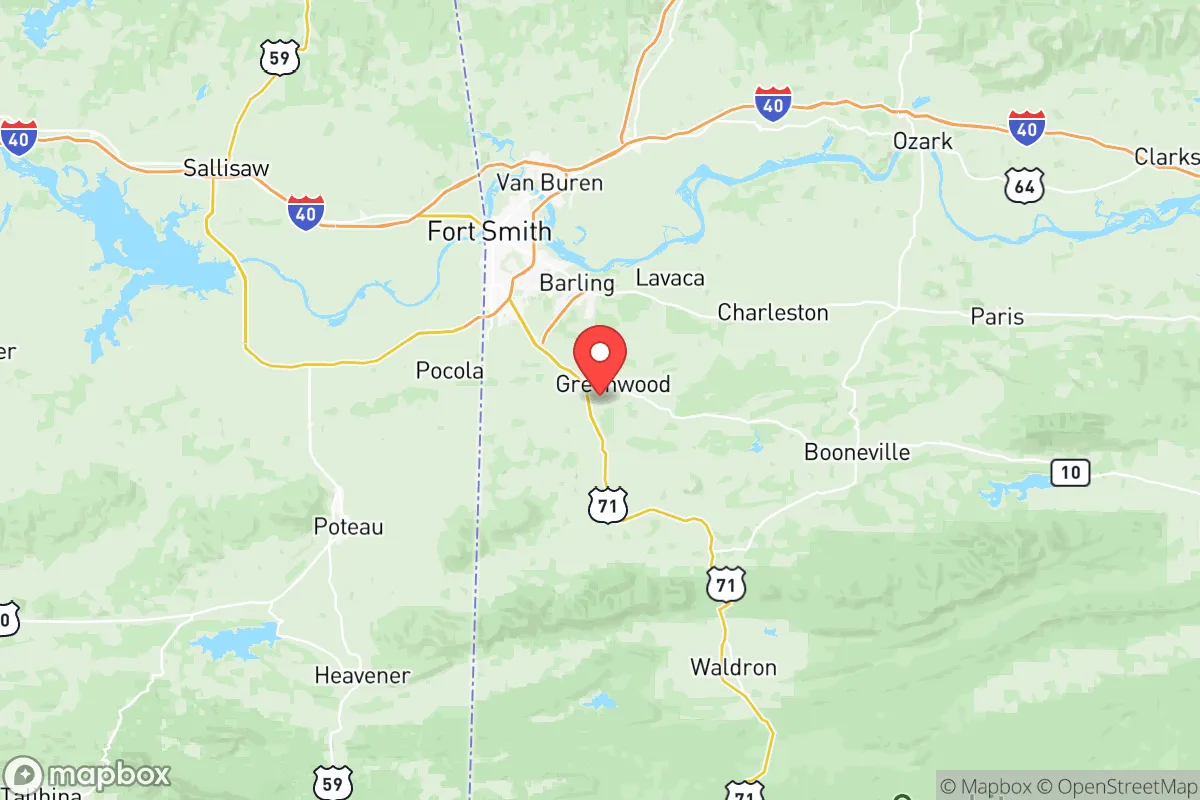
Sebastian County, anchored by Fort Smith and Greenwood, leans solidly Republican with a Cook PVI of R+13, though it's a shade less conservative than Arkansas as a whole (R+16). The county has been trending redder over the past decade, driven largely by population growth in the suburban and exurban areas around Greenwood and Barling, while Fort Smith itself has become a more nuanced battleground. If you're looking at the raw numbers, the county hasn't voted for a Democratic presidential candidate since 1996, but the margins have tightened in some precincts as younger professionals and remote workers move into the downtown Fort Smith area.
How it compares
Sebastian County's R+13 PVI places it slightly to the left of the state average, meaning it's a bit more competitive than places like Washington County (home to Fayetteville) or the deep-red rural counties to the east. The real story is the internal divide: Greenwood and the southern part of the county reliably vote 65-70% Republican, while downtown Fort Smith precincts, especially around the historic district and the University of Arkansas at Fort Smith, can swing 50-55% Democratic. The swing precincts are in the central part of Fort Smith, where a mix of working-class families, newer residents, and a growing Hispanic population (roughly 15% of the county) create a more unpredictable voting bloc. In 2020, these precincts split almost evenly, while the rural townships pushed the county overall to a 62-35 Republican margin. Compared to Arkansas's R+16, Sebastian County is a microcosm of the state's political shift: still red, but with a visible blue undercurrent in its urban core.
What this means for residents
For conservative residents, the county's lean means local policy tends to favor limited government, low taxes, and Second Amendment rights without much pushback. The county commission and most city councils in Greenwood, Barling, and Lavaca are reliably Republican, so zoning, school funding, and law enforcement budgets generally align with conservative priorities. For liberal residents, the reality is more about finding community in specific pockets: Fort Smith's downtown area has a visible progressive scene, with groups like the River Valley Democrats and local advocacy organizations active in city-level issues like affordable housing and public transit. Statewide elections can feel like a foregone conclusion, but local races in Fort Smith's wards are often competitive, and a motivated liberal vote can swing a city council seat or a school board race. The county's trajectory suggests the urban-rural split will widen: expect Fort Smith to become more purple over the next decade, while the surrounding towns stay deep red.
Culturally, Sebastian County is distinct from the rest of Arkansas in a few ways. Fort Smith's history as a frontier town and its role in the Trail of Tears give it a more layered identity than the typical Bible Belt county, and the presence of the U.S. Marshals Museum and the Fort Smith National Historic Site draws visitors who care about history, not just politics. The county also has a noticeable Catholic and Mainline Protestant presence, which softens some of the evangelical influence seen in neighboring Crawford County. Policy-wise, the county has been slower to adopt the state's hardline stances on issues like marijuana (medical use is legal but tightly regulated) and alcohol sales (wet by default, unlike many dry counties in the region). For anyone moving here, the political climate is straightforward: you'll find your tribe if you look, but the overall tone is conservative, practical, and increasingly shaped by the tension between a growing urban core and a steadfast rural base.

State Political ClimatePolitical Climate in Arkansas
State Political AnalysisPolitical Environment in the State
Arkansas is a deeply conservative state with a Cook PVI of R+16, meaning it votes about 16 points more Republican than the nation as a whole. Over the past 20 years, the state has shifted from a competitive, split-ticket state to a solidly red one, driven by the realignment of rural white voters and the collapse of the old Democratic machine that once dominated the Delta and the Ozarks. While Democrats still hold some local offices and a few state legislative seats, Republicans now control every statewide office, both U.S. Senate seats, and a supermajority in the General Assembly, making the practical political reality for a new resident one of near-total GOP dominance.
Urban vs. rural divide
The political map of Arkansas is a classic study in urban-rural polarization. The state's two major metros, Little Rock (Pulaski County) and Fayetteville-Springdale-Rogers (Washington and Benton counties), are the only real blue or purple anchors. Pulaski County, home to the state capital and a more diverse, college-educated population, has voted Democratic in every presidential election since 2008, though its margins are shrinking. Washington County, anchored by the University of Arkansas in Fayetteville, has trended leftward over the past decade, flipping from reliably red to a competitive swing county in 2020 and 2024. Meanwhile, the booming suburbs of Bentonville and Rogers in Benton County remain solidly Republican, driven by the corporate presence of Walmart and a fast-growing, family-oriented population. Outside these two corridors, the state is overwhelmingly red. The Arkansas Delta, once a Democratic stronghold due to Black voters in counties like Lee and Phillips, has seen those populations shrink and the remaining white voters shift hard right. The Ozark and Ouachita mountain regions, including towns like Harrison and Mena, are among the most conservative areas in the country. The result is a state where a Democrat can win a county-level race in Little Rock or Fayetteville, but has virtually no path to statewide office without winning over rural voters who now reliably vote Republican by 40-point margins.
Policy environment
Arkansas's policy environment reflects its conservative lean. The state has a flat income tax rate of 4.4% (down from 6.9% in 2015) with a goal of reaching 3.9% by 2027, and no estate or inheritance tax. Sales tax rates are high, averaging over 9.5% in many cities when local options are included, which makes the tax burden regressive. The state is a right-to-work state with weak labor unions and a business-friendly regulatory posture, particularly for manufacturing and logistics. Education policy has been a flashpoint: the state adopted universal school vouchers (the "Arkansas LEARNS" Act) in 2023, allowing public funds to follow students to private and religious schools. Healthcare is a mixed bag; Arkansas expanded Medicaid under the private option model (Arkansas Works), but the state has also imposed work requirements and has one of the strictest abortion bans in the country, with no exceptions for rape or incest. Election laws have tightened: the state requires a photo ID to vote, has limited early voting windows, and passed a voter ID law in 2013 that was later strengthened. The state also banned ranked-choice voting and has strict ballot initiative requirements, making it harder for citizen-led measures to reach the ballot.
Recent policy direction
The last five years have seen Arkansas move aggressively on a broad front of conservative priorities. On gun and self-defense law, the state enacted permitless carry (constitutional carry) in 2021, allowing any adult who can legally possess a firearm to carry it concealed without a license. On parental and education rights, the LEARNS Act (2023) also banned the teaching of "critical race theory" and prohibited classroom discussion of gender identity in K-3. On speech and privacy, the state passed the "Social Media Safety Act" in 2023, requiring parental consent for minors to open social media accounts, and a law banning TikTok on government devices. On medical and bodily autonomy, the state's near-total abortion ban (Act 180 of 2019, triggered by the Dobbs decision) has no exceptions for rape or incest, only to save the mother's life. The state also passed a ban on gender-affirming care for minors in 2021, which has been upheld in court. On property rights, Arkansas is a strong "right to farm" state, limiting nuisance lawsuits against agricultural operations. On taxation, the state has been cutting income tax rates steadily, with the goal of full phase-out of the income tax by 2030, though that timeline is uncertain. On voting and ballot access, the state passed Act 249 in 2021, which shortened the absentee ballot application window and required a copy of the voter's ID with the application, making absentee voting more restrictive.
Civil unrest & political movements
Arkansas has not seen the large-scale civil unrest of larger states, but there have been notable flashpoints. In 2020, Little Rock saw several nights of protests following the murder of George Floyd, with some property damage and a heavy police response, but the state avoided the prolonged unrest seen in Portland or Seattle. The state has a small but active progressive movement centered in Fayetteville and Little Rock, focused on criminal justice reform and LGBTQ rights. On the right, the state has a vocal "constitutional sheriff" movement, particularly in rural counties, and there have been periodic calls for a state constitutional convention or nullification of federal gun laws. Immigration politics are less visible here than in border states, but the state passed a law in 2023 requiring law enforcement to cooperate with federal immigration authorities (Act 237). There is no sanctuary city policy anywhere in the state; in fact, Springdale and Rogers, which have significant Marshallese and Hispanic populations, have generally cooperated with federal enforcement. Election integrity controversies have been minimal; the state's 2020 and 2022 elections were conducted without major incident, though the legislature has continued to tighten voting laws in response to broader national concerns.
Projection
Over the next 5-10 years, Arkansas is likely to remain solidly Republican, but the nature of that conservatism may shift. The fastest-growing parts of the state are the northwest Arkansas corridor (Benton and Washington counties), which is attracting a younger, more educated, and slightly more moderate population, including many transplants from California and Texas. This could create a tension between the business-friendly, Chamber of Commerce conservatism of Bentonville and the more culturally conservative, rural populism of the rest of the state. The Delta will continue to lose population, reducing the Democratic base. The state's income tax cuts will likely continue, but the sales tax burden may rise to compensate. The biggest wild card is the state's healthcare system: the Medicaid expansion has been popular, but the work requirements and administrative hurdles have caused coverage losses, and the state's high rates of chronic disease and low life expectancy could become a political liability. A new resident moving in now should expect a state that is reliably red, with low taxes and a business-friendly climate, but also one with limited public services, a strained healthcare system, and a political culture that is increasingly resistant to federal mandates on everything from education to environmental regulation.
For a new resident, the bottom line is straightforward: if you are conservative, you will find Arkansas's political climate welcoming and aligned with your values, with low taxes, strong gun rights, and a government that is actively pushing conservative policy. If you are liberal, you will find yourself in a clear minority, with limited political influence and a policy environment that may feel restrictive on issues like abortion, LGBTQ rights, and voting access. The state's politics are stable and predictable, but the growing diversity of northwest Arkansas suggests that the political conversation may become more nuanced over time, even if the overall partisan lean remains deeply red.
* Values derived from national, state, county, city and local statistics and may differ in a specific area. Last updated: 2026-08-08T12:33:11.000Z
Narrative content on this page is AI-generated and may contain mistakes. Verify any details that matter before acting on them.
ReloMaps may earn a commission from affiliate links at no extra cost to you.

