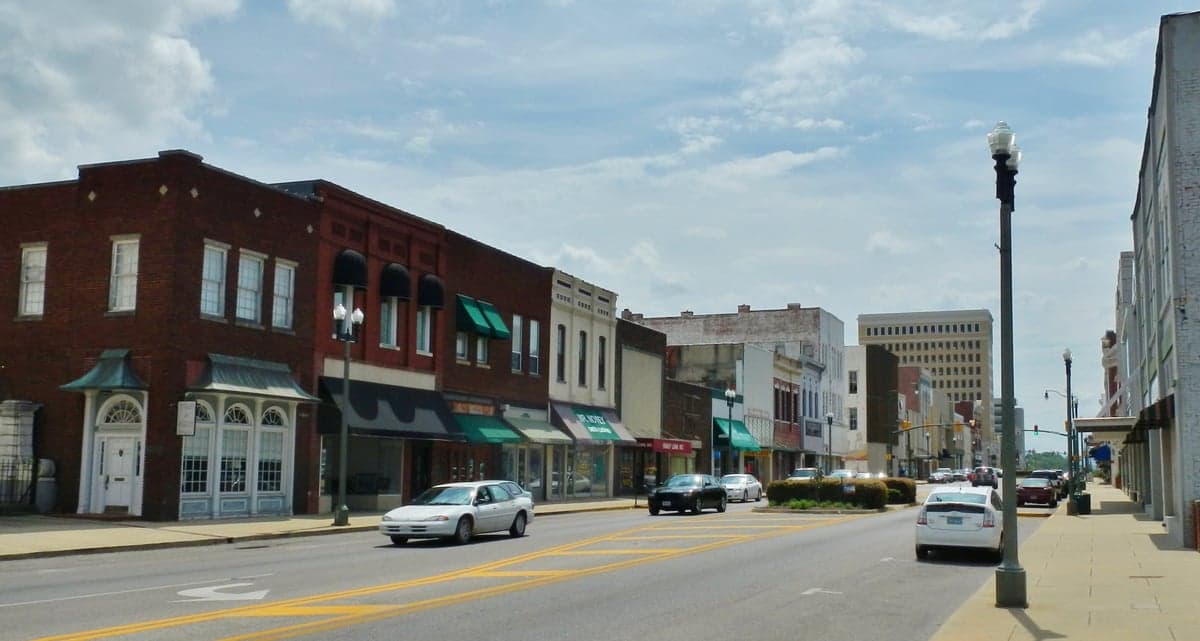
Photo: Wikipedia
Political ClimatePolitical Climate in Anniston, AL
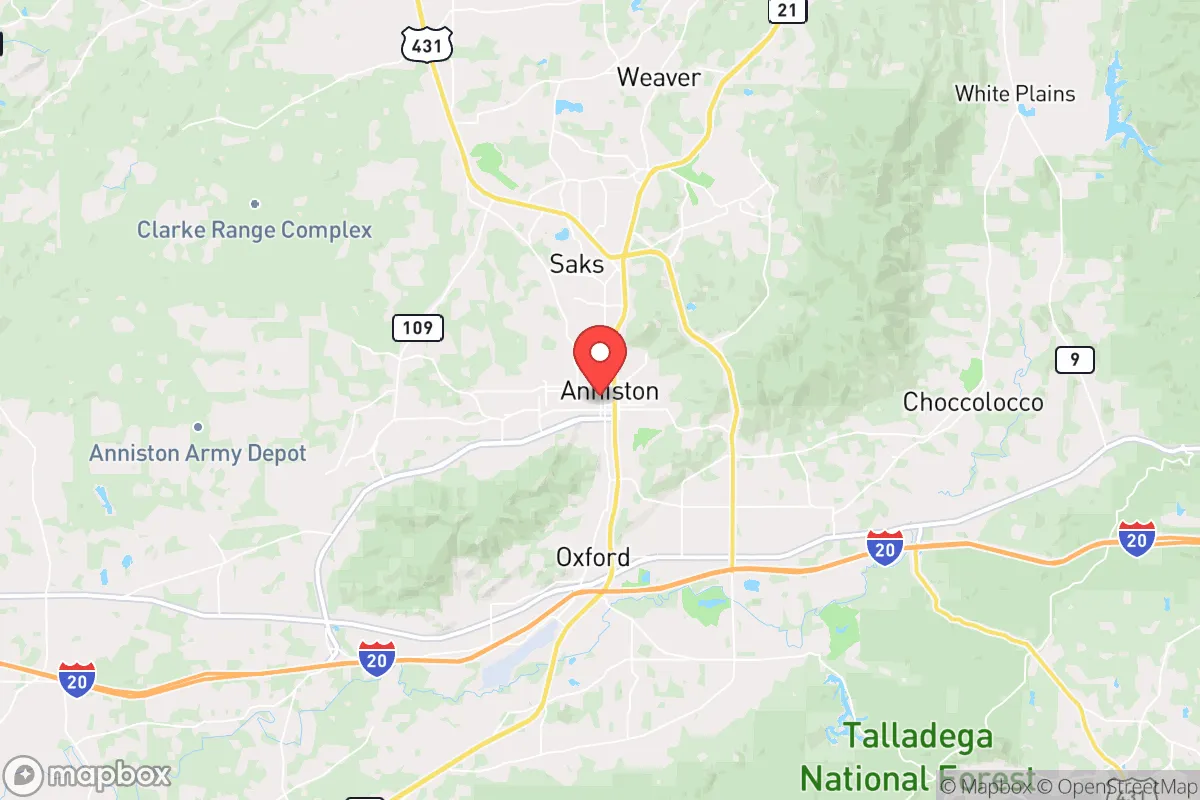
District shown is the primary district for this city’s centroid. Cities may span multiple districts.
Local Political AnalysisPolitical Analysis of Anniston, AL
Anniston, Alabama, sits deep in the heart of a solidly conservative region, with a Cook PVI of R+23 that tells you everything you need to know about its political DNA. This isn’t a place that’s flipped or flirted with the other side; it’s been reliably red for generations, and the local culture reflects that. The real story here isn’t about Anniston itself changing its stripes, but about the slow creep of outside pressures—from Montgomery and Washington—that have started to test the community’s patience with government overreach.
How it compares
Drive 20 minutes west to Oxford, and you’ll find a similar conservative vibe, though Oxford has seen a bit more commercial growth and a slightly younger, more transient population that sometimes leans a little less reliably red in local races. Head south to Talladega, and the politics are even more rural and traditional, with a heavier emphasis on gun rights and local control. The real contrast is if you go northeast to the Birmingham suburbs, like Mountain Brook or Vestavia Hills—those places have their own brand of conservatism, but they’re also more susceptible to national trends and progressive messaging from the city core. Anniston, by contrast, still feels like a place where folks remember when the federal government wasn’t in every aspect of daily life, and that memory keeps the local politics grounded.
What this means for residents
For someone living here, the political climate means a few practical things. First, you can generally expect local law enforcement and city council to respect the Second Amendment without a lot of fuss—concealed carry permits are straightforward, and there’s no appetite for red flag laws or magazine bans. Second, taxes stay relatively low, and there’s a strong resistance to any new state or federal mandates that would raise the cost of living. The downside is that this same resistance can sometimes slow down infrastructure improvements or economic development projects that require state cooperation. But for most folks, that trade-off is worth it. The community values personal freedom over government handouts, and you see that in everything from the local school board elections to the way people talk about property rights at the county commission meetings.
What daily life is like for families
Daily life here is shaped by a sense that the government should stay out of your business. You’ll find churches on nearly every corner, and community events like the annual Anniston Army Depot appreciation day draw big crowds. The military presence at the depot is a major employer, and that brings a certain discipline and patriotism that reinforces the conservative lean. Schools are traditional, with a focus on core subjects and local control over curriculum—there’s no push for critical race theory or gender ideology in the classroom, and parents are vocal about keeping it that way. The biggest concern among long-time residents is the slow erosion of local autonomy as state and federal agencies try to impose uniform standards on everything from environmental regulations to education mandates. People here remember when decisions were made by neighbors, not bureaucrats, and they’re wary of any shift that takes that power away.
Looking ahead, Anniston’s political future seems stable in the short term, but the long-term trend is concerning. The national Democratic Party’s push for expanded federal control over healthcare, energy, and education is a direct threat to the way of life here. If progressive policies continue to gain ground at the state level—through court rulings or legislative maneuvering—Anniston could find itself fighting to preserve the very freedoms that make it a good place to raise a family. For now, the community holds the line, but it takes constant vigilance to keep the government from creeping into areas it doesn’t belong.

State Political ClimatePolitical Climate in Alabama
State Political AnalysisPolitical Environment in the State
Alabama is a deeply conservative state, with Republicans holding every statewide office and supermajorities in both legislative chambers, a position they’ve solidified over the past 20 years. The state has not voted for a Democratic presidential candidate since 1976, and in 2024, Donald Trump carried it by over 30 points. That said, the political climate isn’t monolithic — there’s a real urban-rural split, and the state’s trajectory is shaped by a mix of strong conservative governance and growing pains from in-migration and demographic shifts.
Urban vs. rural divide
The political map of Alabama breaks down along familiar lines: the rural Black Belt and the city of Birmingham lean Democratic, while the rest of the state is solidly Republican. The Birmingham metro area, particularly Jefferson County, is the state’s Democratic stronghold, driven by a large African American population and a more diverse, educated workforce tied to the UAB medical complex and banking sector. Montgomery and the Black Belt counties — like Dallas, Lowndes, and Greene — also vote heavily Democratic, but their populations are shrinking. Meanwhile, the fast-growing suburbs of Huntsville and Madison County are the engine of Republican dominance. Huntsville, home to the Redstone Arsenal and a booming aerospace and tech sector, has seen an influx of conservative-leaning professionals from other states, and its surrounding counties — Limestone, Morgan, and Marshall — are among the most reliably red in the nation. Mobile and Baldwin counties on the Gulf Coast are also deeply Republican, with Baldwin being one of the fastest-growing and most conservative areas in the state. The rural north and east — places like DeKalb, Jackson, and Cleburne counties — are ancestrally Democratic but have flipped hard to the GOP over the past two decades, driven by cultural and religious conservatism.
Policy environment
Alabama’s policy environment is aggressively conservative. The state has no state income tax on wages for individuals earning under $3,000 (essentially a flat 5% on most income above that), but property taxes are among the lowest in the nation — about 0.4% of assessed value on average. Sales taxes are high, often over 9% in cities like Birmingham and Mobile, but the overall tax burden is low. The regulatory posture is business-friendly, with right-to-work laws and minimal zoning restrictions outside major cities. Education policy is a flashpoint: the state has a robust school choice movement, with the Alabama Accountability Act providing tax credits for private school tuition, and the 2024 CHOOSE Act expanded Education Savings Accounts (ESAs) for families. However, public school funding remains low, and many rural districts struggle. Healthcare is a mixed bag: Alabama did not expand Medicaid under the ACA, leaving a coverage gap for about 200,000 low-income adults, but the state has a strong network of rural hospitals and a growing telemedicine sector. Election laws are strict: voter ID is required, absentee voting is limited, and the state has purged inactive voters aggressively. There’s no early voting in most counties, though some urban areas have pushed for it. The state also passed a 2023 law banning ranked-choice voting and limiting ballot initiatives, which keeps the political establishment firmly in control.
Trajectory & freedom
Alabama is moving in a direction of expanded personal liberty in several key areas, but with some concerning trends. On gun rights, the state is a constitutional carry state since 2022 — no permit needed to carry a concealed firearm — and has preemption laws that prevent local governments from enacting their own restrictions. Parental rights were strengthened by the 2022 Alabama Parental Rights Protection Act, which requires schools to notify parents of any changes in a child’s mental or physical health and prohibits classroom instruction on sexual orientation or gender identity in K-5. The state also passed a 2024 law banning gender-affirming care for minors, with criminal penalties for providers. Medical autonomy is limited: the state has a near-total abortion ban with no exceptions for rape or incest, and a 2023 law restricts telehealth prescriptions for abortion pills. Property rights are strong, with no state-level rent control and minimal eminent domain abuse, though coastal areas like Baldwin County face pressure from short-term rental regulations. Taxation is trending downward: the 2024 tax reform package cut the state’s grocery tax from 4% to 2% and increased the standard deduction. However, there are red flags: the state’s heavy reliance on sales taxes hits low-income families hardest, and the lack of Medicaid expansion means many working poor lack coverage. The 2023 law banning DEI programs in public universities and state agencies is a double-edged sword — it limits government overreach into ideological training, but also restricts academic freedom.
Civil unrest & political movements
Alabama has seen relatively little civil unrest compared to other states, but there are active political movements on both sides. The Black Lives Matter protests in 2020 were largely peaceful in Birmingham and Montgomery, but they did lead to the removal of several Confederate monuments and a push for police reform that stalled in the legislature. The state’s immigration politics are tense: Alabama passed a strict anti-sanctuary city law in 2024, requiring local law enforcement to cooperate with ICE, and the state has a history of aggressive immigration enforcement, including the 2011 HB 56 law that was largely struck down in court. There’s a growing secessionist and nullification rhetoric on the far right, particularly around federal gun control and environmental regulations, but it remains fringe. Election integrity controversies flared after 2020, with the state GOP pushing for tighter voter ID laws and purging of non-citizen voters, though no widespread fraud was ever proven. The most visible flashpoint for a new resident would be the ongoing debate over Confederate symbols — the state flag remains controversial, and the city of Birmingham removed its Confederate monument in 2020, sparking a legal battle that reached the state supreme court. The state’s political movements are largely channeled through the legislature and local school boards, where fights over curriculum and library books are common.
Projection
Over the next 5-10 years, Alabama will likely become more conservative, but with a more suburban, professional flavor. In-migration from blue states — particularly to Huntsville, Baldwin County, and the Auburn-Opelika area — is bringing younger, more educated conservatives who are less focused on culture war issues and more on economic growth and quality of life. This could moderate the state’s hardline stance on some issues, like Medicaid expansion or education funding, but the GOP supermajority is unlikely to be threatened. The Black Belt will continue to lose population, reducing the Democratic base, while the Huntsville and Gulf Coast metros grow. The state’s demographic shift is toward a whiter, more suburban electorate, which will keep Republicans in power but may push them toward a more pragmatic, business-friendly conservatism. The biggest wildcard is the federal courts: Alabama’s abortion ban and transgender care ban are being challenged, and if they are struck down, the legislature will likely pass more restrictive versions. The state’s heavy reliance on sales taxes may become a political issue as inflation persists, but tax cuts are popular. A new resident moving in now should expect a state that is politically stable, culturally conservative, and increasingly prosperous, but with persistent challenges in healthcare access and education quality.
For a new resident, the bottom line is that Alabama offers a low-tax, low-regulation environment with strong protections for gun rights and parental authority, but you’ll need to navigate a healthcare system with gaps and a public school system that varies wildly by district. The political climate is reliably conservative, but it’s not static — the growth of Huntsville and the Gulf Coast is reshaping the state’s politics toward a more suburban, economically focused conservatism. If you value personal freedom, limited government, and a community that shares your values, Alabama is a solid bet, but don’t expect the libertarian paradise some hype — the state still has plenty of government overreach, particularly in healthcare and education mandates. Know your county and your local school board, and you’ll be fine.
* Values derived from national, state, county, city and local statistics and may differ in a specific area. Last updated: 2026-04-19T18:42:14.000Z
Narrative content on this page is AI-generated and may contain mistakes. Verify any details that matter before acting on them.
ReloMaps may earn a commission from affiliate links at no extra cost to you.

