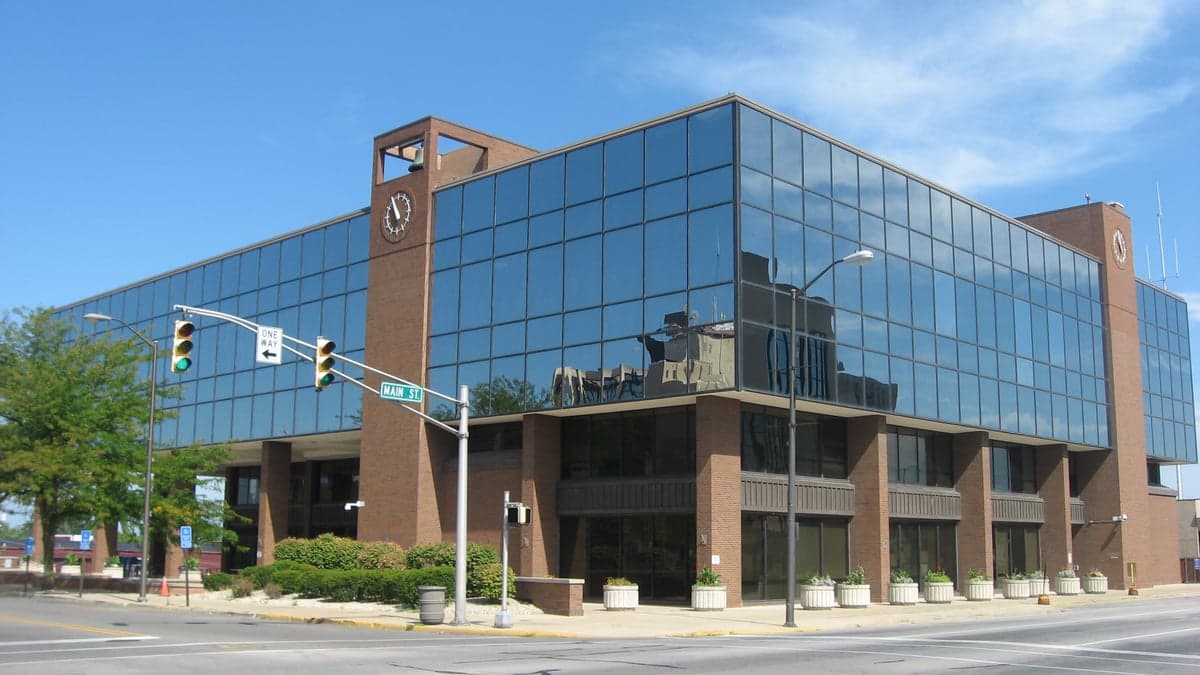
Photo: Wikipedia
Political ClimatePolitical Climate in Anderson, IN
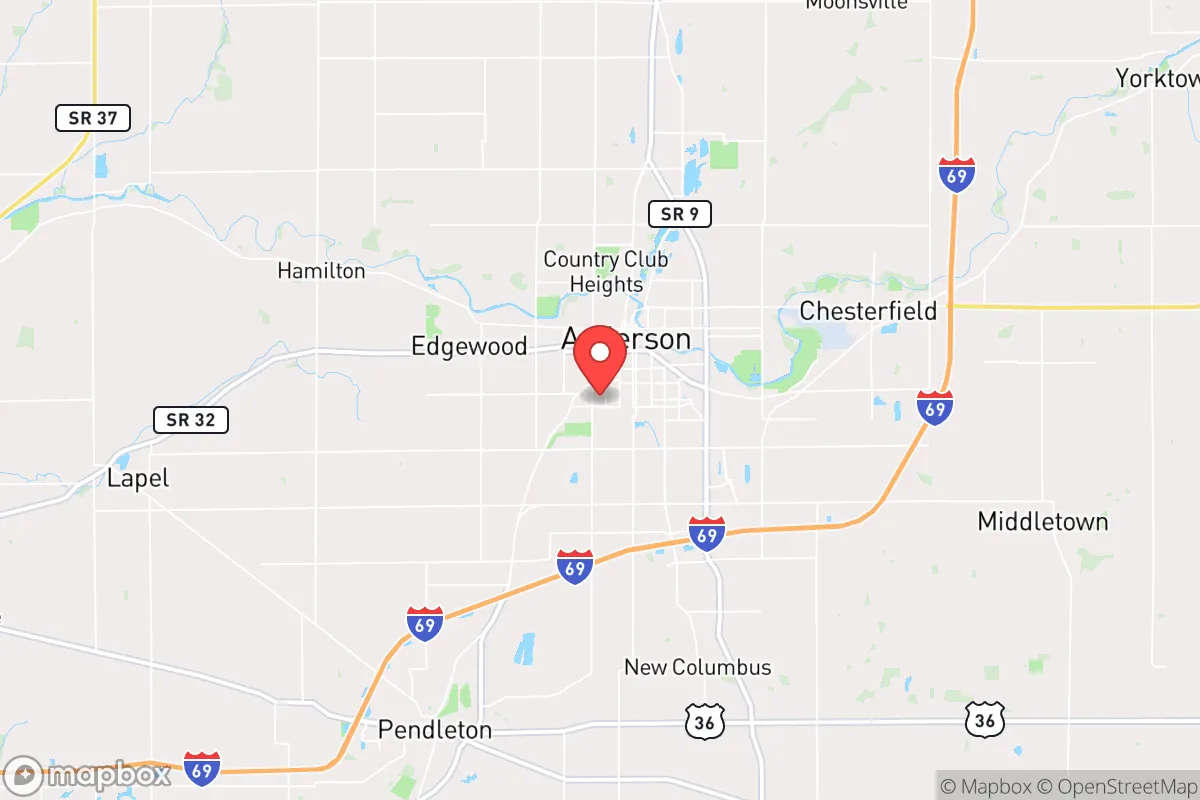
District shown is the primary district for this city’s centroid. Cities may span multiple districts.
Local Political AnalysisPolitical Analysis of Anderson, IN
Anderson, Indiana, has long been a bellwether for the state’s shifting political winds, but make no mistake—this is still solidly conservative territory. The Cook PVI rating of R+8 tells you the math, but the real story is in the culture. For decades, this was a union-heavy, blue-collar town built on General Motors and Delco Remy, and it voted reliably Democratic. But as those plants shuttered and the national party moved further left on social issues and economic regulation, the working-class folks here—the ones who actually show up to church and keep their yards mowed—started feeling like the party left them. Now, Madison County leans Republican in most statewide races, and you see more Trump flags than Biden signs in the rural stretches outside town. The shift isn't complete, though; the city itself still has pockets of old-school Democrat voters, especially in the older neighborhoods near the downtown core. But the trajectory is clear: Anderson is trending redder, and the progressive agenda coming out of Indianapolis and Washington is not welcome here.
How it compares
If you drive 40 minutes north to Muncie, you’ll find a similar Rust Belt story, but with a younger, more transient population thanks to Ball State University—so it leans a bit more purple, with a noticeable progressive activist scene. Head south to Indianapolis, and you’re in a blue island surrounded by red suburbs, where the city council is pushing things like sanctuary city policies and defunding police rhetoric. That’s the kind of government overreach that makes folks in Anderson nervous. Out here, we value local control and personal responsibility. The contrast is stark: in Anderson, you can still have a conversation with your neighbor without worrying about being canceled for disagreeing on taxes or school curriculum. The surrounding towns like Pendleton and Alexandria are even more conservative, with strong Second Amendment support and a general distrust of federal mandates. The real dividing line isn’t just party—it’s whether you believe the government should be in your business at all.
What this means for residents
For the average person living here, the political climate means a few practical things. First, property taxes stay relatively low compared to Marion County, and there’s no city income tax eating into your paycheck. Second, school board meetings have become a battleground over parental rights and curriculum transparency—and so far, the conservative majority has held the line against critical race theory and gender ideology being pushed into elementary classrooms. Third, the local police department is well-funded and respected, not defunded or demoralized like in some bigger cities. You won’t see homeless encampments taking over parks or open drug use on Main Street, because the city still enforces basic public order. That said, there’s a growing concern about the long-term trend: as younger people move away for jobs, the remaining population skews older and more conservative, which can make the town feel stuck in time. The challenge is keeping the conservative values that work—low taxes, personal freedom, community safety—while attracting new businesses and families who might bring different ideas.
One cultural distinction worth noting: Anderson is home to a strong evangelical Christian community, and that influences everything from the local food pantry networks to the way city council talks about zoning for liquor stores. There’s also a proud military veteran presence, with the VA clinic and American Legion posts playing a central role in civic life. The biggest red flag I see on the horizon is the state legislature’s slow creep toward more centralized control—things like statewide mask mandates or vaccine passports during the pandemic really rubbed people the wrong way. If that kind of top-down overreach continues, you’ll see even more folks here digging in their heels. For now, Anderson remains a place where you can live your life without the government breathing down your neck, and that’s something worth fighting to keep.

State Political ClimatePolitical Climate in Indiana
State Political AnalysisPolitical Environment in the State
Indiana has been a reliably Republican state for decades, with the GOP holding a firm grip on the governor’s mansion, both chambers of the state legislature, and both U.S. Senate seats. The state hasn’t voted for a Democratic presidential candidate since 2008, when Barack Obama narrowly won it, and since then the Republican margin has only widened, with Donald Trump carrying the state by 16 points in 2020 and 18 points in 2024. The dominant coalition is a mix of socially conservative rural voters, fiscally conservative suburbanites, and a growing number of working-class defectors from the Democratic Party, especially in the industrial north. Over the past 10-20 years, the state has shifted rightward as union strongholds like Lake County have weakened and once-competitive suburbs have become reliably red.
Urban vs. rural divide
The political map of Indiana is a textbook example of the urban-rural split. Indianapolis (Marion County) is the lone blue stronghold, consistently voting Democratic by 15-20 points, driven by a diverse population and a concentration of government and healthcare workers. But even here, the surrounding suburban counties—Hamilton, Hendricks, and Johnson—are deeply red, with Hamilton County (home to Carmel, Fishers, and Noblesville) routinely voting 60-65% Republican. To the north, Lake County (Gary and Hammond) is another Democratic pocket, but its influence is waning as population declines and the GOP makes inroads with white working-class voters in the region. The rest of the state is overwhelmingly Republican: the rural south (Evansville, Bloomington’s outskirts, and the Ohio River counties) votes 70-80% GOP, while the northeast (Fort Wayne, Allen County) and the west (Terre Haute, Vigo County) have trended redder over the last decade. The only real exception is Bloomington (Monroe County), home to Indiana University, which votes reliably Democratic but is too small to swing statewide elections.
Policy environment
Indiana’s policy environment is among the most conservative in the Midwest. The state has a flat income tax rate of 3.05% (down from 3.23% in 2023, with a scheduled phase-down to 2.9% by 2029), no estate tax, and a sales tax of 7% that applies to most goods but not groceries. Property taxes are capped at 1% of assessed value for owner-occupied homes, a constitutional amendment that keeps housing costs manageable. The regulatory posture is business-friendly: Indiana is a right-to-work state (though that law was repealed in 2025 after a GOP supermajority decided it was no longer necessary, a controversial move that some conservatives saw as a retreat). Education policy is a bright spot for school choice advocates: Indiana has one of the nation’s most expansive voucher programs, with the Choice Scholarship Program serving over 60,000 students, and charter schools are widely available. On healthcare, the state did expand Medicaid under the Affordable Care Act (the HIP 2.0 program), but it also passed a near-total abortion ban in 2022 (Senate Enrolled Act 1), with exceptions only for rape, incest, and lethal fetal anomalies. Election laws are strict: voter ID is required, early voting is limited to 28 days before an election, and same-day registration is not allowed. The state also passed a law in 2023 banning private funding of election administration, a response to the Zuckerberg-funded 2020 election grants that many conservatives viewed as corrupting.
Trajectory & freedom
Indiana is moving in a decidedly more free direction on most fronts, but there are warning signs. On the plus side, the state enacted constitutional carry (permitless carry of handguns) in 2022, and in 2023 it passed a law prohibiting any state or local enforcement of federal gun laws that don’t exist in state statute (a kind of Second Amendment sanctuary measure). Parental rights were strengthened in 2023 with House Enrolled Act 1608, which requires schools to notify parents of any changes to a student’s health or well-being and prohibits instruction on human sexuality in grades K-3. Medical freedom took a hit, however: the 2022 abortion ban is one of the strictest in the nation, and while that pleases social conservatives, it also means the state has no exceptions for fatal fetal anomalies beyond the first trimester, which some see as government overreach. Property rights are generally strong, with no statewide rent control and minimal zoning restrictions outside of Indianapolis. Taxation is trending downward, with the income tax rate scheduled to hit 2.9% by 2029, but the 2025 repeal of right-to-work has some conservatives worried about a slow creep back toward union influence. Overall, the trajectory is positive for liberty, but the abortion ban and the right-to-work repeal are two areas where the state has actually contracted freedom in recent years.
Civil unrest & political movements
Indiana has seen its share of political flashpoints, but nothing approaching the chaos of Portland or Seattle. The most visible unrest came in 2020, when Black Lives Matter protests in Indianapolis turned violent, with looting and fires along Monument Circle and the destruction of the Christopher Columbus statue. The state responded by passing a law in 2021 that increased penalties for rioting and blocking highways, which was criticized by the left but widely supported by conservatives. On the right, the most organized movement is the Indiana Firearms Coalition, which successfully pushed for constitutional carry and has been active in local elections. Immigration politics are relatively quiet, but there was a controversy in 2023 when the city of Indianapolis declared itself a “welcoming city” for immigrants, stopping short of a full sanctuary city designation but drawing backlash from the state legislature, which passed a law in 2024 prohibiting any local government from adopting sanctuary policies. Election integrity has been a hot topic: the 2020 election in Indiana was smooth by most accounts, but the state still passed a law in 2021 requiring absentee ballots to be returned by Election Day (no postmark grace period) and banning ballot drop boxes. There’s no serious secession or nullification movement here, but the state did join the multi-state lawsuit challenging the 2024 federal election certification, which energized the grassroots. A new resident would notice that political signs are everywhere in rural areas, and that local county fairs often feature booths from the local GOP and gun rights groups.
Projection
Over the next 5-10 years, Indiana is likely to become even more Republican, but with some internal tensions. The biggest demographic shift is the continued growth of the Indianapolis suburbs—Hamilton County is projected to add another 100,000 residents by 2035, and these newcomers are mostly conservative families fleeing high-tax states like Illinois and California. This in-migration will reinforce the GOP’s dominance, but it could also create a split between the old-school rural conservatives and the newer suburban libertarians who care more about taxes and school choice than social issues. The abortion ban may become a liability if it drives away young families and professionals, but so far the state’s low cost of living and business climate have outweighed that concern. The biggest wild card is the 2025 right-to-work repeal: if it leads to a resurgence of union power in the industrial north, it could shift Lake County and Allen County back toward the Democrats. But given the GOP’s supermajority in the legislature, any such shift would be slow. A new resident moving in now should expect to find a state that is reliably conservative on most issues, with a government that is generally hands-off on taxes and regulations but increasingly assertive on social and cultural matters. The freedom trajectory is positive overall, but the state is not a libertarian paradise—it’s a place where the government is willing to use its power to enforce traditional values, for better or worse.
For a new resident, the bottom line is this: Indiana offers a low-tax, business-friendly environment with strong gun rights and school choice, but you’ll have to accept a government that is not shy about intervening in personal medical decisions and local governance. If you’re a conservative looking for a place where your values are reflected in the law and your tax dollars are relatively well-managed, Indiana is a solid bet. Just don’t expect the kind of live-and-let-live libertarianism you might find in New Hampshire or Texas—this is a state where the community still has a say in how you live, and that’s exactly how most Hoosiers want it.
* Values derived from national, state, county, city and local statistics and may differ in a specific area. Last updated: 2026-04-30T01:45:18.000Z
Narrative content on this page is AI-generated and may contain mistakes. Verify any details that matter before acting on them.
ReloMaps may earn a commission from affiliate links at no extra cost to you.

