Photo: Wikipedia
Demographics of Anchorage County
Affluence Level in Anchorage County
A middle-class area roughly in line with national averages across income, home values, education, and employment.
People of Anchorage County
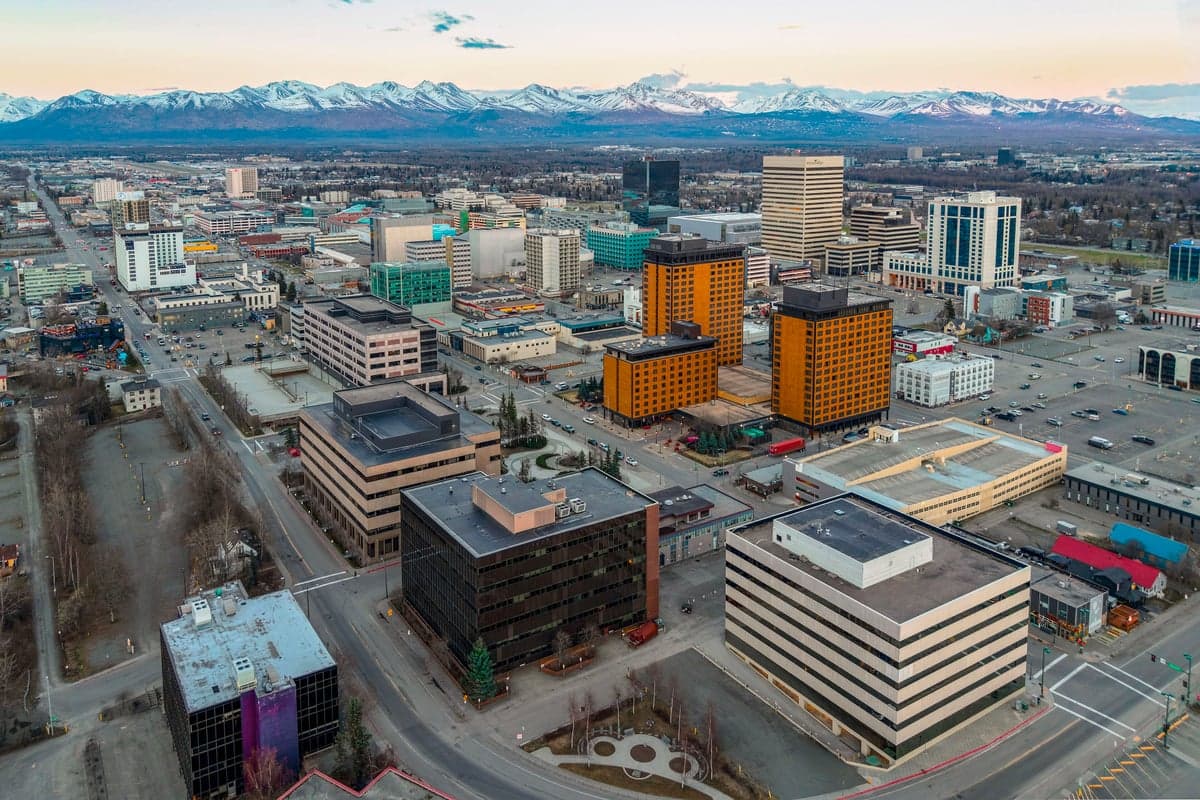
Anchorage County, home to 289,069 residents, is Alaska’s most densely populated and diverse county, anchored by the city of Anchorage itself. Its people are a unique blend of Alaska Native communities, a historically white majority now at 55.1%, and growing East/Southeast Asian (9.3%) and Hispanic (9.3%) populations, with a notably low foreign-born share of just 3.8%. The county’s identity is shaped by its frontier history, military presence, and role as the state’s economic and transportation hub, creating a population that is more urban and educated (37.7% college-educated) than the rest of Alaska, yet still deeply connected to the surrounding wilderness.
Settlement & growth (pre-1960)
The original inhabitants of what is now Anchorage County were the Dena'ina Athabascan people, who lived along the Cook Inlet and its tributaries for thousands of years, with seasonal camps at sites like Eklutna and Knik. Russian colonization in the 18th and early 19th centuries brought fur traders and Orthodox missionaries, but the area remained sparsely populated compared to coastal settlements like Kodiak and Sitka. The United States purchased Alaska in 1867, but significant American settlement in Anchorage County did not begin until the early 20th century.
The county’s modern population boom started with the construction of the Alaska Railroad in 1915, which established Anchorage as a tent city for workers. The railroad drew a mix of white American laborers, Scandinavian immigrants, and a small number of Chinese and Japanese workers, who settled in the nascent downtown and along the Ship Creek area. The 1920s and 1930s saw slow growth, with Anchorage serving as a supply hub for mining and fishing, but the population remained under 5,000 until World War II.
The war transformed Anchorage County. The U.S. military built Elmendorf Air Force Base and Fort Richardson (now Joint Base Elmendorf-Richardson), drawing thousands of servicemen and civilian contractors from across the Lower 48. Many stayed after the war, settling in neighborhoods like Spenard and Mountain View. The 1950s brought the Cold War and further military expansion, along with the construction of the Glenn Highway, which opened up areas like Eagle River and Chugiak to suburban development. By 1960, Anchorage County’s population had surged to over 82,000, overwhelmingly white and native-born, with a strong military and government-employee character.
Modern era (post-1965)
The 1965 Hart-Cellar Act had a modest direct impact on Anchorage County compared to the Lower 48, but the county’s foreign-born population remains low at 3.8%. Instead, the major demographic shifts since the 1970s have come from domestic migration and natural increase. The 1964 Good Friday Earthquake devastated parts of Anchorage, but the city rebuilt and continued to grow as the state’s oil boom of the 1970s drew workers from across the U.S., particularly from the Rust Belt and Pacific Northwest. This wave settled in newer suburbs like Huffman and South Anchorage, as well as the Matanuska-Susitna Valley just north of the county.
The most significant modern change has been the growth of Alaska Native and American Indian communities, who now make up a substantial portion of the population, concentrated in neighborhoods like Mountain View and Fairview, as well as the village of Eklutna. The 1971 Alaska Native Claims Settlement Act (ANCSA) created regional corporations and brought many Alaska Natives from rural villages to Anchorage for jobs and education, reshaping the county’s cultural landscape. East/Southeast Asian communities, particularly Filipino and Korean, grew steadily from the 1980s onward, with Filipino immigrants working in healthcare and the military, and Koreans in small business. Today, these groups are concentrated in Midtown and East Anchorage, where Asian grocery stores and churches are visible markers.
Hispanic population growth, now at 9.3%, accelerated in the 1990s and 2000s, driven by Mexican and Central American immigrants working in construction, hospitality, and fishing. They have settled across Anchorage but are most visible in Mountain View and South Anchorage. The Black population, at 5.1%, has roots in the military and post-war migration from the South, with a notable concentration in Mountain View. The Indian subcontinent population remains tiny at 0.4%, with no distinct enclave. Suburbanization has continued, with Eagle River and Chugiak growing as predominantly white, family-oriented communities, while Anchorage proper has become more diverse and urban.
The future
Anchorage County is projected to become more diverse, though slowly. The white population share is declining as younger, more diverse cohorts age into the population, and as Alaska Native, Hispanic, and East/Southeast Asian communities have higher birth rates. The foreign-born share is likely to remain low compared to the Lower 48, but new immigrant groups—particularly from the Pacific Islands and sub-Saharan Africa—are beginning to arrive, settling in Mountain View and East Anchorage. The county’s population growth has slowed since the 2010s, with some out-migration to the Matanuska-Susitna Valley and the Lower 48, but Anchorage remains the state’s primary destination for new arrivals.
Culturally, the county is becoming less defined by its frontier and military past and more by its role as a diverse, mid-sized city with a strong Alaska Native presence. The next 10-20 years will likely see continued suburban expansion into Eagle River and Chugiak, while Anchorage’s core neighborhoods become more ethnically mixed. The county’s identity as a place where urban amenities meet wilderness access will persist, but its population will be less white and more varied in background than ever before.
For someone moving to Anchorage County now, the area offers a population that is educated, civically engaged, and increasingly diverse, with a strong Alaska Native cultural foundation and a growing Hispanic and Asian presence. The county is becoming a more typical American metropolitan area, but with a distinct northern character—less transient than its frontier past, more settled, and more reflective of the broader demographic trends reshaping the nation.

* Values derived from national, state, county, city and local statistics and may differ in a specific area. Last updated: 2026-08-04T14:15:39.000Z
Narrative content on this page is AI-generated and may contain mistakes. Verify any details that matter before acting on them.
ReloMaps may earn a commission from affiliate links at no extra cost to you.

