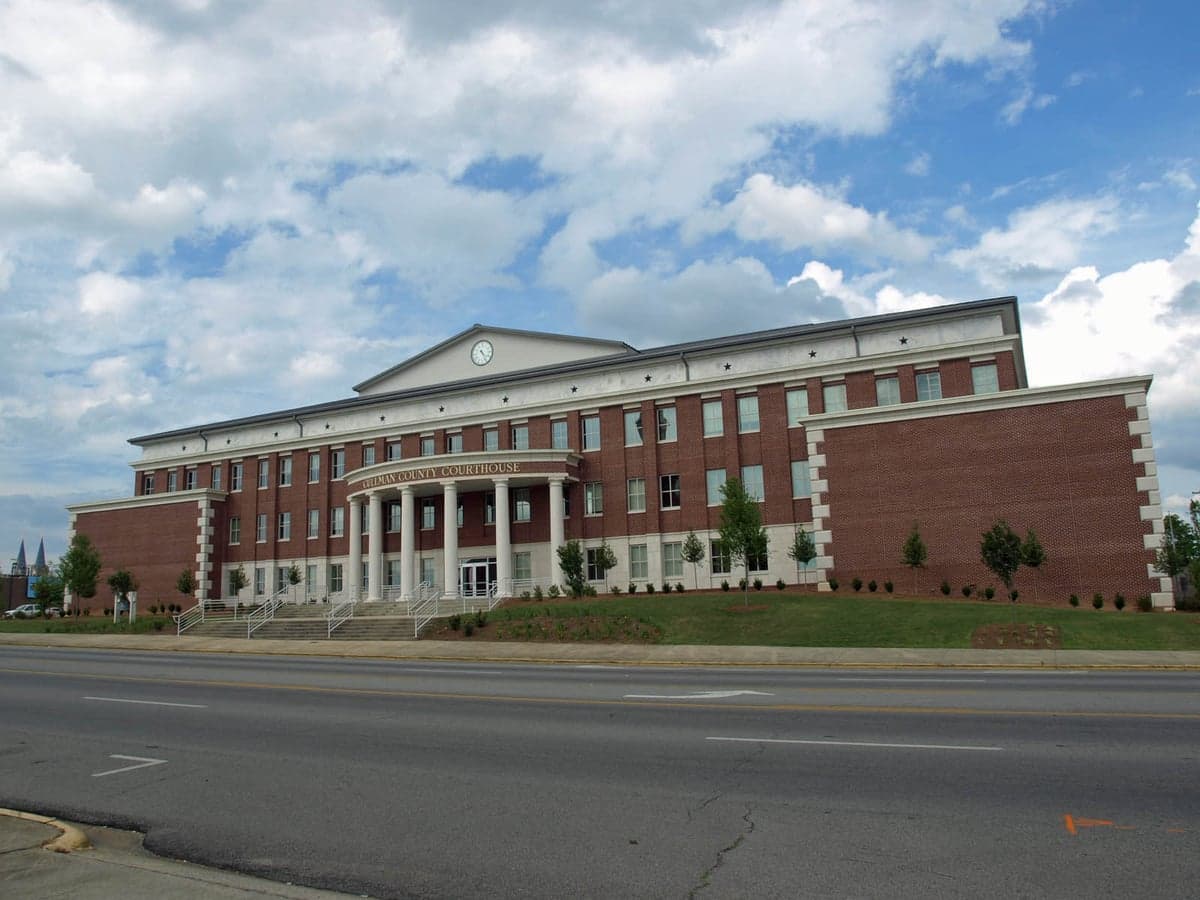
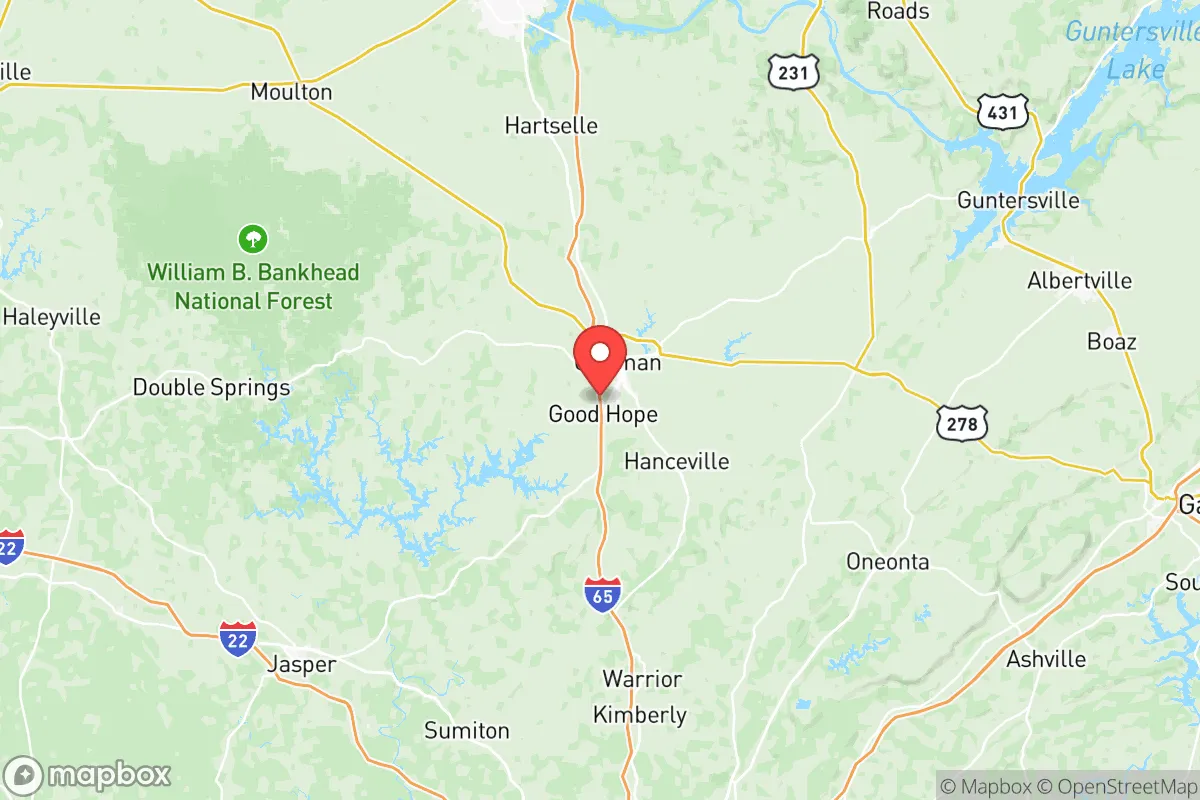
Photo: Wikipedia
Demographics of Cullman County
Affluence Level in Cullman County
A middle-class area roughly in line with national averages across income, home values, education, and employment.
People of Cullman County
The people of Cullman County, Alabama, today number 89,463 and are overwhelmingly white (90.2%), with a foreign-born population of just 1.5% — one of the lowest in the state. The county is known for its strong German Catholic heritage, a legacy that still shapes its cultural identity, from the annual Oktoberfest in Cullman to the many Lutheran and Catholic churches dotting the landscape. This is a place where family roots run deep, and the population is notably less diverse than Alabama as a whole, with a Hispanic share of 4.9% and a Black population of just 1.1%.
Settlement & growth (pre-1960)
Before European settlement, the area that is now Cullman County was part of the traditional hunting grounds of the Cherokee and Creek (Muscogee) nations. The land was largely uninhabited by permanent Native American villages, used instead for seasonal hunting and travel along the Black Warrior River and its tributaries. After the Indian Removal Act of 1830 and the forced relocation of the Cherokee along the Trail of Tears, the region was opened to white settlement, but it remained sparsely populated for decades.
The defining moment in Cullman County's human history came in the 1870s, when a German-born railroad promoter named Colonel John G. Cullmann arrived. Cullmann, a refugee from the failed 1848 revolutions in Germany, envisioned a colony for German immigrants in the rural South. He purchased 350,000 acres of land from the Louisville and Nashville Railroad and began recruiting German Catholic families from the Midwest and directly from Germany. The first settlers arrived in 1873, founding the town of Cullman (originally called "Cullmann") as the county seat. The colony grew rapidly, attracting German farmers, craftsmen, and merchants who were drawn by cheap land, religious freedom, and the promise of a tight-knit ethnic community. By 1900, the county was overwhelmingly German-born or of German descent, with German-language newspapers, churches, and schools common in Cullman, Hanceville, and Garden City.
Other European groups followed, though in smaller numbers. Irish immigrants, many of whom worked on the railroad, settled in Good Hope and Vinemont. A small number of Italian families arrived in the early 1900s, finding work in the coal mines and timber camps around Bremen and Logan. The county's Black population, never large, was concentrated in the rural areas near Holly Pond and Baileyton, where a few families worked as sharecroppers and tenant farmers after the Civil War. However, the Great Migration (1910–1970) drew most of these families north to industrial cities like Chicago and Detroit, leaving the county's Black population at just 1.1% today.
The Dust Bowl and Great Depression had little direct impact on Cullman County's population, as the area was already settled and its agricultural economy was based on cotton, corn, and livestock. The county remained overwhelmingly white, rural, and German-Catholic through the 1950s, with Cullman as the only incorporated town of any size. The 1960 census recorded a population of roughly 35,000, with fewer than 200 Black residents and virtually no Hispanic or Asian presence.
Modern era (post-1965)
The 1965 Hart-Cellar Act, which dramatically reshaped U.S. immigration, had almost no effect on Cullman County. The area's foreign-born population remains at 1.5% today, compared to the national average of 13.7%. The county did not attract the post-1965 waves of immigrants from Latin America, Asia, or Africa that transformed other parts of the South. Instead, the county's demographic story since 1965 has been one of slow, steady domestic growth and suburbanization.
The most significant change has been the growth of the Hispanic population, which rose from near zero in 1990 to 4.9% today. This growth is concentrated in Cullman and Hanceville, where a small but visible Mexican and Central American community has formed, working in poultry processing plants (such as the Wayne Farms facility in Hanceville) and construction. The Hispanic population is still small by regional standards, but it has grown enough to support a handful of tiendas and Spanish-language church services in Cullman.
Domestic migration has been the primary driver of population change. Since the 1990s, the county has attracted retirees and families from the Rust Belt (Ohio, Indiana, Illinois) and from more expensive parts of Alabama (Birmingham, Huntsville). These newcomers are drawn by the county's low cost of living, slower pace of life, and perceived safety. The population has grown from 67,000 in 1990 to 89,463 today, with most new housing developments concentrated along the I-65 corridor in Cullman and the southern part of the county near Good Hope and Vinemont. The county's college-educated share remains low at 19.1%, reflecting its working-class and agricultural roots.
Suburbanization has reshaped the county's geography. Cullman has grown from a small farming town into a regional retail and medical hub, with a Walmart Supercenter, a hospital, and a growing number of chain restaurants and big-box stores. The unincorporated areas around Good Hope and West Point have seen the most new home construction, as families seek larger lots and lower property taxes than in the city limits. The county's Black population has remained stagnant at 1.1%, while the East/Southeast Asian population (0.6%) is almost entirely composed of a small number of Vietnamese and Korean families who own nail salons and restaurants in Cullman.
The future
Cullman County is projected to continue its slow, steady growth, reaching roughly 95,000–100,000 by 2040. The population will become slightly more diverse, with the Hispanic share likely rising to 7–8% as families grow and new workers arrive for poultry and manufacturing jobs. The white share will decline gradually from 90.2% but will remain dominant. The county is unlikely to attract significant numbers of East/Southeast Asian or Indian immigrants, as there is no existing enclave or industry cluster to draw them.
The cultural identity of the county is evolving, but slowly. The German Catholic heritage remains strong, but it is increasingly a symbolic identity rather than a lived one — fewer residents speak German or attend ethnic festivals than a generation ago. The influx of Rust Belt retirees and Southern suburbanites is diluting the county's distinctiveness, making it more like other exurban counties along the I-65 corridor. The county's politics, already deeply conservative, are likely to remain so, as the new arrivals are also predominantly white and conservative-leaning.
For someone moving in now, Cullman County offers a stable, low-cost, and safe environment with a strong sense of community rooted in its German-Catholic past. The trade-off is a lack of diversity, limited cultural amenities, and a population that is aging and slow to change. It is a place where the past still shapes the present, and where the future will look much like today — just a little bigger and a little more diverse.

* Values derived from national, state, county, city and local statistics and may differ in a specific area. Last updated: 2026-08-25T21:26:52.000Z
Narrative content on this page is AI-generated and may contain mistakes. Verify any details that matter before acting on them.
ReloMaps may earn a commission from affiliate links at no extra cost to you.

