Photo: Wikipedia
Demographics of Aiken, SC
Affluence Level in Aiken, SC
A middle-class area roughly in line with national averages across income, home values, education, and employment.
People of Aiken, SC
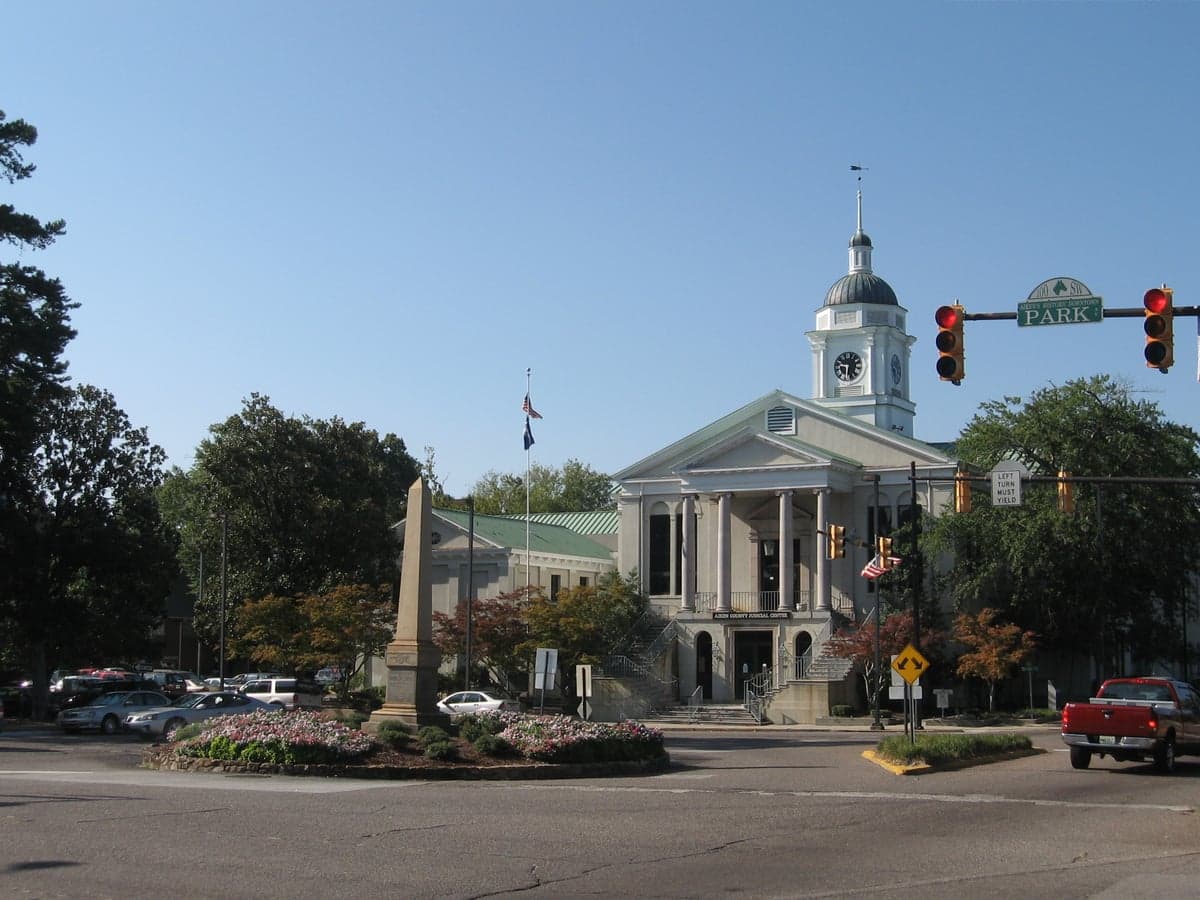
The people of Aiken, South Carolina, today number 32,334, forming a city with a distinctive dual identity: a historic winter colony for wealthy Northern industrialists and a modern, racially diverse Southern community. The population is 59.5% White, 32.0% Black, 3.5% Hispanic, and 1.9% East/Southeast Asian, with a notably high college-educated share of 45.1% and a very low foreign-born rate of just 1.6%. This combination creates a place that feels both deeply traditional and quietly prosperous, where old-money equestrian estates sit alongside established Black neighborhoods and newer suburban subdivisions.
How the city was settled and grew
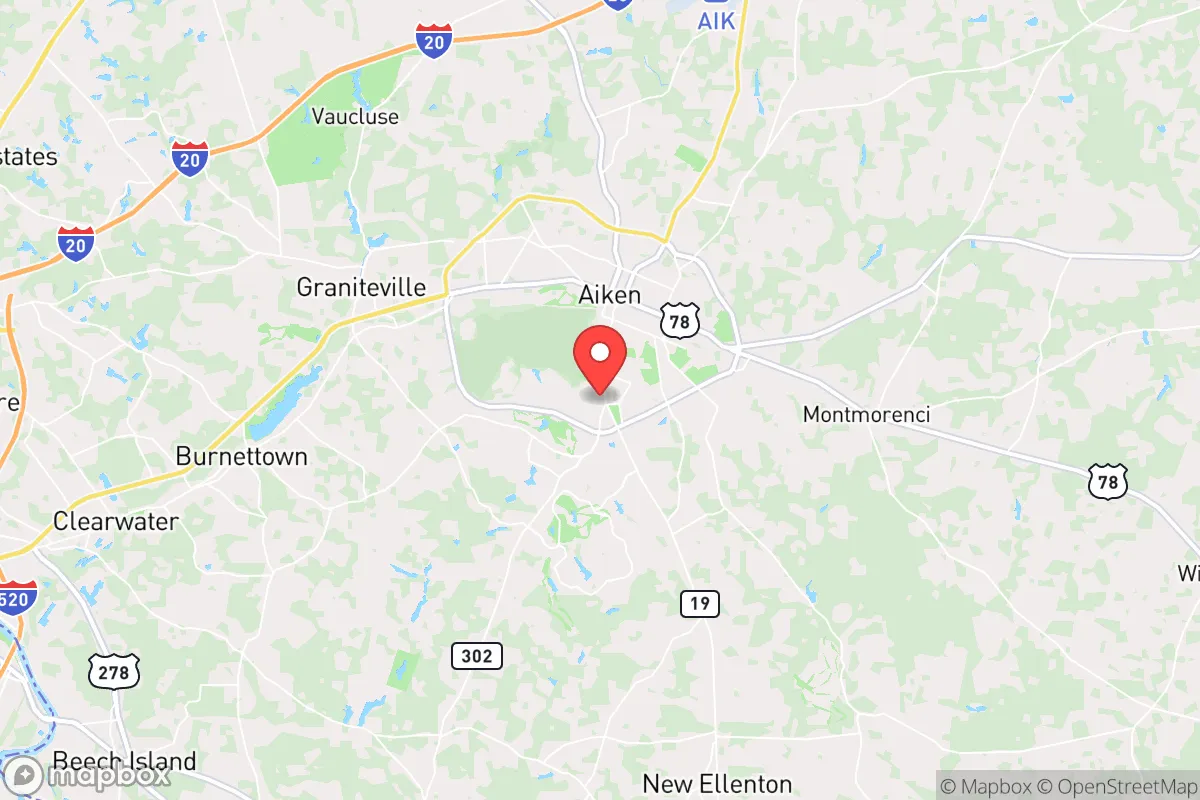
Aiken’s population story begins not with agriculture but with railroads and health. Founded in 1835 as a terminus for the South Carolina Railroad, the city’s first major wave of settlers were railroad workers and merchants. The real transformation came after the Civil War, when Northern industrialists—families like the Vanderbilts, Whitneys, and Houghtons—discovered Aiken’s mild winter climate. They built grand winter estates in what is now the Historic Horse District (also called the Winter Colony), centered around Whiskey Road and Hayne Avenue. This enclave of wealthy seasonal residents, largely White and Protestant, shaped Aiken’s character as a refined, equestrian-oriented town. Simultaneously, freedmen and their descendants established a strong Black community in the Toole Hill and Hammond neighborhoods, working as domestic staff, stable hands, and tradespeople for the Winter Colony families. By the early 20th century, Aiken had a clear racial geography: wealthy Whites in the Horse District, middle-class Whites in the Southside area near downtown, and Black residents concentrated in Toole Hill, Hammond, and the East Aiken corridor along Richland Avenue.
Modern era (post-1965)
The post-1965 period brought two major shifts. First, the 1960s Civil Rights movement opened housing and employment opportunities for Black Aikenites, leading to gradual movement into previously White neighborhoods like Woodside and the newer subdivisions west of Whiskey Road. Second, the 1970s expansion of the Savannah River Site (a nuclear weapons facility 20 miles south) drew a wave of engineers, scientists, and technicians—mostly White and from other parts of the South—who settled in the Cedar Creek and Houndslake planned communities. These newcomers were less tied to the Winter Colony ethos and more focused on professional careers and golf-course living. The Hispanic population, though small at 3.5%, grew steadily from the 1990s onward, concentrated in the East Aiken area and working in construction, landscaping, and the horse industry. The East/Southeast Asian community (1.9%) arrived primarily through professional recruitment to Savannah River Site and the University of South Carolina Aiken, settling in the western subdivisions rather than forming a distinct ethnic enclave. The Indian-subcontinent population remains negligible at 0.1%, reflecting the absence of a tech or medical cluster that typically draws that group.
The future
Aiken’s population is trending toward modest growth and gradual diversification, but not rapid change. The foreign-born share (1.6%) is well below the national average and shows no sign of surging; the city lacks the immigrant-heavy industries (meatpacking, large-scale agriculture, high-tech) that drive foreign-born growth elsewhere. The Hispanic share is rising slowly, primarily through domestic migration from other Southern states rather than direct immigration. The Black population has been stable at roughly 30-32% for decades, with no major out-migration or in-migration. The most notable trend is the influx of retirees and remote workers from the Northeast and Midwest, drawn by lower taxes and the equestrian lifestyle—this group is overwhelmingly White and affluent, settling in Houndslake, Cedar Creek, and new developments along the bypass. This is slowly making the western side of Aiken whiter and wealthier, while the eastern side remains more diverse and working-class. The city is not tribalizing into hostile enclaves, but it is spatially sorting by income more than by race, with the Horse District gentrifying as old estates are subdivided for high-end homes.
For someone moving to Aiken now, the bottom line is this: you are joining a stable, slow-growing city where the population is becoming slightly more affluent and slightly more diverse, but where the fundamental character—Southern, equestrian, politically conservative, with a strong Black middle class and a tiny immigrant presence—is unlikely to change dramatically in the next decade. The city offers a predictable, safe environment for families and retirees, but not a dynamic, multicultural one.

* Values derived from national, state, county, city and local statistics and may differ in a specific area. Last updated: 2026-04-29T19:51:31.000Z
Narrative content on this page is AI-generated and may contain mistakes. Verify any details that matter before acting on them.
ReloMaps may earn a commission from affiliate links at no extra cost to you.

