
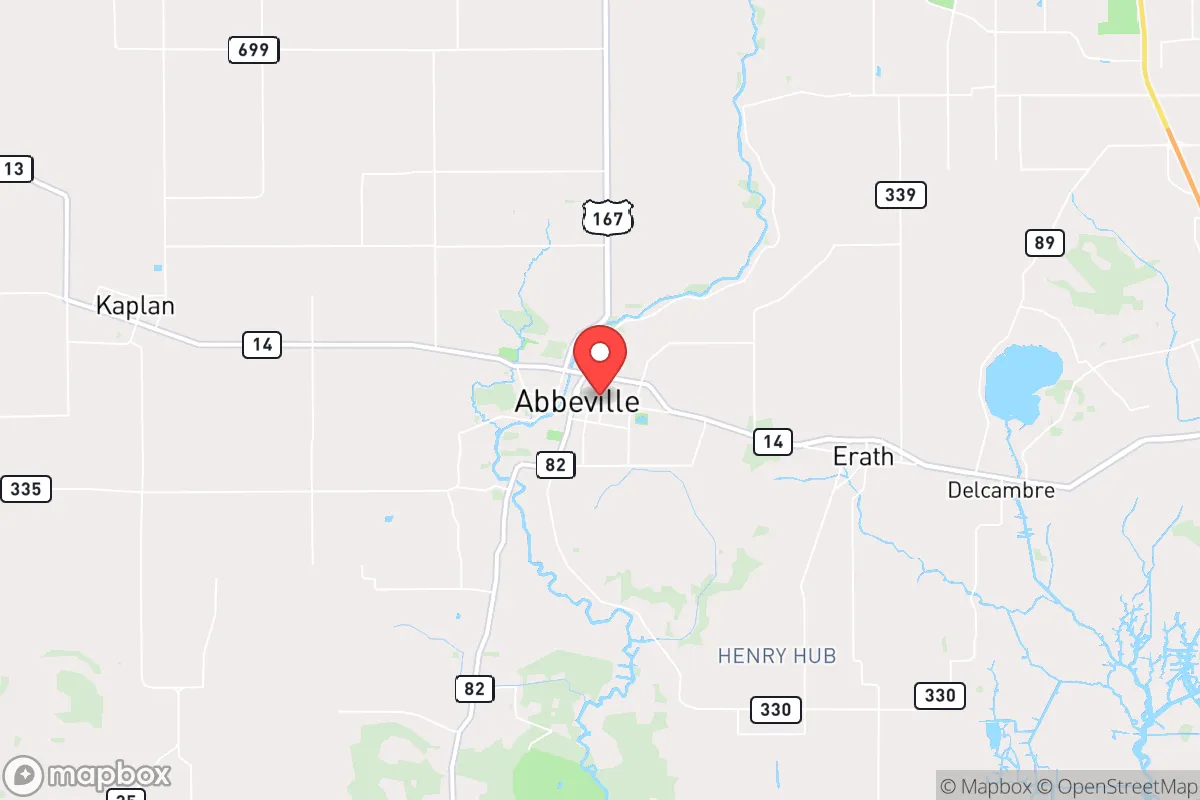
Photo: Wikipedia
Demographics of Abbeville, LA
Affluence Level in Abbeville, LA
A low-income area with significant economic hardship. Household wealth and educational attainment are well below national averages.
People of Abbeville, LA
Today, Abbeville, Louisiana is a city of roughly 11,086 residents with a distinctive biracial character—**42.2% White and 43.3% Black**—alongside small but notable East/Southeast Asian (3.9%), Hispanic (4.3%), and Indian-subcontinent (0.9%) communities. The foreign-born share sits at just 2.1%, well below the national average, reflecting a population shaped overwhelmingly by domestic migration and deep generational roots rather than recent international arrivals. With a college attainment rate of only 9.6%, Abbeville remains a working-class city where family ties, Cajun culture, and a slow pace of life define daily existence more than any influx of newcomers.
How the city was settled and grew
Abbeville was founded in 1843 by French-Catholic missionary Père Antoine Désiré Mégret, who purchased land along the Vermilion River to establish a farming community for Acadian families migrating from other parts of Louisiana. The original settlers were overwhelmingly white Cajuns—descendants of French Acadians expelled from Nova Scotia—who drained marshland for rice, cotton, and sugarcane cultivation. By the late 19th century, the city became a railroad hub for shipping agricultural goods, drawing a small number of German and Irish laborers who settled near the depot in what is now the Railroad District along South State Street. The Black population grew during Reconstruction and the early 1900s as freedmen and their descendants moved into Abbeville for work on plantations and in the emerging seafood industry, establishing a tight-knit community in the St. Charles Street area and along the North Main corridor, where historically Black churches and businesses anchored daily life. By 1950, Abbeville was roughly 60% White and 40% Black, with virtually no other racial groups present.
Modern era (post-1965)
The 1965 Hart-Cellar Act had minimal direct impact on Abbeville—the city never attracted the large-scale refugee or immigrant flows seen in Houston or New Orleans. Instead, the post-1965 period was defined by two domestic trends: White flight to outlying subdivisions and the consolidation of Black neighborhoods. During the 1970s and 1980s, many White families moved from the historic core into newer developments like the Oaklawn subdivision off Highway 14 and the Pecan Grove area near the Vermilion River, leaving the original downtown and St. Charles Street neighborhoods increasingly Black. The small East/Southeast Asian population—primarily Vietnamese and Filipino families—arrived in the 1980s and 1990s, drawn by work in the Gulf seafood processing plants; they concentrated in the West End near the industrial waterfront. The Indian-subcontinent community (0.9%) is a very recent addition, mostly professionals in healthcare and hospitality who have settled in the newer Southwest Abbeville subdivisions since 2010. The Hispanic share (4.3%) grew slowly through the 2000s, with Mexican and Central American laborers working in construction and agriculture, living scattered across the city without a single ethnic enclave.
The future
Abbeville’s population is aging and slowly declining—the city lost roughly 5% of its residents between 2010 and 2020—and the demographic trajectory points toward continued biracial stability rather than rapid diversification. The White and Black shares have held nearly equal for two decades, and neither group shows signs of a major shift. The East/Southeast Asian community is plateauing as younger generations move to larger cities like Lafayette or Baton Rouge for college and white-collar jobs. The Indian and Hispanic populations are growing from a very small base but remain too small to alter the city’s overall character. The most likely scenario over the next 10–20 years is a slow homogenization: Abbeville will remain a majority-Black-and-White working-class city, with the small ethnic communities either assimilating or aging out. New residential construction is concentrated in the South Abbeville expansion area near the Vermilion River bridge, attracting a mix of White and Black families seeking newer homes without leaving the parish.
For someone moving in now, Abbeville offers a stable, slow-changing community where racial lines are well-established and daily life revolves around family, church, and local festivals like the annual Giant Omelette Celebration. The city is not diversifying rapidly, nor is it experiencing the kind of suburban sprawl seen in nearby Lafayette. New residents—especially those from outside the region—should expect a place where social networks are dense, change is gradual, and the population’s character remains rooted in its Cajun and Creole heritage.

* Values derived from national, state, county, city and local statistics and may differ in a specific area. Last updated: 2026-04-23T02:41:37.000Z
Narrative content on this page is AI-generated and may contain mistakes. Verify any details that matter before acting on them.
ReloMaps may earn a commission from affiliate links at no extra cost to you.

