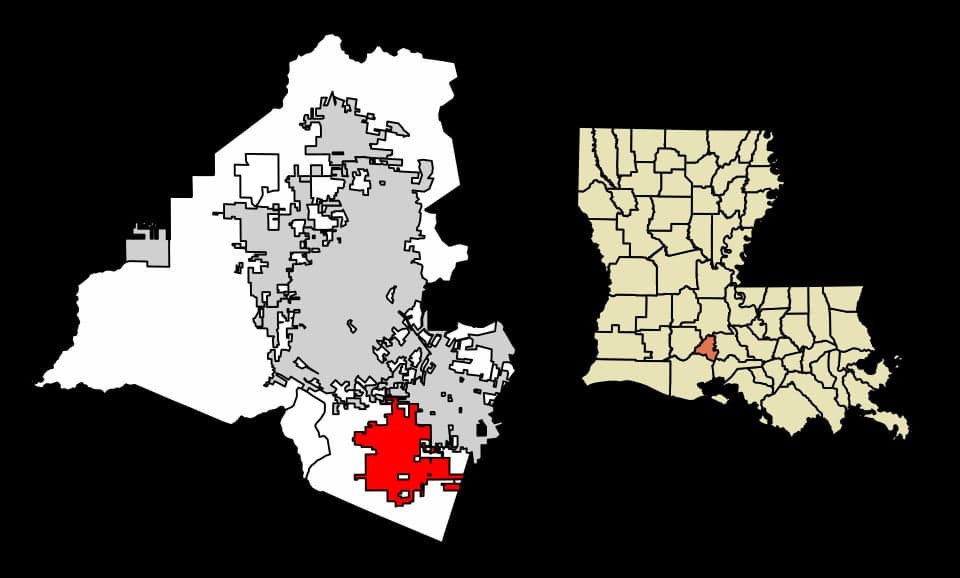
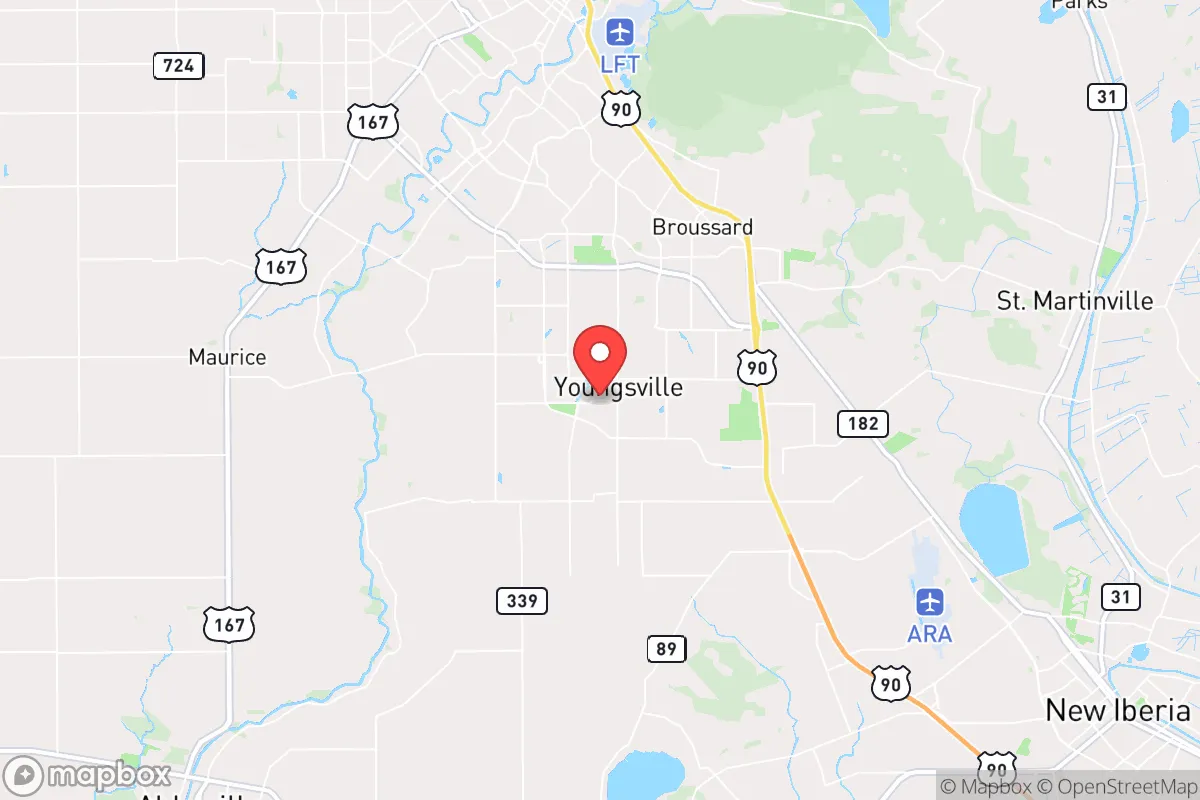
Photo: Wikipedia
Demographics of Youngsville, LA
Affluence Level in Youngsville, LA
A middle-class area roughly in line with national averages across income, home values, education, and employment.
People of Youngsville, LA
Youngsville, Louisiana, is a rapidly growing suburban city of 16,664 residents that remains overwhelmingly white (84.1%) with a small but established Black minority (11.4%) and a very low foreign-born population (1.0%). The city’s identity is shaped by its Cajun and Acadian roots, a strong Catholic cultural presence, and a family-oriented, conservative-leaning character that attracts domestic migrants from across Louisiana and the broader Sun Belt. With a college-educated rate of 37.3%, Youngsville is becoming a hub for professionals and families seeking newer housing, good schools, and a quieter alternative to nearby Lafayette.
How the city was settled and grew
Youngsville’s population history begins with Acadian exiles who arrived in the 1760s after being expelled from Nova Scotia by the British. These French-speaking settlers, known as Cajuns, were granted land along the Vermilion River and its bayous, establishing small farms and fishing communities. The area remained sparsely populated through the 19th century, with the village of Youngsville officially incorporated in 1908, named after a local landowner. The original settlement clustered around what is now the Old Youngsville Historic District, centered on the intersection of La Rue and Chemin Metairie, where the first Catholic church and general store served the farming population. A second wave of Cajun families moved in during the 1930s and 1940s, drawn by the expansion of the oil and gas industry in nearby Lafayette, settling in the Bayou Tortue area along the southern edge of town. These early residents were overwhelmingly white, Catholic, and French-speaking, and their descendants still form the cultural backbone of the city.
Modern era (post-1965)
The post-1965 period transformed Youngsville from a quiet farming village into a fast-growing bedroom suburb. The 1970s oil boom brought a wave of domestic in-migration from other parts of Louisiana and Texas, as professionals and oilfield workers sought affordable land and newer homes within commuting distance of Lafayette. This growth accelerated in the 1990s and 2000s, with large subdivisions like Le Triomphe and River Ranch (the latter technically in unincorporated Lafayette Parish but adjacent to Youngsville) attracting middle-class and upper-middle-class families. These neighborhoods are overwhelmingly white and non-Hispanic, with homeownership rates above 80%. The Black population, which stood at roughly 8% in 2000, grew to 11.4% by the 2020 census, largely through domestic migration from nearby rural areas and from Lafayette itself. Black residents are concentrated in the older, more affordable Youngsville Estates and Broussard Road corridor, where smaller ranch-style homes and duplexes are common. The Hispanic share (2.9%) and East/Southeast Asian share (0.5%) remain very small, with most Hispanic families living in newer apartment complexes along the Chemin Metairie corridor. The Indian-subcontinent population (0.1%) is negligible. The foreign-born share of just 1.0% is among the lowest in Louisiana for a city of this size, reflecting Youngsville’s character as a destination for native-born Americans rather than immigrants.
The future
Youngsville’s population is projected to continue growing, driven by domestic in-migration from higher-cost areas in Texas and California, as well as from within Louisiana. The city’s demographics are likely to remain predominantly white and non-Hispanic, with the Black share stabilizing or growing slowly as more middle-class Black families move into newer subdivisions like Beau Pré and Estates at Sugar Mill. The Hispanic and Asian shares may increase modestly as the service economy expands, but Youngsville lacks the industrial or agricultural base that attracts large immigrant populations. The city is not tribalizing into distinct ethnic enclaves; rather, it is homogenizing around a suburban, family-oriented, conservative culture. The biggest demographic shift will be generational: as Baby Boomers downsize or move to retirement communities, younger families with children will fill the new construction in the Youngsville Sports Complex area and along the future extension of Chemin Metairie. The college-educated share (37.3%) is likely to rise as remote work and Lafayette’s healthcare and tech sectors draw more professionals.
Youngsville is becoming a stable, culturally cohesive suburb where domestic migration, not immigration, drives growth. For a conservative-leaning family or individual moving in now, the city offers a predictable, safe environment with strong schools, low crime, and a population that shares their values and background. The trade-off is limited ethnic diversity and a social fabric that remains deeply rooted in Cajun and Catholic traditions, which newcomers will be expected to respect and, ideally, embrace.

* Values derived from national, state, county, city and local statistics and may differ in a specific area. Last updated: 2026-04-23T04:57:31.000Z
Narrative content on this page is AI-generated and may contain mistakes. Verify any details that matter before acting on them.
ReloMaps may earn a commission from affiliate links at no extra cost to you.

