Political ClimatePolitical Climate in Wolfforth, TX
District shown is the primary district for this city’s centroid. Cities may span multiple districts.
Local Political AnalysisPolitical Analysis of Wolfforth, TX
Wolfforth is about as reliably Republican as a town can get in Texas, and it’s been that way for as long as anyone can remember. The Cook Partisan Voting Index (PVI) here is R+25, meaning the area votes about 25 points more Republican than the national average. That’s a deep red, even by Texas standards—the state as a whole sits at R+4, so Wolfforth is significantly more conservative than the rest of Texas. If you look at recent elections, the pattern holds: in 2024, Lubbock County (which includes Wolfforth) went for the Republican presidential candidate by about 30 points, while the state overall was closer to a 10-point margin. The trajectory hasn’t shifted much either; if anything, the area has gotten a little more Republican over the last decade, as new housing developments have drawn families who work in Lubbock’s energy and agriculture sectors—industries that lean heavily conservative.
How it compares
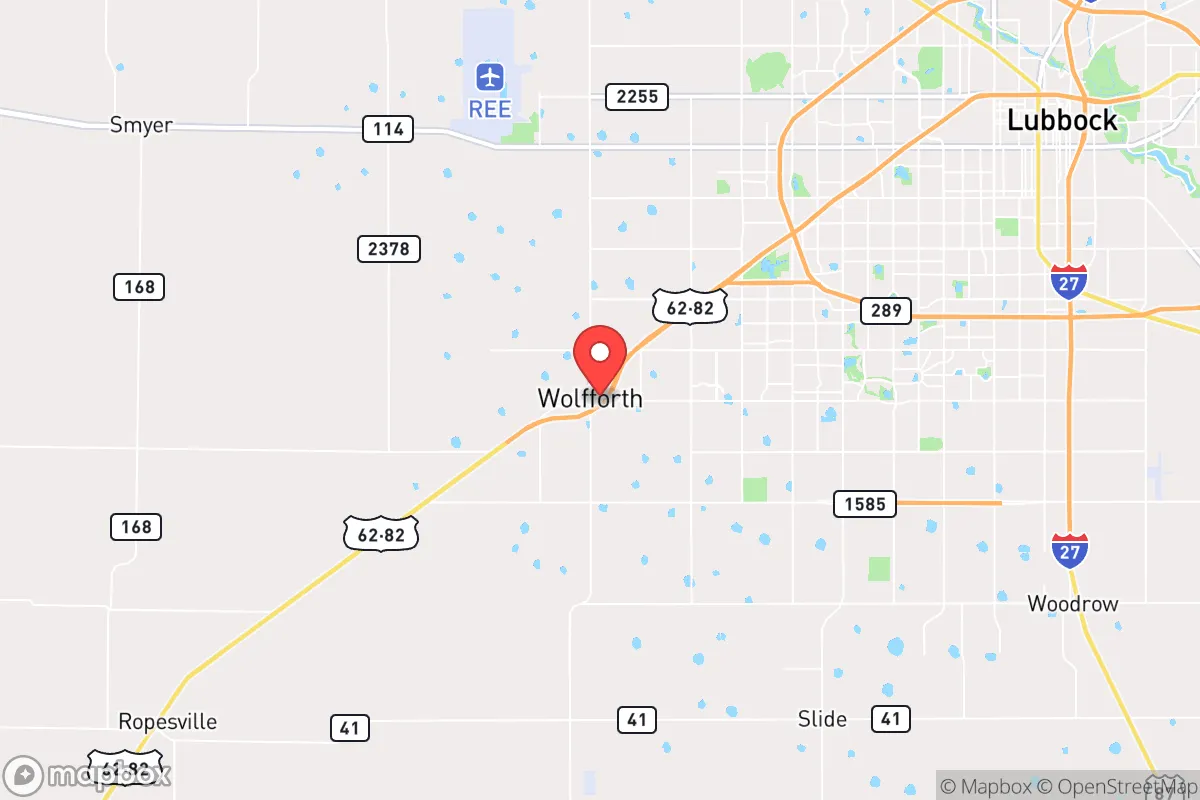
Compared to Texas as a whole, Wolfforth is a political outlier. The state’s R+4 PVI reflects a mix of deep-red rural areas, purple suburbs, and blue urban centers like Houston, Dallas, and Austin. Wolfforth, by contrast, sits in the South Plains region, where the political landscape is uniformly conservative. Drive 15 minutes north to Lubbock proper, and you’ll find a slightly more moderate vibe—Lubbock County still votes Republican, but the city itself has a small but vocal Democratic presence, especially around Texas Tech University. Head east to places like Idalou or Slaton, and you’ll see similar R+20+ numbers. The real contrast is with cities like Austin (D+25) or even Midland (R+18), which is also conservative but has a more libertarian, oil-patch flavor. Wolfforth’s politics are more traditional, church-going, and community-focused—less about rugged individualism and more about shared values.
What this means for residents
For conservative residents, Wolfforth is a comfortable fit. Local government, school board meetings, and city council decisions tend to reflect conservative priorities: low taxes, support for law enforcement, and a focus on family-friendly policies. You’ll see “God Bless America” signs in front yards and a strong sense of community at the annual Cotton Festival. For liberal residents, the reality is different. While no one is hostile, you’ll likely feel like a minority in political discussions. There’s no active Democratic party presence in town, and progressive viewpoints are rarely voiced in public forums. That said, most folks here are polite and neighborly—politics doesn’t dominate daily life the way it does in more polarized cities. If you’re liberal, you might find your social circle through Texas Tech in Lubbock or through local civic groups that focus on non-political issues like the library or youth sports.
One cultural distinction worth noting: Wolfforth’s politics are deeply tied to its evangelical Christian community. That means you’ll see more emphasis on faith-based initiatives and less on secular public events. The city doesn’t have a large immigrant population, so immigration debates are more abstract than personal. Gun rights are widely supported, and you’ll see open carry in everyday settings. Over the next decade, I expect Wolfforth to stay solidly Republican, but as Lubbock grows and diversifies, the edges might soften slightly—maybe a few more moderate voices in local races. For now, though, it’s a place where the political climate is stable, predictable, and overwhelmingly conservative.

State Political ClimatePolitical Climate in Texas
State Political AnalysisPolitical Environment in the State
Texas has been a reliably Republican state for the past three decades, with a Cook Partisan Voting Index of R+4, but that label masks a dramatic and ongoing realignment. The state hasn't voted for a Democratic presidential candidate since Jimmy Carter in 1976, yet the margin has tightened from 16 points in 2012 to 9 points in 2016 and just under 6 points in 2020, driven by explosive growth in the urban crescent from Dallas-Fort Worth down through Austin to Houston and San Antonio. What you're really looking at is a state where the old solid-red coalition of rural conservatives and suburban moderates is fracturing, with the suburbs trending left while the exurbs and small towns dig in deeper on the right.
Urban vs. rural divide
The political map of Texas is a story of three distinct zones. The major metros — Harris County (Houston), Dallas County, Bexar County (San Antonio), and Travis County (Austin) — have become Democratic strongholds, with Travis County delivering a 50-point margin for Biden in 2020. The suburban ring counties that once anchored Republican dominance are now battlegrounds: Tarrant County (Fort Worth) flipped to Biden by a razor-thin 0.2 points in 2020 after voting Republican for decades, while Collin County (north of Dallas) went from 57% Romney in 2012 to 51% Trump in 2020. Meanwhile, rural West Texas (Lubbock, Midland-Odessa), the Panhandle (Amarillo), and East Texas (Tyler, Longview) remain deeply Republican, often voting 75-80% for GOP candidates. The Rio Grande Valley, historically a Democratic stronghold, has shifted rightward — Hidalgo County (McAllen) went from 68% Clinton in 2016 to 52% Biden in 2020, a seismic shift driven by working-class Hispanic voters moving toward the GOP on economic and cultural issues.
Policy environment
Texas operates under a low-tax, low-service model that defines its political identity. There is no state income tax — funded instead by a combination of property taxes (among the highest in the nation) and an 8.25% sales tax cap (state plus local). The regulatory posture is famously business-friendly: no state-level occupational licensing for many trades, weak environmental enforcement relative to California or New York, and a tort-reform system that caps noneconomic damages in medical malpractice cases at $250,000. Education policy is dominated by the school choice debate — the 2023 legislative session saw a major push for education savings accounts (ESAs) that failed due to rural Republican opposition, but Governor Greg Abbott has made it his top priority for 2025. Healthcare is a flashpoint: Texas has the highest uninsured rate in the nation at roughly 17%, having refused Medicaid expansion under the Affordable Care Act. Election laws were tightened in 2021 with Senate Bill 1, which added ID requirements for mail-in ballots, limited drive-through and 24-hour voting, and gave partisan poll watchers more access — changes that critics say suppress turnout and supporters say protect integrity.
Recent policy direction
The 2023 and 2024 legislative sessions have pushed Texas sharply in a conservative direction across multiple fronts. On gun rights, Texas became a permitless carry state in 2021 (HB 1927), allowing most adults to carry handguns without a license or training — one of the most permissive regimes in the country. On parental rights and education, the 2023 session passed HB 900, which requires book vendors to rate materials for "sexually explicit" content and bans them from public schools, and SB 17, which eliminated diversity, equity, and inclusion offices at public universities. On speech and privacy, a 2023 law (HB 20) requires social media platforms with over 50 million users to host user content without viewpoint-based censorship, though it's currently tied up in court. Medical and bodily autonomy saw the state enact a near-total abortion ban (SB 8 and the trigger law) after Dobbs, with no exceptions for rape or incest, and a 2023 law (SB 14) banning gender-affirming care for minors. Property rights remain strong — Texas has no state-level zoning in most unincorporated areas, though cities like Austin and Houston have their own land-use rules. Voting access remains a partisan battleground, with the 2023 session passing SB 2, which requires counties with populations over 100,000 to have at least one in-person voting location per 100,000 residents, effectively mandating minimum access in Democratic-leaning urban counties.
Civil unrest & political movements
Texas has been a stage for high-profile political flashpoints. The 2020-2021 period saw significant protests in Austin, Houston, and Dallas over police brutality and racial justice, with the Austin Police Department's budget being cut and then restored after a political backlash. Immigration politics are a constant, visible issue: Operation Lone Star, launched by Governor Abbott in 2021, has deployed thousands of Texas National Guard troops and state troopers to the border, bused migrants to Democratic-led cities like New York and Chicago, and installed razor wire along the Rio Grande — a program that has drawn legal challenges and cost over $10 billion. The "secession" or "Texit" movement, while fringe, has a vocal minority — the Texas Nationalist Movement claims tens of thousands of supporters, but polling consistently shows 80%+ of Texans oppose leaving the Union. Election integrity controversies flared after 2020, with Attorney General Ken Paxton leading a failed Supreme Court lawsuit to overturn results in four other states, and the 2022 primary saw a wave of "election integrity" activists winning local county clerk and elections administrator positions. A new resident would notice the omnipresence of political signage — from "Don't Mess with Texas" to "Keep Austin Weird" — and the sharp contrast between urban and rural political cultures, especially on issues like gun display (open carry is legal) and immigration enforcement.
Projection
Over the next 5-10 years, Texas is likely to become more competitive at the statewide level but remain Republican-leaning, with the path to a Democratic win running through the suburbs. The state is adding roughly 1,000 new residents per day, with the vast majority settling in the urban crescent — many from California and the Northeast, bringing more Democratic-leaning voters. However, the in-migration also includes conservative retirees and remote workers drawn by low taxes and housing costs, and the Hispanic vote continues to shift rightward, especially among younger men. The Texas Senate map is heavily gerrymandered, meaning the state legislature will likely remain under Republican control through 2030 even if statewide races tighten. The key wildcard is the 2026 gubernatorial election: if a Democrat can win the governor's mansion, it would signal a true realignment, but that remains a long shot given the state's structural advantages for the GOP. For a new resident, expect the culture wars to intensify — school board meetings, library boards, and city council races will remain battlegrounds over books, curriculum, and transgender rights.
For someone moving to Texas, the practical takeaway is that you're choosing a state where your local experience will vary dramatically by zip code. In Austin or Dallas, you'll find a blue bubble with progressive policies on housing, transit, and social issues, while in Lubbock or Tyler, you'll encounter a deeply conservative community where church attendance and gun ownership are the norm. The state government in Austin will continue to push conservative legislation on abortion, guns, and education, but cities will resist through local ordinances and legal challenges. If you're conservative, you'll find a state that largely aligns with your values on taxes, regulation, and cultural issues. If you're liberal, you'll find strong communities in the cities and a state where your vote matters more than it does in a deep-blue state — but you'll also face a legislature that actively works against your priorities. Either way, Texas is a state where politics is lived loudly and publicly, and you'll need to decide which Texas you want to live in.
* Values derived from national, state, county, city and local statistics and may differ in a specific area. Last updated: 2026-08-25T23:28:03.000Z
Narrative content on this page is AI-generated and may contain mistakes. Verify any details that matter before acting on them.
ReloMaps may earn a commission from affiliate links at no extra cost to you.

