Photo: Wikipedia
Demographics of Winfield, KS
Affluence Level in Winfield, KS
A middle-class area roughly in line with national averages across income, home values, education, and employment.
People of Winfield, KS
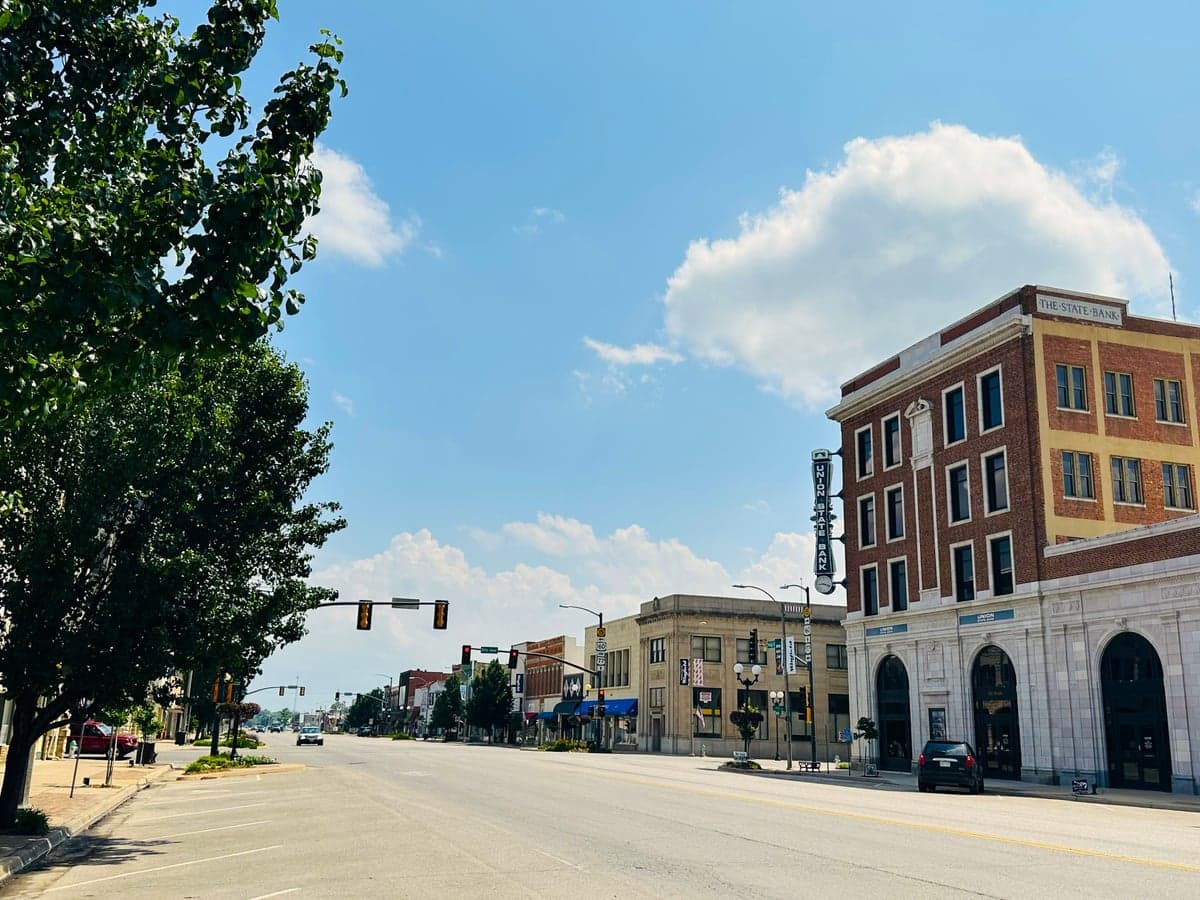
Winfield, Kansas, is a city of 11,731 residents that retains a distinctly small-town, Midwestern character, with a population that is 82.1% White and notably less diverse than the national average. The city’s identity is shaped by its history as a manufacturing and agricultural hub, and its people today are a mix of long-established families, a modest but growing Hispanic community (6.7%), and small East/Southeast Asian (3.6%) and Black (2.5%) populations. With a foreign-born rate of just 1.7% and a college-educated share of 28.9%, Winfield’s population is relatively stable, rooted, and less transient than many comparably sized Kansas towns.
How the city was settled and grew
Winfield’s founding population arrived in the early 1870s, drawn by the promise of fertile land along the Walnut River and the construction of the Kansas and Neosho Valley Railroad. The city was officially incorporated in 1873, and its early growth was fueled by European-American settlers, primarily of German, English, and Irish descent, who established farms and small businesses. The original town center, now known as Downtown Winfield, was built around the railroad depot and became the commercial and civic heart, with brick storefronts and churches that still define the area today. A second wave of growth came in the early 1900s with the discovery of oil and gas in Cowley County, which brought workers and speculators to neighborhoods like East Side, where modest frame houses were built for oil-field laborers. By the 1920s, the city’s population had swelled to over 7,000, and the Southwestern College campus—founded in 1885—attracted a steady stream of students and faculty, many of whom settled in the College Hill neighborhood, a tree-lined district of older homes near the campus.
Modern era (post-1965)
After the 1965 Immigration and Nationality Act, Winfield saw only modest demographic change compared to larger Kansas cities. The Hispanic population began to grow slowly in the 1980s and 1990s, with families moving into the West Side neighborhood, an area of older, affordable homes near the city’s industrial plants, including the Cessna (now Textron Aviation) facility that opened in the 1970s. This manufacturing base attracted some East/Southeast Asian workers, primarily Vietnamese and Filipino, who settled in small numbers in the North Industrial District near the airport and rail lines. The Black population, historically small, has remained concentrated in the South Central area, near the city’s older public housing and the former railroad yards. Unlike many Sun Belt cities, Winfield did not experience a large suburbanization wave; instead, most growth has been infill within the existing city limits, with new subdivisions like Prairie View Estates (developed in the 2000s) attracting mostly White families seeking newer homes without leaving town. The Indian subcontinent population is negligible at 0.2%, and there is no identifiable Arab community.
The future
Winfield’s population is projected to remain stable or decline slightly over the next decade, as the city’s aging White population (median age 39.7) is not being fully replaced by younger families. The Hispanic share is likely to continue its gradual increase, potentially reaching 8-9% by 2035, driven by natural growth and some migration for agricultural and manufacturing jobs. The East/Southeast Asian community, tied largely to specific employers like Textron Aviation, is expected to plateau unless new industrial recruitment occurs. The city is not tribalizing into distinct ethnic enclaves; rather, it is slowly homogenizing as older White residents age in place and younger, more diverse families move into the same neighborhoods. The College Hill area may see a slight uptick in diversity as Southwestern College recruits more international students, but this will have a minor effect on the overall population.
For someone moving to Winfield now, the city offers a stable, low-crime environment with a strong sense of community, but it is not a place of rapid demographic change or cultural diversity. The population is becoming slightly more Hispanic and slightly older, while remaining overwhelmingly White and native-born. New residents should expect a traditional Midwestern social fabric where long-term roots and local institutions—churches, schools, and the college—remain the primary anchors of community life.

* Values derived from national, state, county, city and local statistics and may differ in a specific area. Last updated: 2026-04-30T03:55:13.000Z
Narrative content on this page is AI-generated and may contain mistakes. Verify any details that matter before acting on them.
ReloMaps may earn a commission from affiliate links at no extra cost to you.

