Demographics of Windermere, FL
Affluence Level in Windermere, FL
A wealthy area with high-earning, well-educated households. Incomes, home values, and educational attainment meaningfully outpace national averages.
People of Windermere, FL
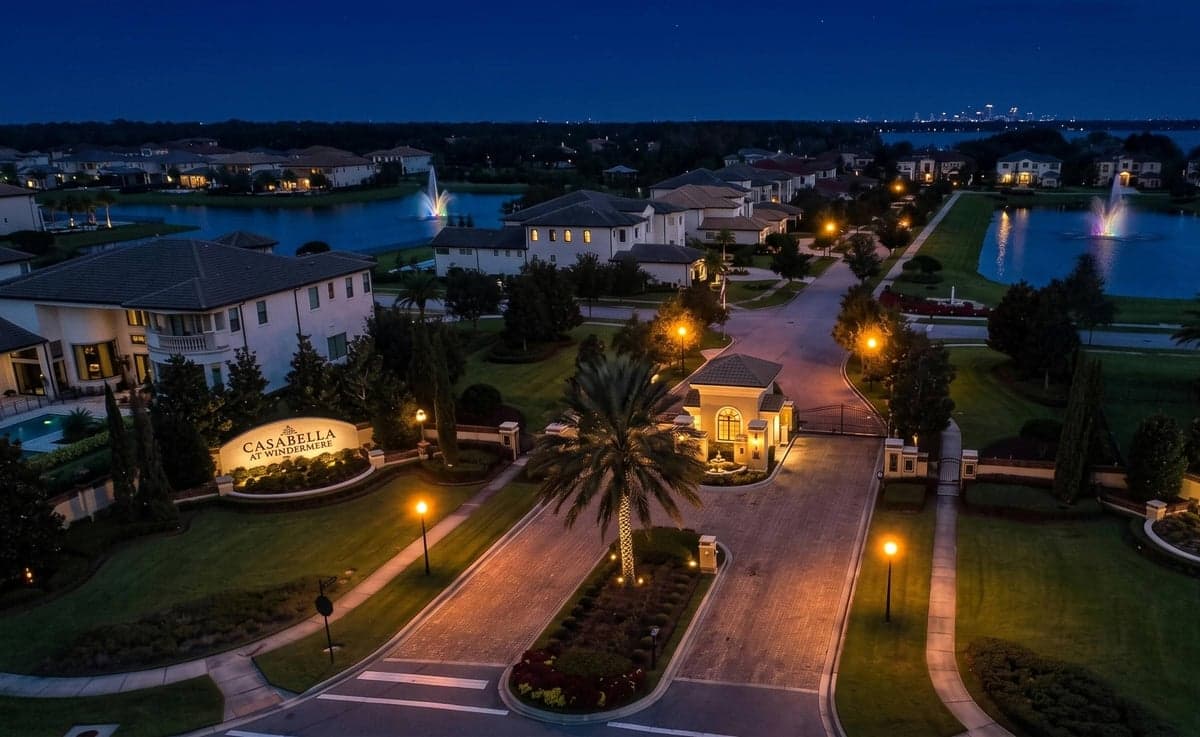
Windermere, Florida, is a small, affluent town of 3,034 residents, characterized by its exceptionally high college attainment rate of 69.7% and a population that is predominantly White (79.1%). Known for its historic lakeside estates and tight-knit community feel, the city has a notably low foreign-born population of just 3.7%, making it one of the less diverse communities in Central Florida. Its identity is shaped by old-money families, equestrian traditions, and a deliberate resistance to the rapid suburban sprawl that defines much of the surrounding Orange County.
How the city was settled and grew
Windermere’s human history begins not with colonial settlement but with the arrival of wealthy Northerners in the late 19th and early 20th centuries, drawn by the area’s chain of clear lakes and temperate climate. The town was officially incorporated in 1925, but its character was set earlier by the construction of grand winter homes along the shores of Lake Butler, Lake Down, and Lake Chase. The original population was almost exclusively White, Anglo-Saxon Protestant, and wealthy—a pattern that persisted for decades. The historic Butler Bay and Lake Down Circle neighborhoods were the first to be developed, with large estates built by citrus barons and railroad executives. Unlike many Florida towns, Windermere never had a significant agricultural or working-class phase; it was designed from the start as an exclusive enclave. The mid-20th century saw slow, controlled growth, with the Palm Lake area adding a few dozen homes for professionals commuting to Orlando, but the town’s population remained under 500 until the 1970s.
Modern era (post-1965)
The post-1965 era brought gradual demographic change, though Windermere remained far more homogeneous than the booming Orlando metro area. The 1990s and 2000s saw an influx of upper-middle-class families, many of them White professionals from the Northeast and Midwest, drawn by the town’s reputation for excellent schools (Orange County Public Schools’ top-rated elementary and middle schools) and low crime. The Windermere Downs and Lake Burden neighborhoods were developed during this period, attracting corporate executives, doctors, and lawyers. The foreign-born population remains very low at 3.7%, and the Asian (East/Southeast Asian) share is just 1.0%, while the Indian subcontinent population stands at 3.2%—a small but notable presence concentrated in newer subdivisions like Lakeside at Windermere. The Black population is 5.5% and the Hispanic population is 5.4%, both figures reflecting modest growth from near-zero levels in the 1980s. These groups are not concentrated in any single neighborhood but are dispersed among the town’s newer housing stock. The town’s racial and ethnic composition has shifted only slightly: the White share dropped from roughly 95% in 1990 to 79.1% today, with most of the change coming from the addition of Indian and Hispanic families in professional occupations.
The future
Windermere’s population is heading toward slow, selective diversification, but the town is likely to remain a predominantly White, high-income enclave for the foreseeable future. The city has very little undeveloped land left, and zoning laws strictly limit new construction, meaning population growth will be minimal—projections suggest a rise to around 3,500 by 2040. The Indian subcontinent community, while small, is the fastest-growing segment, driven by tech and medical professionals working in nearby Lake Nona and downtown Orlando. The East/Southeast Asian and Hispanic populations are plateauing, as the town’s high housing costs (median home value above $1 million) filter for income rather than ethnicity. No new immigrant enclaves are forming; instead, the trend is toward assimilation into the existing upper-class culture. The town is not tribalizing into distinct ethnic neighborhoods—it is too small and too expensive for that—but is instead homogenizing around wealth and educational attainment.
For a conservative-leaning individual or family considering a move, Windermere offers a stable, low-crime, high-amenity environment with a population that is overwhelmingly native-born, college-educated, and politically moderate-to-conservative. The town is becoming slightly more diverse in professional categories (Indian and Hispanic professionals) but remains fundamentally a White, wealthy, and insular community where newcomers are expected to fit into an established social order. It is not a place of demographic upheaval or rapid change, but of careful, managed continuity.

* Values derived from national, state, county, city and local statistics and may differ in a specific area. Last updated: 2026-05-12T16:50:10.000Z
Narrative content on this page is AI-generated and may contain mistakes. Verify any details that matter before acting on them.
ReloMaps may earn a commission from affiliate links at no extra cost to you.

