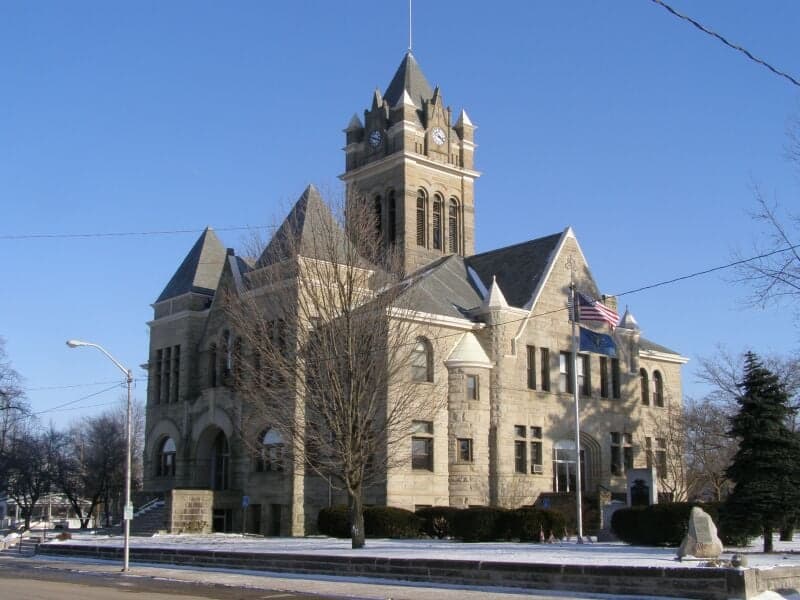
Photo: Wikipedia
Political ClimatePolitical Climate in Winamac, IN
District shown is the primary district for this city’s centroid. Cities may span multiple districts.
Inherited from parent county — no local data available.
* Lean and PVI are calculated from the surrounding county’s 2020 and 2024 presidential results, Cook-style — a finer measure here than its congressional district (IN-2).
Political rankings in Indiana
- Most Conservative Cities in Indiana
- Most Liberal Cities in Indiana
- Best Liberal-Leaning Towns in the Midwest
- Safest Liberal-Leaning Towns in the Midwest
- Safest Conservative-Leaning Towns in the Midwest
- Affordable Small Towns for Conservatives
- Most Affordable Liberal-Leaning Small Towns in the U.S.
- Safest Conservative-Leaning Cities in the U.S.
- Most Conservative Counties in Indiana
- Most Liberal Counties in Indiana
Local Political AnalysisPolitical Analysis of Winamac, IN
Winamac is about as reliably Republican as any small town in Indiana gets, and that’s saying something. The Cook PVI for the area sits at R+27, which is a full 18 points more conservative than the state of Indiana as a whole, which clocks in at R+9. That gap isn’t just a number on a map—it reflects a deep, consistent voting pattern that has held steady for decades. In presidential elections, Pulaski County (where Winamac is the county seat) routinely delivers margins that make the rest of the state look purple by comparison. Neighboring towns like Logansport or Monticello might swing more moderately, but Winamac’s rural, agricultural base keeps it firmly anchored to the right.
How it compares
To understand how conservative Winamac is, look at the numbers: an R+27 PVI means the area votes roughly 27 points more Republican than the national average. That’s a stark contrast even within Indiana, where the statewide PVI is already R+9. For context, places like Indianapolis (Marion County) lean Democratic, and even nearby Lafayette (Tippecanoe County) is a toss-up. But drive 30 minutes south to Winamac, and the political landscape shifts dramatically. The area’s voting record isn’t just a reflection of party loyalty—it’s tied to local issues like farming regulations, gun rights, and school funding, which tend to resonate more with conservative voters. In 2024, Pulaski County voted for the Republican presidential candidate by a margin that exceeded 70%, a number that dwarfs the statewide average.
What this means for residents
For conservative residents, Winamac feels like home in a way that larger, more diverse cities might not. Local government, school board meetings, and county commissions are overwhelmingly Republican, so policy tends to align with conservative priorities—lower taxes, limited regulation, and a focus on rural infrastructure. For liberal residents, the reality is more isolating. While there’s no open hostility, progressive viewpoints are a distinct minority, and national political debates often feel distant or irrelevant. That said, the community is small enough that personal relationships often transcend political divides. You might disagree with your neighbor on national policy, but you’ll still help them haul hay or fix a fence. The trajectory here is toward even deeper conservatism, driven by an aging population and limited in-migration from more liberal areas.
One cultural distinction worth noting is Winamac’s strong sense of local identity, which sometimes clashes with state or national trends. For example, while Indiana has moved toward expanded gambling and looser alcohol laws, Pulaski County has been slower to adopt those changes. The area also has a notable gun culture—open carry is common, and local ordinances tend to favor minimal restrictions. For newcomers, especially those from more liberal states, the adjustment can be jarring. But for longtime residents, the political climate is simply part of the landscape, as familiar as the Tippecanoe River or the annual Pulaski County 4-H Fair. If you’re considering a move here, know that the politics are deeply conservative, but the people are generally welcoming—as long as you respect the local way of life.

State Political ClimatePolitical Climate in Indiana
State Political AnalysisPolitical Environment in the State
Indiana has been a reliably Republican state for decades, with a Cook Partisan Voting Index of R+9, meaning it votes about nine points more Republican than the nation as a whole. The state hasn't backed a Democrat for president since 2008, when Barack Obama narrowly won it, and that was largely a fluke driven by the Great Recession and a strong ground game in the industrial northwest. Since then, the GOP has tightened its grip: Donald Trump won by 16 points in 2020 and 19 points in 2024, and Republicans hold supermajorities in both chambers of the state legislature and every statewide office. The trajectory over the last 20 years has been a steady rightward shift, driven by the hollowing out of union-heavy manufacturing strongholds and the growth of conservative exurbs around Indianapolis and along the I-69 corridor.
Urban vs. rural divide
The political map of Indiana is a textbook case of the urban-rural split. Marion County (Indianapolis) is the only reliably blue stronghold, voting Democratic by double digits in every recent presidential cycle, but it's surrounded by a ring of deep-red suburban and exurban counties like Hamilton, Hendricks, and Johnson that more than cancel out the city's votes. Lake County in the northwest corner, part of the Chicago metro area, is also Democratic-leaning, but its influence has waned as population growth has shifted to the Indianapolis suburbs and the I-69 corridor toward Bloomington and Evansville. The rest of the state is overwhelmingly Republican. Fort Wayne (Allen County) has trended redder as its manufacturing base has diversified, while South Bend (St. Joseph County) is a rare swing county that has drifted rightward in recent cycles. The rural counties along the Ohio River and in the central farm belt routinely vote 70-80% Republican. The divide isn't just about population density—it's cultural. The urban cores are younger, more diverse, and more college-educated, while the rural and exurban areas are older, whiter, and more culturally conservative.
Policy environment
Indiana's policy environment is consistently conservative, with a few notable exceptions. The state has a flat income tax rate of 3.05%, which is scheduled to drop to 2.9% by 2027, and no inheritance or estate tax. Property taxes are capped at 1% of assessed value for owner-occupied homes, which keeps housing costs relatively low. The state is a right-to-work state (enacted in 2012), which has weakened union influence but made it more attractive to manufacturers. Education policy is a mixed bag: Indiana has a robust school voucher program (the oldest in the nation, dating to 2011) that allows public funds to follow students to private and religious schools, but public school funding has been a perennial source of tension, with rural districts often feeling shortchanged. The state has some of the most restrictive abortion laws in the country—a near-total ban passed in 2022 with limited exceptions for rape, incest, and life of the mother—and no exceptions for fetal anomalies. Election laws have tightened: voter ID is required, early voting windows are narrower than in many states, and same-day voter registration is not allowed. On the other hand, Indiana has no state-level hate crime law (it's one of only a handful of states without one), which has been a point of criticism from civil rights groups.
Recent policy direction
The last few years have seen Indiana's legislature push aggressively on cultural and liberty-related fronts. In 2023, the state passed a permitless carry law, allowing any adult who can legally possess a firearm to carry it openly or concealed without a license—a major shift from its previous shall-issue regime. On education, the 2022 "Parents' Bill of Rights" (HB 1134) requires schools to notify parents of any changes to a student's health or well-being, which has been used to challenge LGBTQ+ inclusive policies. The state also banned transgender girls from participating in K-12 girls' sports (2022) and restricted gender-affirming care for minors (2023). On property rights, Indiana has a relatively strong eminent domain framework that favors landowners, but it's not as protective as some Western states. On privacy and surveillance, the state has no comprehensive data privacy law, though a bill is pending. Medical and bodily autonomy is sharply limited by the abortion ban, but the state has expanded medical marijuana discussions—though no law has passed yet. Voting access has been tightened: the 2021 law (SB 398) reduced the early voting window from 28 to 14 days and limited the use of mail-in ballot drop boxes. The overall direction is toward more individual liberty on guns and education, but less on reproductive and medical choices.
Civil unrest & political movements
Indiana has seen its share of political flashpoints, though large-scale civil unrest is rare. The most visible recent event was the 2020 George Floyd protests in Indianapolis, which included some property damage and a heavy police response, but were smaller and shorter-lived than in many other major cities. On the right, the Indiana Freedom Coalition and local Moms for Liberty chapters have been active in school board races and library board elections, particularly in Hamilton County (Carmel, Fishers) and Johnson County (Greenwood). Immigration politics are less heated than in border states, but there have been localized controversies over sanctuary city proposals—Indianapolis briefly considered one in 2019 but backed down after state threats to withhold funding. There is no serious secession or nullification movement in Indiana, though some rural counties have passed symbolic "Second Amendment sanctuary" resolutions. Election integrity has been a recurring theme: the 2020 and 2024 elections were not seriously contested in Indiana, but the legislature has continued to tighten voting laws, citing public confidence. A new resident would notice the political divide most acutely in the contrast between Indianapolis's progressive city council and the statehouse's conservative supermajority, which often preempts local ordinances on issues like minimum wage, housing, and nondiscrimination.
Projection
Over the next 5-10 years, Indiana is likely to remain solidly Republican, but the margins may narrow slightly as the Indianapolis suburbs continue to diversify and attract younger, more moderate transplants. Hamilton County (Carmel, Fishers, Noblesville) has been trending from deep red to light red as it fills with tech workers and corporate relocations—it still votes Republican, but by smaller margins than a decade ago. Meanwhile, the rural counties are aging and losing population, which could slowly erode the GOP's base. The state's in-migration is modest compared to Sun Belt states, but it's concentrated in the Indianapolis metro and the I-69 corridor toward Bloomington, both of which are slightly more moderate. The legislature will likely continue to push conservative cultural policies, especially on education and medical freedom, but the flat tax and business-friendly climate will remain stable. A new resident moving in now should expect the state to be reliably Republican for the foreseeable future, with the most interesting political action happening at the local level—school boards, county commissions, and city councils—where the urban-rural divide plays out in real time.
For a new resident, the bottom line is this: if you're conservative, you'll find a state that broadly aligns with your values on taxes, guns, education choice, and limited government. If you're liberal, you'll find a state where your vote in statewide elections won't matter much, but where you can still have real influence in Indianapolis, Bloomington, or a few other blue pockets. The practical takeaway is that Indiana offers a stable, predictable political environment with low taxes and a business-friendly regulatory climate, but with sharp limits on certain personal freedoms—especially reproductive rights—that you'll need to weigh carefully. The state is not trending toward purple anytime soon, but the growing suburbs are creating a more nuanced political landscape than the simple R+9 label suggests.
* Values derived from national, state, county, city and local statistics and may differ in a specific area. Last updated: 2026-11-15T14:20:36.000Z
Narrative content on this page is AI-generated and may contain mistakes. Verify any details that matter before acting on them.
ReloMaps may earn a commission from affiliate links at no extra cost to you.

