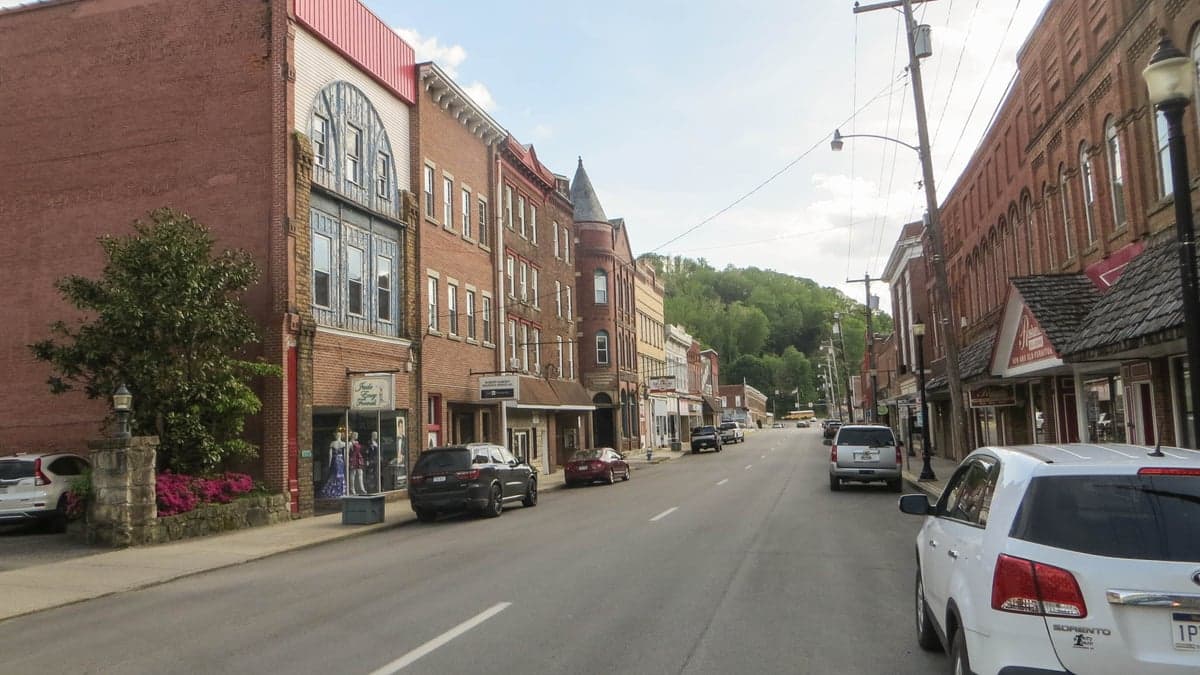
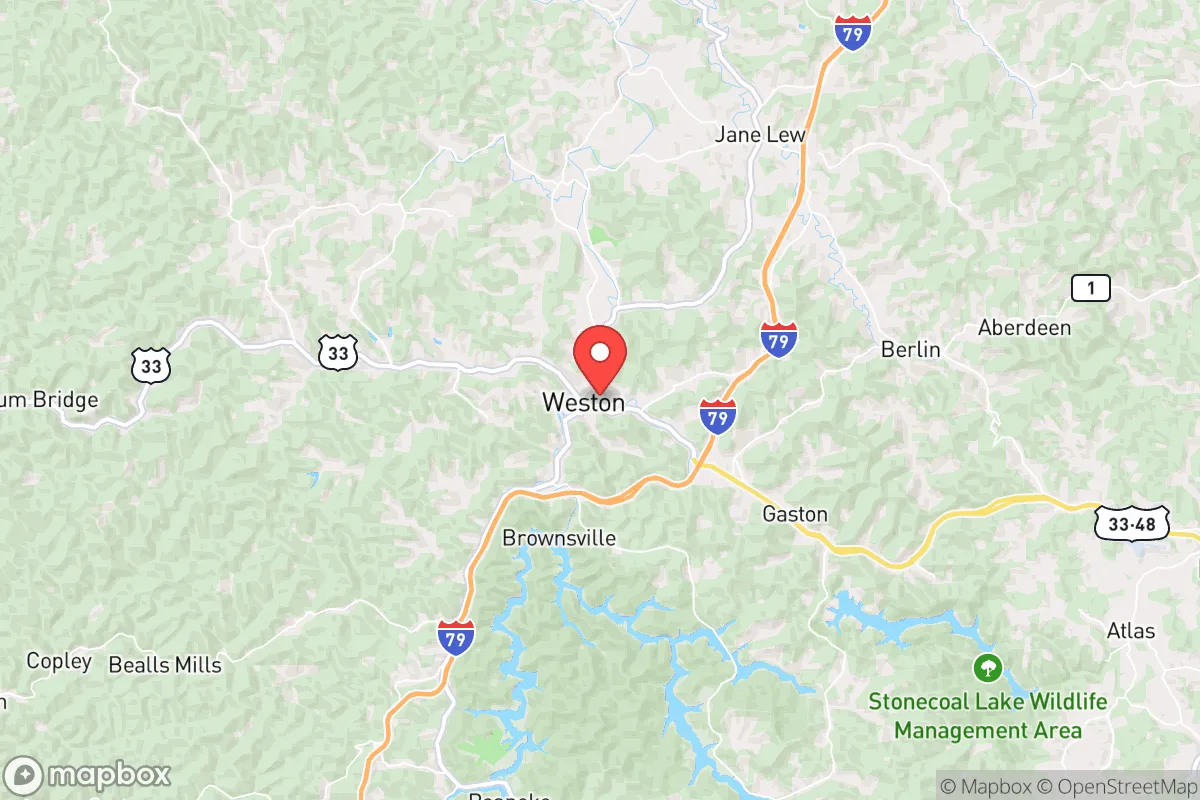
Photo: Wikipedia
Demographics of Weston, WV
Affluence Level in Weston, WV
A below-average socioeconomic profile. Incomes, home values, and educational attainment trail the U.S., with higher poverty and unemployment.
People of Weston, WV
The people of Weston, West Virginia today form a small, predominantly white community of 3,884 residents, characterized by deep generational roots in the region and a notably low population density of roughly 1,200 people per square mile. The city’s identity is shaped by its Appalachian heritage, a strong sense of local tradition, and a population that is 91.3% white, with a Hispanic share of 2.6% and a Black share of 1.2%. With 0.0% foreign-born residents and a college education rate of just 14.6%, Weston’s population is largely native-born and working-class, reflecting a community that has seen little recent international immigration and remains culturally homogeneous.
How the city was settled and grew
Weston’s population history begins with its founding in 1818 by European-American settlers, primarily of English, Scots-Irish, and German descent, who were drawn to the fertile lands along the West Fork River. The town was officially incorporated in 1846 and grew slowly as a market center for surrounding farms. The arrival of the railroad in the 1850s spurred a modest industrial wave, with glass manufacturing becoming the dominant employer by the late 19th century. The historic Jackson’s Mill area, just south of downtown, was the site of an early gristmill and later a key Civil War-era encampment, anchoring the original settlement. The Downtown Historic District, centered on Main Avenue and Second Street, was built by the families of glassworkers and railroad laborers, many of whom lived in the compact, walkable blocks that still define the city’s core. A second wave of growth came in the early 1900s with the expansion of the Weston State Hospital (now the Trans-Allegheny Lunatic Asylum), which drew workers and their families to the Asylum Hill neighborhood, a residential area of modest frame houses built to house hospital staff. By 1950, Weston’s population peaked at around 8,000, driven by the glass industry and state hospital employment.
Modern era (post-1965)
After the 1965 Hart-Cellar Act, Weston saw virtually no new immigration, with the foreign-born population remaining at 0.0% through the present day. The post-1965 era instead brought domestic out-migration as the glass industry declined, with many younger residents leaving for larger cities. The population fell from 8,000 in 1950 to 3,884 by 2024, a loss of over 50%. The North Weston neighborhood, developed in the 1970s along Route 19, absorbed some of the remaining middle-class families, while the Benedum Drive corridor saw modest suburban-style housing built for workers at the local Walmart and healthcare facilities. The city’s racial composition remained overwhelmingly white, with the Black share dropping from a small historic presence (tied to railroad and hospital work) to just 1.2% today. The Hispanic share, at 2.6%, is a recent and very small increase, likely from a few families employed in service industries. The South Weston area, near the river, has become a lower-income enclave where many long-term white residents remain, while the Jackson’s Mill area has transitioned to a historic site and state park, drawing tourism but not new residents.
The future
Weston’s population is projected to continue its slow decline, with no major economic drivers to reverse the trend. The city is homogenizing further, as the small Black and Hispanic shares are not growing and the foreign-born population remains zero. The lack of college-educated residents (14.6%) and the absence of immigrant communities mean the city is not tribalizing into distinct ethnic enclaves but rather aging in place, with a median age likely above the state average. The next 10-20 years will likely see a continued contraction, with the remaining population concentrated in the Downtown Historic District and North Weston, while outlying areas like Asylum Hill may see depopulation. For someone moving in now, Weston offers a stable, culturally homogeneous environment with low housing costs and a strong sense of local history, but limited economic opportunity and demographic diversity.
Weston is becoming a quieter, older, and more insular community, where the population is shrinking and the cultural fabric remains rooted in its 19th-century Appalachian origins. For a conservative-leaning individual or family seeking a low-cost, low-crime, and traditional small-town setting, Weston provides a predictable and stable environment, but one with few prospects for growth or demographic change.

* Values derived from national, state, county, city and local statistics and may differ in a specific area. Last updated: 2026-05-01T06:56:29.000Z
Narrative content on this page is AI-generated and may contain mistakes. Verify any details that matter before acting on them.
ReloMaps may earn a commission from affiliate links at no extra cost to you.

