Photo: Wikipedia
Demographics of Wayne, NE
Affluence Level in Wayne, NE
A below-average socioeconomic profile. Incomes, home values, and educational attainment trail the U.S., with higher poverty and unemployment.
People of Wayne, NE
The people of Wayne, Nebraska, today number 6,055, forming a tight-knit community where 81.7% of residents identify as White, 13.3% as Hispanic, and 5.7% as foreign-born. The city’s character is defined by its role as a regional education and healthcare hub, anchored by Wayne State College, which pulls in a young, transient population alongside multi-generational farming and manufacturing families. Distinctive markers include a strong sense of civic pride, a visible Latino presence concentrated in the central and south-side neighborhoods, and a demographic profile that is slightly more diverse than the surrounding rural county.
How the city was settled and grew
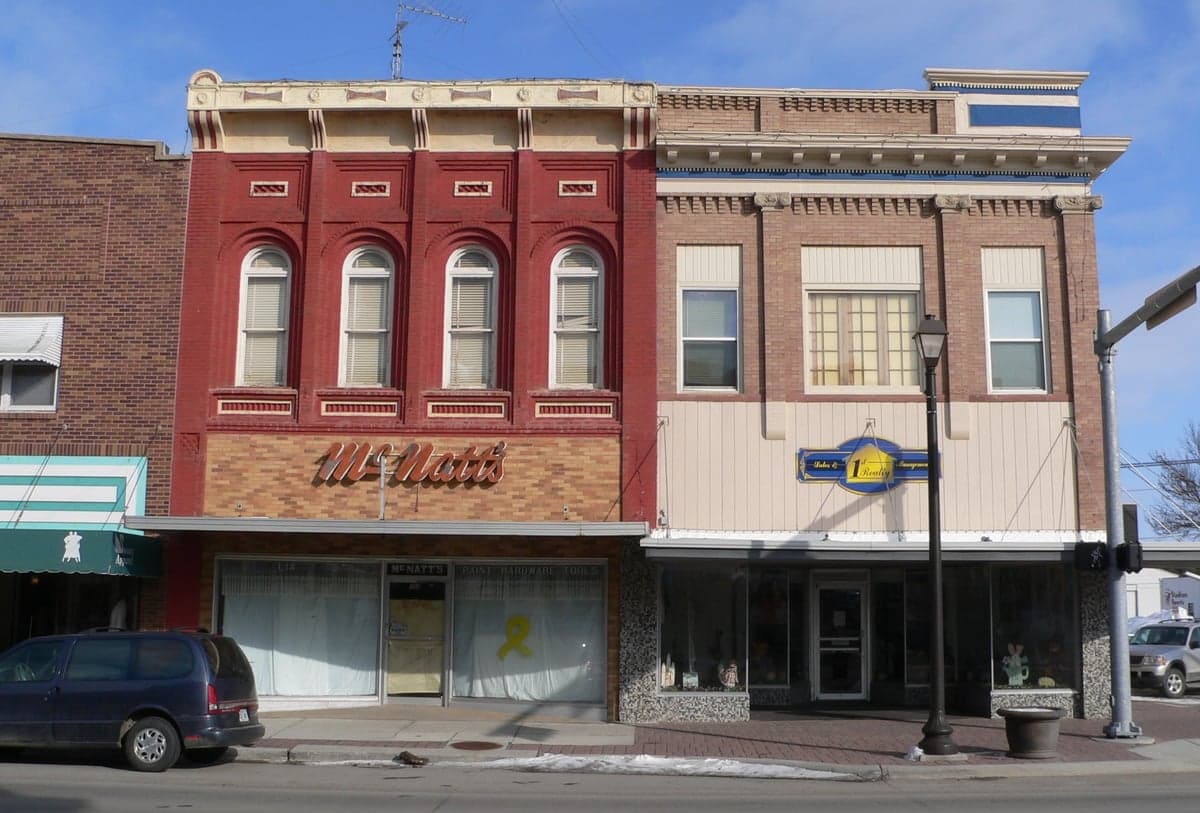
Wayne was founded in 1881 as a railroad town on the Fremont, Elkhorn and Missouri Valley line, drawing its first wave of settlers—primarily German, Czech, and Scandinavian farmers—who were granted land through the Homestead Act and later the railroad’s land sales. These early families built the original downtown district along Main Street, with wood-frame homes and storefronts that still form the historic core. A second wave arrived in the 1910s-1920s as the Nebraska Normal College (now Wayne State College) opened, attracting educators and their families to the College View neighborhood north of campus, where many faculty homes remain. The city’s growth remained steady through the mid-20th century, fueled by agricultural processing and the college’s expansion, with the West Side developing as a post-war subdivision for returning veterans and their families.
Modern era (post-1965)
After the 1965 Hart-Cellar Act, Wayne saw a modest but notable influx of Hispanic immigrants, primarily from Mexico and later Central America, drawn to work in the region’s meatpacking plants and agricultural fields. These families initially settled in the South Wayne area, near the rail corridor and older rental housing stock, where a small but established Latino community took root. By the 1990s, the Hispanic share of the population had grown to roughly 5%, and by 2020 it reached 13.3%, with many families moving into the East Side neighborhoods around the hospital and industrial park. The college’s recruitment of out-of-state and international students—mostly White and East/Southeast Asian—added a transient layer to the College View and North Campus areas, though the Asian share remains very small at 0.3%. The Black population (1.5%) is concentrated among college-affiliated residents and a handful of families in the central Downtown district. Domestic in-migration from other Nebraska counties and the Great Plains has kept the White majority stable, with many newcomers choosing the West Side subdivisions for newer, affordable single-family homes.
The future
Wayne’s population is slowly homogenizing in terms of race, with the White share declining slightly as the Hispanic share continues to grow—projected to reach 15-18% by 2035 based on birth rates and continued labor demand in agriculture and healthcare. The foreign-born population (5.7%) is plateauing, as most new Hispanic residents are U.S.-born children of earlier immigrants, and the college’s international enrollment has stabilized. The city is not tribalizing into distinct enclaves; instead, Hispanic families are dispersing across the South Wayne and East Side neighborhoods, while White families remain dominant in the West Side and College View. The East/Southeast Asian and Indian subcontinent populations are negligible and unlikely to grow significantly without a major employer shift. The next 10-20 years will likely see Wayne become a slightly more Hispanic, still overwhelmingly White, and aging community, as the college attracts younger residents but many leave after graduation.
For someone moving in now, Wayne is becoming a stable, moderately diverse small city where the Hispanic community is integrating into the social and economic fabric, while the White majority remains firmly in place. The city offers a low-crime, family-oriented environment with a strong educational anchor, but limited racial or ethnic variety beyond the White-Hispanic dynamic. New residents should expect a welcoming but culturally homogeneous atmosphere, with the most visible diversity centered in the South Wayne and East Side neighborhoods.

* Values derived from national, state, county, city and local statistics and may differ in a specific area. Last updated: 2026-04-22T23:52:15.000Z
Narrative content on this page is AI-generated and may contain mistakes. Verify any details that matter before acting on them.
ReloMaps may earn a commission from affiliate links at no extra cost to you.

