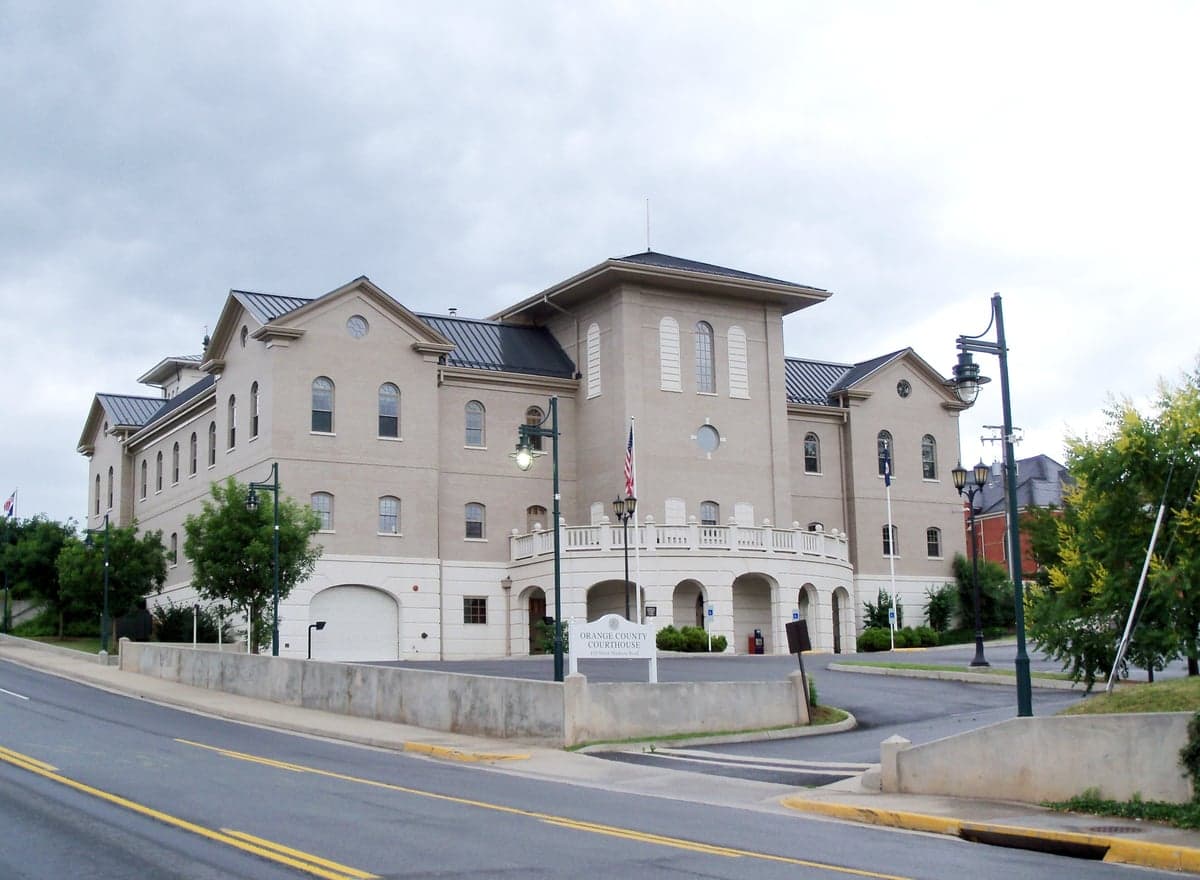
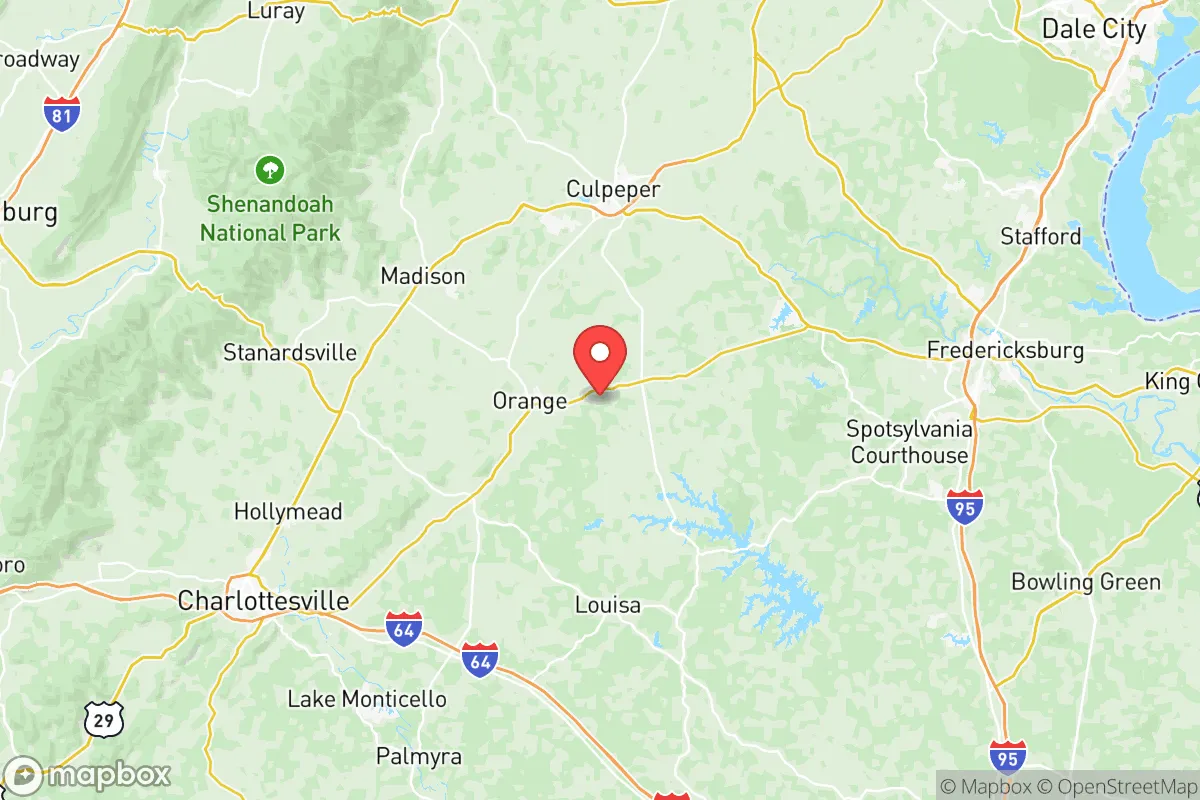
Photo: Wikipedia
Demographics of Orange County
Affluence Level in Orange County
A middle-class area roughly in line with national averages across income, home values, education, and employment.
People of Orange County
Orange County, Virginia, is a predominantly rural community of 37,208 residents where the population is overwhelmingly white (75.3%) and native-born, with only 2.1% foreign-born. The county’s identity is shaped by its deep agricultural roots, historic small towns like the county seat of Orange and the village of Gordonsville, and a growing tension between preservation and the suburban spillover from the Washington, D.C., and Charlottesville metro areas. Politically and culturally, the county leans conservative, with a population that values land, tradition, and local governance, though the southern end near the Rapidan River is seeing gradual diversification.
Settlement & growth (pre-1960)
Long before European settlers arrived, the land that is now Orange County was inhabited by the Siouan-speaking Monacan people, who lived in small villages along the Rapidan and Rappahannock rivers. By the early 1700s, English colonists from Virginia’s Tidewater region began pushing westward, drawn by the promise of fertile tobacco land and generous headright grants. The Virginia General Assembly created Orange County in 1734 from part of Spotsylvania County, naming it for the Dutch-born Prince William of Orange. The first wave of settlers were largely English gentry and their indentured servants, who established sprawling plantations along the rivers. The town of Orange (originally called Orange Court House) became the county seat in 1749, serving as a market and legal hub for the surrounding plantations.
In the mid-1700s, a second wave arrived: Scots-Irish and German farmers who pushed into the Piedmont’s rolling hills, settling in the western part of the county around what is now the village of Rhoadesville and the area near the present-day town of Unionville. These groups were less tied to the plantation economy and more focused on small-scale grain and livestock farming. By the 1790s, Orange County was a patchwork of large slaveholding estates and modest freehold farms. The county’s most famous native son, President James Madison, was born at Port Conway in 1751 but grew up at Montpelier, his family’s plantation near the modern-day town of Montpelier Station. The institution of slavery was central to the county’s antebellum economy: by 1860, enslaved people made up roughly 45% of the population, with most laboring on tobacco plantations.
After the Civil War and emancipation, the county’s Black population remained high, but the collapse of the tobacco economy and the rise of sharecropping kept most families in poverty. The late 1800s saw the arrival of the railroad, which spurred the growth of Gordonsville as a rail junction and market town. A small number of Italian and Irish laborers came to work on the railroad and in the quarries, but they did not form lasting ethnic enclaves. The early 20th century was a period of stagnation: the county’s population actually declined from about 13,000 in 1900 to 12,000 in 1930 as rural families left for industrial jobs in the North. The Great Depression hit hard, and the county remained overwhelmingly agricultural and white until after World War II.
Modern era (post-1965)
The 1965 Hart-Cellar Act had a minimal direct impact on Orange County, as the foreign-born population remains just 2.1% today. Instead, the county’s modern demographic story is one of domestic migration and suburbanization. Beginning in the 1970s, the construction of Interstate 64 and the expansion of Route 29 made the county accessible to commuters working in Charlottesville (25 miles south) and, increasingly, in the Washington, D.C., suburbs (about 70 miles north). This brought a wave of white-collar professionals, many from the D.C. area, who bought land for hobby farms and large-lot homes in the northern part of the county around the town of Locust Grove and the Lake of the Woods gated community. Lake of the Woods, a 2,600-acre planned development built in the 1970s, became a magnet for retirees and second-home buyers, and it remains the county’s largest concentration of newcomers.
The Hispanic population, now 6.6% of the total, began growing in the 1990s and 2000s, driven by demand for labor in the county’s poultry processing plants, construction, and landscaping. Most Hispanic residents are of Mexican and Central American origin and have settled in the more affordable southern part of the county, particularly around the town of Orange and in mobile home parks along Route 20. The Black population, now 10.4%, has remained relatively stable but is aging, with many younger Black residents leaving for urban job centers. The East/Southeast Asian population (0.5%) and Indian subcontinent population (0.4%) are very small, consisting mostly of professionals employed at the University of Virginia in Charlottesville or at Germanna Community College’s Locust Grove campus. There is no visible Asian or Indian enclave in the county.
Suburbanization has reshaped the county’s settlement pattern. The area around the Germanna Community College campus and the intersection of Routes 3 and 20 in Locust Grove has seen the most new housing construction, including subdivisions of single-family homes aimed at commuters. Meanwhile, the historic downtowns of Orange and Gordonsville have experienced modest revitalization, with boutique shops and farm-to-table restaurants catering to weekend visitors from the cities. The county’s college-educated population stands at 29.4%, a figure that has risen steadily as educated newcomers arrive but remains below the state average of about 40%.
The future
Orange County is projected to grow slowly but steadily, with the population expected to reach roughly 40,000 by 2035. The county is becoming slightly more diverse, driven primarily by Hispanic growth and the arrival of younger, more liberal-leaning families from Northern Virginia. However, the pace of diversification is slow: the white share of the population is projected to remain above 70% for the foreseeable future. The Hispanic population is likely to grow to around 8-9% as families settle and have children, while the Black share may hold steady or decline slightly as older residents pass away. The Asian and Indian populations will remain tiny unless a major employer relocates to the county.
The cultural identity of Orange County is evolving into a hybrid: the rural, agricultural, conservative base remains strong in the western and southern parts of the county, while the northern end around Lake of the Woods and Locust Grove is becoming more suburban and politically mixed. The county’s political leanings have shifted slightly: Donald Trump won Orange County by 18 points in 2020, down from 26 points in 2016, suggesting a slow drift toward competitiveness. New development is concentrating in the Locust Grove area and along the Route 29 corridor, while the historic towns of Orange and Gordonsville are seeing infill and renovation rather than sprawl. The county’s land-use policies remain pro-development but with a strong preservationist streak, as many residents resist the kind of dense suburban growth seen in neighboring Spotsylvania County.
For someone moving in now, Orange County offers a rural lifestyle with growing suburban amenities, a conservative-leaning community, and proximity to Charlottesville and Washington, D.C. The population is becoming slightly more diverse and educated, but the county remains overwhelmingly white and native-born, with a culture rooted in land, family, and local tradition. The next decade will likely see continued slow growth, with the northern end of the county becoming more suburban and the southern end staying rural, while the county’s political and cultural identity gradually moderates without losing its conservative foundation.

* Values derived from national, state, county, city and local statistics and may differ in a specific area. Last updated: 2026-09-23T19:19:17.000Z
Narrative content on this page is AI-generated and may contain mistakes. Verify any details that matter before acting on them.
ReloMaps may earn a commission from affiliate links at no extra cost to you.

