

Photo: Wikipedia
Political ClimatePolitical Climate in Vicksburg, MS
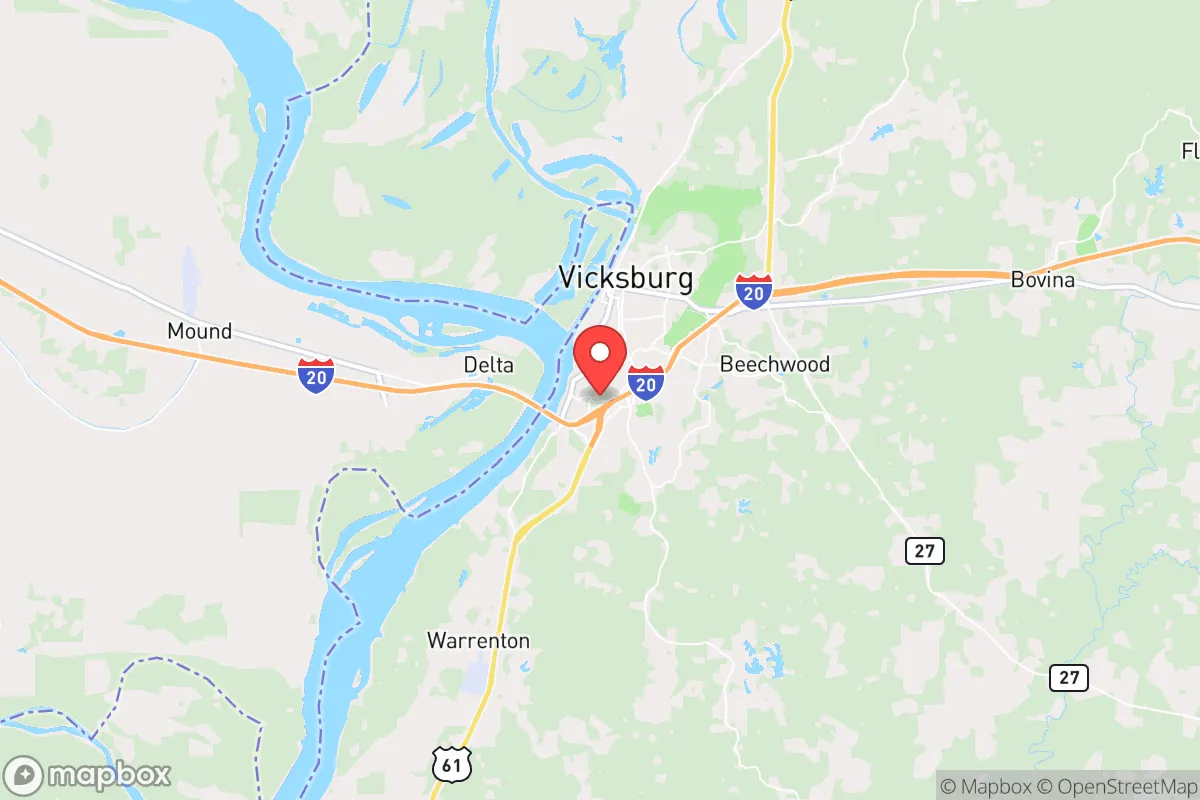
District shown is the primary district for this city’s centroid. Cities may span multiple districts.
Local Political AnalysisPolitical Analysis of Vicksburg, MS
Look, I’ve lived in Vicksburg my whole life, and I’ve watched this town’s politics shift in ways that would surprise folks who only know it from the history books. We’re a D+11 district on the Cook PVI, which means we lean pretty solidly Democratic—about 11 points more than the national average. That’s not a new thing; Vicksburg has been a blue dot in a red state for decades, but the flavor of that blue has changed. It used to be more about old-school, conservative-leaning Democrats—folks who went to church, owned guns, and wanted the government to stay out of their business. Now, I’m seeing a younger, more progressive crowd moving in, and with it, a push for policies that feel like they’re creeping into your personal life, from zoning rules to school curriculum changes. The trajectory is concerning if you value local control and individual freedoms.
How it compares
Drive 45 minutes east to Jackson, and you’ll find a much more pronounced progressive machine—higher taxes, more regulations, and a city council that’s not shy about telling you how to run your property. Vicksburg isn’t that bad yet, but we’re heading in that direction. Head west across the river into Louisiana, and places like Tallulah or even Monroe feel like a different world—more hands-off, more “live and let live.” The contrast is stark: in Vicksburg, you’ve got a county government that’s increasingly cozy with state-level mandates on things like mask requirements and business closures, while just over the bridge, folks are still running their shops without a government minder. The surrounding Warren County is a bit more mixed, but the city itself is where the real pressure comes from. If you’re a conservative who values personal responsibility over government overreach, you’ll feel that tension every time you see a new ordinance or a school board meeting that’s more about social engineering than education.
What this means for residents
For the average person living here, this political climate means you have to stay vigilant. It’s not just about who you vote for—it’s about how much the government is willing to step into your backyard. I’ve seen property tax hikes justified by “community development” that really just fund pet projects for the city council. I’ve watched school board meetings where parents who spoke up about curriculum content were dismissed as out of touch. The shift towards progressive ideology here is slow but steady, and it’s wearing down the old Vicksburg spirit of self-reliance. If you’re thinking of moving here, you need to understand that your voice matters more than ever—attend those town halls, join the local civic groups, because if you don’t, the folks who want more government control will fill that void. It’s still a great place to raise a family, but you’ve got to be ready to push back against the overreach.
One thing that sets Vicksburg apart culturally is our deep-rooted sense of history—we’re a Civil War town, and that legacy makes people here fiercely independent. But that independence is under threat. We’ve got a city council that’s flirted with “equity” initiatives that sound nice but often mean more bureaucracy and less freedom for small business owners. The local paper, the Vicksburg Post, still covers these fights, but the narrative is shifting. My advice? Keep your ear to the ground, vote in every local election, and don’t let the progressive wave wash away what makes this town special. It’s still worth fighting for, but the fight is real.

State Political ClimatePolitical Climate in Mississippi
State Political AnalysisPolitical Environment in the State
Mississippi is one of the most reliably conservative states in the country, with a Republican lean that has only deepened over the past two decades. The state hasn’t voted for a Democratic presidential candidate since 1976, and in 2024, Donald Trump carried it by over 17 points. The dominant coalition is a mix of rural white evangelicals, suburban families in the Jackson metro exurbs, and Gulf Coast retirees, all united around low taxes, gun rights, and traditional values. But don’t mistake the red veneer for uniformity — there’s a real urban-rural split, and the political energy is shifting in ways a new resident should understand before planting roots.
Urban vs. rural divide
The political map of Mississippi is a study in contrasts. The state’s three major metro areas — Jackson, the Gulf Coast, and the Memphis suburbs in DeSoto County — each vote differently. Jackson itself is a deep-blue island, consistently voting 80%+ Democratic, driven by a majority-Black population and a strong progressive activist class. But the surrounding Rankin and Madison Counties are among the most Republican in the nation; Madison County voted +38 for Trump in 2024. The Gulf Coast, anchored by Biloxi and Gulfport, leans Republican but with a libertarian streak — locals there are more concerned about hurricane recovery and property rights than culture wars. DeSoto County, just south of Memphis, is the fastest-growing part of the state and votes like a Tennessee suburb: heavily Republican, with a focus on school choice and low taxes. Rural counties like Yalobusha and Tishomingo are deep red, but their populations are shrinking. The real political action is in the suburban crescent from Southaven to Madison to Ocean Springs, where growth is happening and where the GOP’s future is being forged.
Policy environment
Mississippi’s policy environment is a mixed bag for a conservative. On the plus side, the state has no personal income tax on most earnings — the rate was cut from 4% to 0% over a four-year phase-out that completed in 2026, making it one of the few truly income-tax-free states. Property taxes are among the lowest in the nation, and the regulatory climate is business-friendly. But the state also has a high sales tax (7% state + local add-ons) and a Medicaid system that hasn’t expanded, which means rural hospitals are struggling. Education policy is a bright spot: the state has a robust school choice program, including Education Scholarship Accounts (ESAs) passed in 2024 that let parents use state funds for private school or homeschooling. On the flip side, the state’s public schools rank near the bottom nationally, and the teacher shortage is acute in the Delta. Election laws are solid — voter ID is required, and the state has no no-excuse absentee voting, which keeps the system clean. But there’s no early voting, which some conservatives see as a safeguard and others as an inconvenience.
Trajectory & freedom
Mississippi is moving in a decidedly freer direction on most fronts, but with some caveats. The biggest win for personal liberty in recent years was the constitutional carry law passed in 2016, which allows permitless carry of firearms — no license, no training required. That’s been a point of pride for locals. In 2024, the legislature passed a Parents’ Bill of Rights (HB 1230), which requires schools to notify parents of any medical or mental health services sought by a minor and prohibits classroom instruction on sexual orientation or gender identity in K-3. That’s a clear expansion of parental authority. On medical freedom, the state has a strong conscience clause for healthcare workers and banned COVID-19 vaccine mandates for state employees in 2023. But there’s a dark spot: the state’s medical marijuana program, passed by voters in 2020, was gutted by the legislature and replaced with a highly restricted system that many conservatives see as government overreach. Property rights are strong — no statewide zoning mandates, and the state has a right-to-farm law that protects agricultural operations from nuisance lawsuits. Overall, the trajectory is toward more freedom, but the legislature still has a paternalistic streak, especially on alcohol sales (still dry counties in parts of the Delta) and gambling (limited to the Coast and a few riverboat casinos).
Civil unrest & political movements
Mississippi has a quieter political landscape than many states, but there are flashpoints. The most visible in recent years has been the debate over the state flag — in 2020, the legislature voted to remove the Confederate battle emblem, a move that was controversial among conservatives but ultimately passed with bipartisan support. That was a one-time event, not a trend. Immigration politics are muted here — the state has a very small foreign-born population (about 2%), so the issue doesn’t dominate. There’s no sanctuary city movement; in fact, the state passed a law in 2024 requiring local law enforcement to cooperate with ICE. Election integrity is a settled issue — the 2020 and 2022 elections were smooth, and the state’s voter ID law has been in place since 2014 with no major controversies. The most organized activist movements are on the right: the Mississippi Federation of Republican Women is active, and there’s a growing homeschool network that lobbies for parental rights. On the left, the NAACP and ACLU are present but have limited influence outside Jackson. A new resident won’t see protests or political violence; the culture is polite but firm in its conservatism.
Projection
Over the next 5-10 years, Mississippi will likely stay deep red, but the character of that conservatism is shifting. The biggest demographic trend is the in-migration of retirees and remote workers to the Gulf Coast and the Memphis suburbs, drawn by low taxes and warm weather. These newcomers tend to be more libertarian than the native population — they want low taxes and gun rights, but they’re less interested in culture war battles. That could push the state toward a more “live and let live” conservatism, similar to what’s happened in Tennessee. The Delta will continue to lose population, which means rural conservative power will slowly wane relative to suburban and coastal growth. The biggest wildcard is education: if the ESA program succeeds, it could accelerate the decline of public schools and create a more fragmented, family-driven system. That’s a net positive for freedom, but it could also deepen the urban-rural divide. Expect the legislature to continue cutting taxes and expanding school choice, but don’t expect any movement on Medicaid expansion — that’s a non-starter for the GOP supermajority.
For a new resident, the bottom line is this: Mississippi offers a high degree of personal freedom, especially on guns, taxes, and parental rights, but it’s not a libertarian paradise. The state government is still willing to intervene in local matters, especially on social issues, and the lack of early voting or medical marijuana access can be frustrating. If you’re moving here, you’ll find a welcoming, conservative culture in the suburbs and small towns, but you’ll need to be self-reliant — the public infrastructure is thin, and the economy is still heavily dependent on agriculture and manufacturing. Choose your county carefully: Madison County for top schools and a strong tax base, DeSoto County for growth and proximity to Memphis, or the Coast for a more laid-back, libertarian vibe. Avoid Jackson proper unless you’re comfortable with urban politics. Mississippi is a good bet for someone who values freedom and community, but it’s not for everyone — and that’s exactly how most locals like it.
* Values derived from national, state, county, city and local statistics and may differ in a specific area. Last updated: 2026-04-30T13:12:13.000Z
Narrative content on this page is AI-generated and may contain mistakes. Verify any details that matter before acting on them.
ReloMaps may earn a commission from affiliate links at no extra cost to you.

