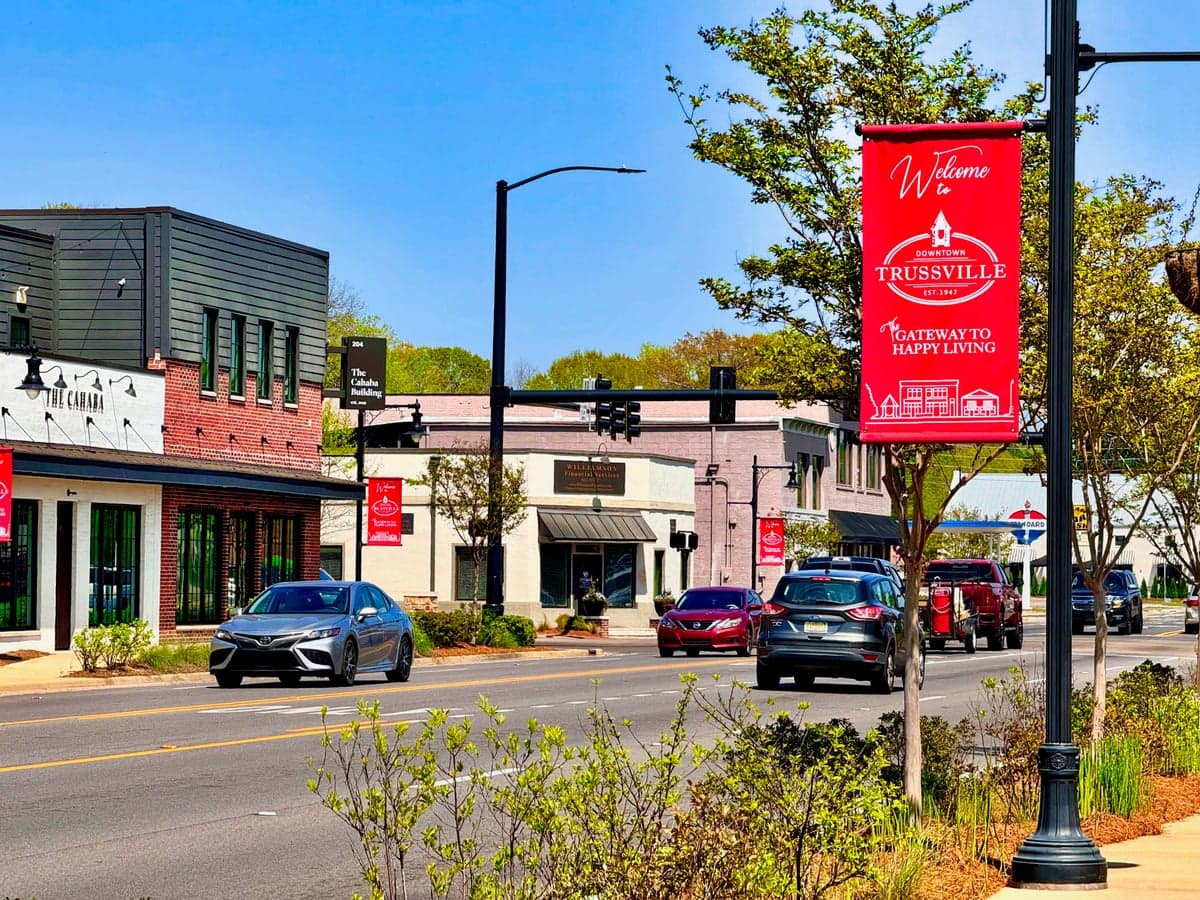
Photo: Wikipedia
Political ClimatePolitical Climate in Trussville, AL
District shown is the primary district for this city’s centroid. Cities may span multiple districts.
Local Political AnalysisPolitical Analysis of Trussville, AL
Trussville is about as solidly conservative as it gets in Alabama, and that’s not changing anytime soon. The Cook PVI sits at R+20, meaning the area votes about 20 points more Republican than the national average. In the 2024 election, Jefferson County as a whole went for Trump by a comfortable margin, but Trussville itself was even redder—think closer to 70-75% Republican in most precincts. The trajectory here is steady: folks moved out of Birmingham over the last decade looking for lower taxes, better schools, and less government nonsense, and they’re not about to let that slip away.
How it compares
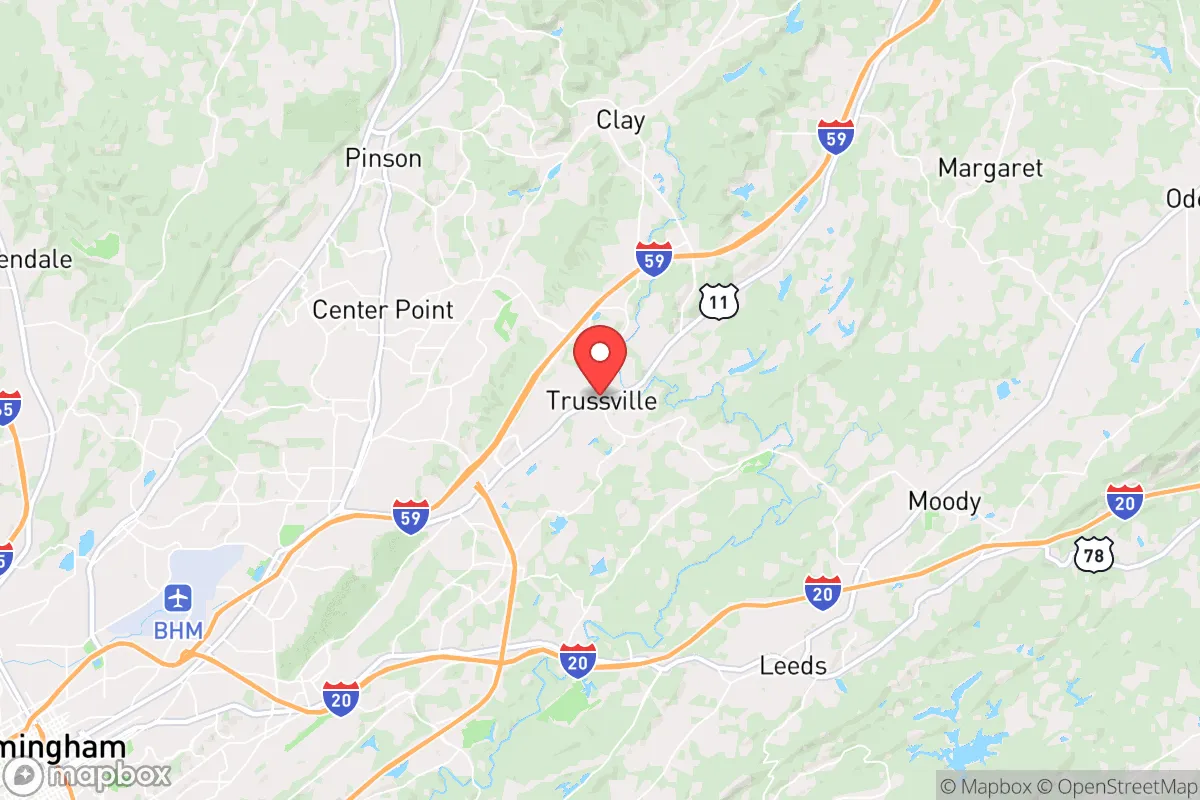
Drive 15 minutes south into downtown Birmingham, and you’re in a completely different world—politically, culturally, and economically. Birmingham’s Jefferson County government has been pushing progressive policies like higher minimum wages, more zoning regulations, and tax hikes for public transit projects that most Trussville residents see as wasteful. Meanwhile, Trussville keeps its own city council and school board firmly conservative, with no appetite for the kind of government overreach that’s creeping into larger cities. Compare that to nearby Hoover or Vestavia Hills, which are still red but have seen some purple creeping in over the last few cycles—especially in local school board races where progressive candidates have started showing up. Trussville hasn’t had that problem yet, and the local leadership is vigilant about keeping it that way. The contrast is stark: you can live in Trussville and basically ignore the nonsense coming out of Birmingham City Hall, but you can’t ignore it if you’re inside the city limits.
What this means for residents
For the people living here, the political climate translates directly into daily life. Property taxes are low compared to the rest of Jefferson County, and the city has resisted the urge to pile on new fees or regulations for small businesses. The school system is one of the best in the state, and it’s run by a board that focuses on academics and discipline, not social experiments. You won’t see mask mandates or critical race theory creeping into the curriculum here—parents made sure of that during the 2021 school board elections. The police department is well-funded and respected, and there’s no talk of defunding or reallocating resources. For a family that values personal freedom, low taxes, and a community that doesn’t try to micromanage your life, Trussville is a safe harbor. The downside? If you’re hoping for a more diverse political scene or a place where progressive ideas get a fair hearing, you’ll be disappointed. But for most residents, that’s a feature, not a bug.
Culturally, Trussville is still very much a “leave me alone” kind of place. The big policy fights here are about keeping development from turning into sprawl, maintaining the small-town feel, and making sure the city doesn’t get dragged into Jefferson County’s debt problems. There’s a strong sense of local control—people here trust their neighbors more than they trust the state or federal government. If you’re looking for a place where the government stays out of your business and the community looks out for each other, Trussville delivers. Just keep an eye on the city council meetings; every few years, someone tries to push a zoning change or a tax increase that sounds like a good idea on paper but usually ends up being a foot in the door for more regulation. So far, the residents have been good at shutting that down. Long-term, the concern is that as Birmingham’s problems spill further out—crime, traffic, higher taxes—Trussville will have to decide how much growth it can handle without losing what makes it work. For now, it’s holding strong.

State Political ClimatePolitical Climate in Alabama
State Political AnalysisPolitical Environment in the State
Alabama is a deeply conservative state, with Republicans holding every statewide elected office and supermajorities in both legislative chambers, a dominance that has only solidified over the past 20 years. The state has not voted for a Democratic presidential candidate since 1976, and in 2024, Donald Trump carried it by roughly 30 points. This partisan lean is driven by a coalition of rural and suburban voters who prioritize limited government, gun rights, and traditional values, though the state’s political landscape is not monolithic—pockets of blue in places like Birmingham and Montgomery create a sharp urban-rural divide that shapes every election cycle.
Urban vs. rural divide
The political map of Alabama is a study in contrast. The state’s largest metro, the Birmingham-Hoover area, is a Democratic stronghold, with Jefferson County consistently delivering 60%+ margins for Democrats. Montgomery, the capital, and the Black Belt counties stretching across the central part of the state—places like Selma, Lowndes County, and Greene County—are also reliably blue, driven by high African American voter turnout. Meanwhile, the rest of the state is overwhelmingly red. The fast-growing suburbs of Huntsville, particularly in Madison County, have shifted rightward as tech and defense workers move in, while Mobile and Baldwin County on the Gulf Coast are solidly Republican. Rural counties like DeKalb, Jackson, and Winston routinely vote 80%+ Republican. The divide is stark: in 2024, Jefferson County went for Kamala Harris by 18 points, while neighboring Shelby County, a wealthy Birmingham suburb, went for Trump by 25 points. This geographic split means that while Democrats can win local offices in urban centers, they have virtually no path to statewide victory without cutting into the rural vote—something that hasn’t happened in decades.
Policy environment
Alabama’s policy environment is among the most conservative in the nation, reflecting a deep skepticism of federal overreach. The state has no state income tax on wages for most residents—only a flat 5% on taxable income—and property taxes are among the lowest in the country, averaging about 0.4% of home value. This low-tax posture is a deliberate draw for businesses and retirees. Education policy is a mixed bag: the state passed the Alabama CHOICE Act in 2024, creating a universal school choice program that allows parents to use state funds for private or homeschool expenses, a major win for parental rights. However, public school funding remains below the national average, and teacher shortages are common in rural areas. Healthcare is a flashpoint: Alabama refused to expand Medicaid under the Affordable Care Act, leaving roughly 300,000 low-income adults in a coverage gap. On election integrity, the state passed a voter ID law in 2011 and has resisted mail-in ballot expansions, maintaining a system that conservatives argue is secure but critics call restrictive. The state also has some of the nation’s strictest abortion laws, with a near-total ban in effect since the 2022 Dobbs decision, and it has passed laws protecting gun rights, including permitless carry in 2022.
Trajectory & freedom
Alabama is trending toward more personal freedom in several key areas, though not without concerns. The 2022 permitless carry law, which allows any law-abiding adult to carry a concealed firearm without a permit, was a major expansion of Second Amendment rights. The 2024 CHOICE Act similarly expanded educational freedom, giving parents control over their children’s schooling. On medical freedom, the state has resisted COVID-19 vaccine mandates, with Governor Kay Ivey signing an executive order in 2021 prohibiting state agencies from requiring proof of vaccination. However, there are worrying signs of government overreach. The state’s medical cannabis program, passed in 2021, has been mired in legal battles and licensing delays, leaving patients without access. Property rights are generally strong, but the state’s heavy reliance on federal funding—about 40% of the state budget—creates vulnerability to federal strings. The biggest red flag for conservatives is the ongoing federal court intervention in Alabama’s congressional map, which has forced the creation of a second majority-Black district, diluting the state’s Republican advantage in the U.S. House. This judicial activism is a clear example of federal overreach that many residents view as an attack on state sovereignty.
Civil unrest & political movements
Alabama has seen relatively little civil unrest compared to other states, but there are active political movements on both sides. The Black Lives Matter protests in 2020 were largely peaceful, with the largest gatherings in Birmingham and Montgomery, but they did not escalate into the property destruction seen in other cities. On the right, the Alabama Citizens for Constitutional Freedom and similar groups have been vocal about election integrity, pushing for hand-counting of ballots and opposing electronic voting machines. Immigration politics are less heated than in border states, but the 2011 HB 56 law, which was one of the nation’s strictest anti-illegal immigration measures, remains a touchstone; parts were struck down in court, but the law’s legacy still influences local enforcement. There is a small but vocal secessionist movement, mostly online, but it has no real political traction. The most visible flashpoint for a new resident would be the ongoing debate over Confederate monuments, particularly in Montgomery and Birmingham, where statues have been removed or relocated amid heated public meetings. Overall, Alabama is a low-drama state politically, with most residents focused on daily life rather than street protests.
Projection
Over the next 5-10 years, Alabama is likely to become even more conservative, driven by in-migration from blue states and the continued growth of Huntsville and Baldwin County. Huntsville’s population has grown by over 20% since 2020, attracting tech workers and military families who tend to lean Republican. Baldwin County, including the beach towns of Gulf Shores and Orange Beach, is seeing a surge of retirees from the Midwest and Northeast, many of whom are fleeing high taxes and crime. This demographic shift will likely reinforce the state’s Republican supermajorities and push policy further right on issues like school choice and tax cuts. However, the federal court’s intervention in redistricting could eventually flip one or two U.S. House seats to Democrats, creating a more competitive congressional delegation. The biggest wildcard is the state’s healthcare system: without Medicaid expansion, rural hospitals continue to close, and the state’s health outcomes remain among the worst in the nation. If this crisis deepens, it could force a political realignment, but for now, the trajectory is clear: Alabama will remain a red state fortress, with a growing population of like-minded conservatives.
For a new resident, the bottom line is that Alabama offers a political environment where conservative values are the norm, not the exception. You’ll find low taxes, strong gun rights, and a government that generally stays out of your personal life—though you’ll also need to navigate a healthcare system with gaps and a public school system that varies wildly by district. If you’re moving from a blue state, expect a culture shock in the best way: neighbors who wave, churches on every corner, and a state government that sees your freedom as a priority. Just be prepared for the summer heat and the occasional federal judge telling you how to draw your maps.
* Values derived from national, state, county, city and local statistics and may differ in a specific area. Last updated: 2026-04-19T11:55:20.000Z
Narrative content on this page is AI-generated and may contain mistakes. Verify any details that matter before acting on them.
ReloMaps may earn a commission from affiliate links at no extra cost to you.

