Photo: Wikipedia
Demographics of Thackerville, OK
Affluence Level in Thackerville, OK
A below-average socioeconomic profile. Incomes, home values, and educational attainment trail the U.S., with higher poverty and unemployment.
People of Thackerville, OK
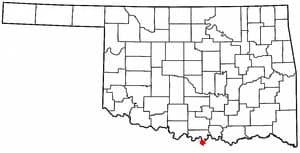
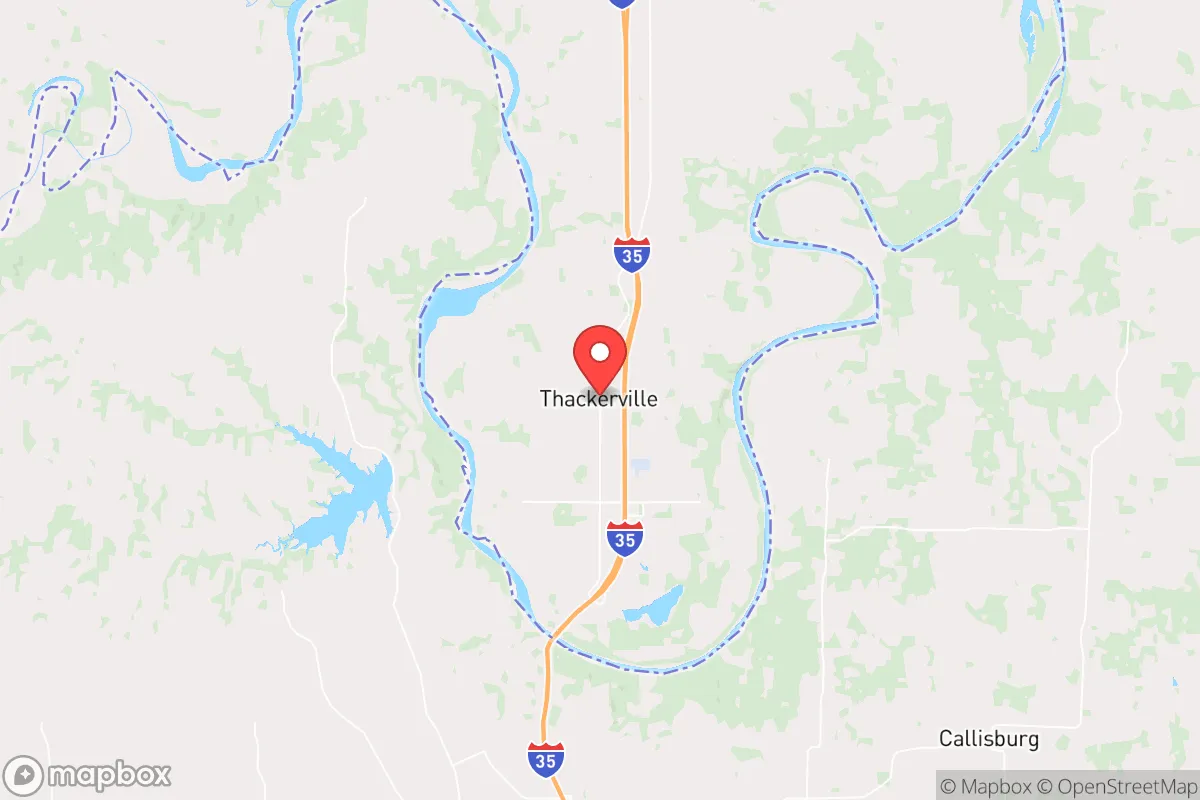
Today, Thackerville, Oklahoma, is a tiny, deeply rooted community of 487 residents, overwhelmingly White (82.5%) with a notable Hispanic minority (9.9%) and virtually no foreign-born population (0.6%). Its character is defined by its rural, border-town location on the Red River, a strong local economy anchored by the WinStar World Casino and Resort, and a population density so low that neighbors know each other by name. The city’s identity is a blend of Native American heritage, Southern frontier resilience, and a modern-day reliance on a single massive employer, making it a place where family ties and a quiet, self-reliant lifestyle dominate.
How the city was settled and grew
Thackerville’s human history begins not with European settlers, but with the Chickasaw Nation, who were forcibly relocated to this area during the 1830s under the Indian Removal Act. The town itself was officially founded in the late 19th century as a stop on the Missouri-Kansas-Texas Railroad, drawing a wave of Anglo-American homesteaders and merchants. The original settlement clustered around the railroad depot in what is now Old Town Thackerville, a historic district near the intersection of U.S. 77 and the railroad tracks. These early families—names like Thacker, from whom the town takes its name—were primarily farmers and ranchers, drawn by the promise of cheap land in the Chickasaw Nation’s leased district. A second, smaller wave arrived during the 1920s oil boom, settling in the Oil Field Flats area south of town, where roughnecks and their families lived in temporary camps that later became permanent homes. By 1950, the population had stabilized at around 350, a mix of White ranchers and a small number of Chickasaw families who remained on tribal allotments in the Indian Creek Bottom neighborhood along the river.
Modern era (post-1965)
The post-1965 era brought little of the immigration-driven change seen in larger cities. Thackerville’s foreign-born population remains negligible at 0.6%, and the city’s Black and Asian populations are zero. The most significant demographic shift has been the growth of the Hispanic community, which now stands at 9.9%. This wave began in the 1990s, driven by construction and service jobs at the expanding WinStar Casino. These families, largely of Mexican origin, settled in the Casino Corridor area along U.S. 77, where modest ranch-style homes and mobile home parks house casino workers and their children. Meanwhile, the White population—still the overwhelming majority—has aged in place in Heritage Acres, a quiet subdivision of 1970s-era homes on the north edge of town, and in the River Bend district, where multi-generational ranching families hold onto land that has been in their names for a century. The college-educated share is just 5.2%, reflecting a workforce that is heavily blue-collar and service-oriented, with most adults employed by the casino, local schools, or small-scale agriculture.
The future
Thackerville’s population is likely to remain small and stable, with modest growth tied entirely to the WinStar Casino’s expansion. The Hispanic share may continue to rise slowly as casino and hospitality jobs attract workers from nearby Texas towns, but the community is not tribalizing into distinct enclaves—rather, it is slowly integrating, with Hispanic children attending the same small schools and playing on the same sports teams as their White peers. The White population is aging, and without significant in-migration of young families, the town could see a slight decline in overall numbers over the next decade. The Indian Creek Bottom neighborhood, historically Chickasaw, has seen many families move away to larger tribal centers in Ada or Oklahoma City, leaving a smaller but still present Native community. There is no sign of growth in Asian or Black populations, and the foreign-born share is expected to remain below 1%.
For someone moving in now, Thackerville is becoming a quieter, more homogenous version of itself—a place where the casino economy provides steady work but little upward mobility, and where community life revolves around church, school, and family. It is not a place of rapid change or diversity, but of deep continuity, where a new resident will be welcomed if they respect the land, the local pace, and the unspoken rules of a small border town.

* Values derived from national, state, county, city and local statistics and may differ in a specific area. Last updated: 2026-04-19T21:17:12.000Z
Narrative content on this page is AI-generated and may contain mistakes. Verify any details that matter before acting on them.
ReloMaps may earn a commission from affiliate links at no extra cost to you.

