Photo: Wikipedia
Demographics of Gregg County
Affluence Level in Gregg County
A below-average socioeconomic profile. Incomes, home values, and educational attainment trail the U.S., with higher poverty and unemployment.
People of Gregg County
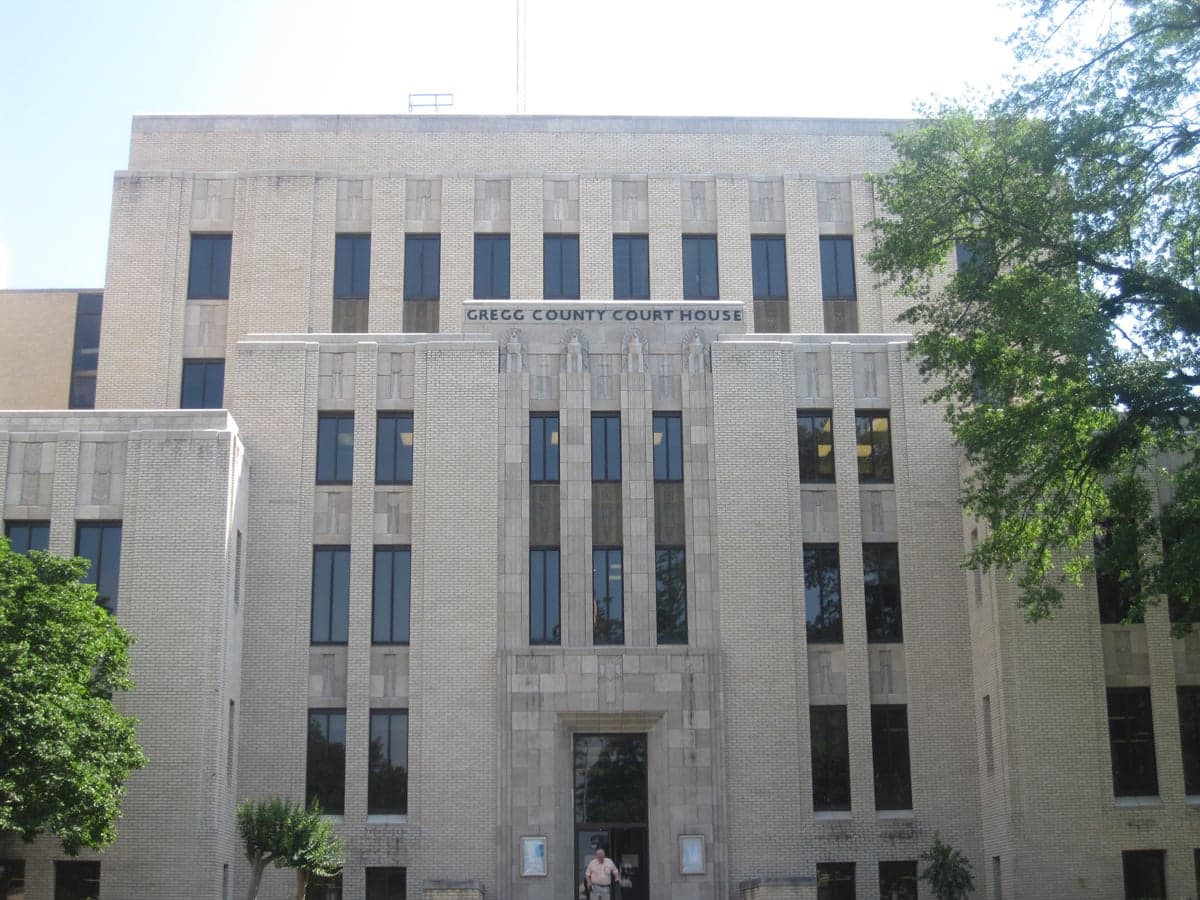
Today, Gregg County, Texas, is home to 124,860 residents who form a community shaped by the piney woods of East Texas and a deep-rooted industrial heritage. The population remains predominantly white (55.3%), with significant Black (19.2%) and Hispanic (19.8%) communities that trace their local histories back generations, creating a cultural landscape that prizes tradition and self-reliance. With a foreign-born population of just 5.9% and a college attainment rate of 22.4%, the county retains a working-class character that sets it apart from the fast-growing, white-collar suburbs of the Dallas-Fort Worth metroplex to the west.
Settlement & growth (pre-1960)
Before American settlement, the area that is now Gregg County was part of the homeland of the Caddo Confederacy, particularly the Hasinai bands who lived in settled villages along the Sabine River and its tributaries. Caddo populations were decimated by disease and displacement in the 18th and early 19th centuries, and by the time Anglo-American settlers arrived in significant numbers, the region was largely a sparsely inhabited pine forest. Spanish and Mexican land grants drew a few early families, but widespread settlement did not begin until after Texas joined the Union in 1845.
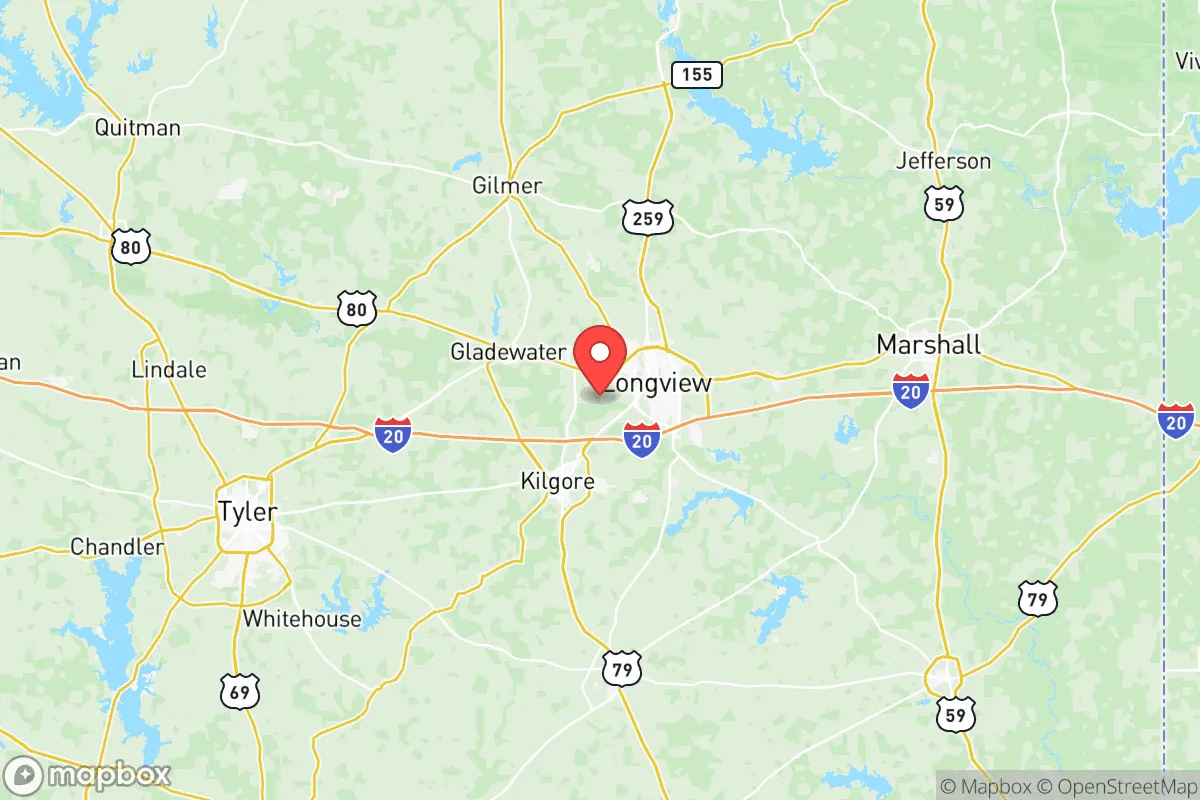
The primary wave of Anglo-American settlers came from the Upland South — Tennessee, Arkansas, Kentucky, and Missouri — between the 1840s and the 1870s. These were Scots-Irish and English homesteaders seeking cheap, timbered land for subsistence farming. They founded the earliest communities, including Longview (established 1870 as a railroad stop), Gladewater (a later oil-boom town), Kilgore (just over the county line in Gregg County's western slice), and the smaller rural settlements of Clarksville City and White Oak. The arrival of the Texas and Pacific Railway through Longview in the 1870s cemented the town's role as a regional trade hub for cotton and timber.
The single most transformative event in Gregg County's demographic history was the 1931 discovery of oil in the East Texas Oil Field. The field stretched across multiple counties, but Gregg County sat at its productive heart. Kilgore exploded from a village of a few hundred to a boomtown of over 10,000 within months. Thousands of white and Black migrants poured in from across the South — displaced tenant farmers, roughnecks, and speculators — creating a gusher-era society that was raw, violent, and overwhelmingly male. The Black population, which had been present since Reconstruction as farm laborers and sharecroppers, swelled as African American workers took on the most dangerous and lowest-paid jobs in the oil fields, settling in segregated neighborhoods like the "Brickyard" area of Kilgore and the Flanagan Addition in Longview. By 1940, the county's population had nearly doubled from its 1920 level, reaching roughly 55,000.
The post-World War II period saw a stabilization of this oil-field population. The boom gave way to a more disciplined petrochemical industry, with major employers like the Humble Oil refinery in Longview (later ExxonMobil) providing steady work. Suburban development began in earnest in the 1950s, with new housing tracts spreading outward from downtown Longview toward places like Spring Hill and along the road to Judson. The county's rural white population gradually shifted into town, while Black residents remained largely in defined urban neighborhoods and the small rural settlement of Easton.
Modern era (post-1965)
The 1965 Hart-Cellar Act had a relatively muted effect on Gregg County compared to major metropolitan areas. The foreign-born share remains low at 5.9%, and post-1965 immigration has been modest and specific. The most visible new population has been a small but growing Hispanic community, composed mostly of Mexican and Central American immigrants drawn to the construction, poultry processing, and landscaping industries. These families have concentrated in Longview's south and east sides, as well as in Kilgore, where a handful of Spanish-language churches and small tiendas have opened since the 1990s. The Hispanic share rose from under 5% in 1990 to 19.8% by 2025, a significant shift driven by both immigration and higher birth rates.
Domestic migration has had a clearer impact. Since the 1980s, Gregg County has received a steady trickle of white retirees and professionals from the Rust Belt — Ohio, Indiana, and Michigan — seeking lower taxes and a slower pace of life. This group has largely settled in the newer subdivisions of west Longview and around Lake O' the Pines, a reservoir created in the 1950s that has become a magnet for boating and lakefront homes. The county's Black population, which saw modest out-migration to Houston and Dallas in the 1960s and 1970s, has stabilized at 19.2%, supported by deep-rooted family ties and institutions like the historically Black churches in Longview and Kilgore.
Suburbanization has reshaped the county without producing the sprawling exurbs seen around Dallas. White Oak has evolved from a coal-mining hamlet into a bedroom community for Longview. Gladewater, once a boomtown of 10,000 during the 1930s oil peak, has declined to roughly 6,000 and now serves as a quiet residential and antiques-shopping destination. The East and Southeast Asian population remains tiny at just 0.9%, consisting mostly of a few dozen Vietnamese and Filipino families who arrived in the 1980s and 1990s, largely working in healthcare and engineering at Longview's hospitals and industrial plants. The Indian-subcontinent population is even smaller at 0.4%, with a handful of professionals in medicine and academia.
The future
Gregg County's demographic trajectory points toward gradual diversification rather than rapid transformation. The Hispanic share will likely continue rising, possibly reaching 25-28% by 2040, driven by second-generation growth and continued modest immigration. This growth will not create segregated, explicitly ethnic enclaves — the community is too small and the housing stock too integrated for that — but will instead be absorbed into existing neighborhoods, with Spanish becoming increasingly common in public spaces and local businesses. The white population, in absolute numbers, is likely to hold steady or decline slightly as births fail to outpace deaths, while the Black population is projected to remain stable at roughly 18-20%.
The county is not tribalizing into distinct ethnic enclaves in the manner of larger cities. Instead, it is experiencing a slow homogenization-by-assimilation, particularly among younger residents who attend integrated schools and share a common local culture centered on Friday night football, church, and hunting. In-migration from outside the South remains modest — the area lacks the job growth and amenities to attract large numbers of coastal transplants. The greatest demographic wildcard is the future of the regional economy: if the petrochemical industry contracts significantly, younger residents may leave for Houston or Dallas, accelerating an aging trend that would make the county older and less diverse.
For someone moving into this area now, Gregg County offers a community where the population is recognizably East Texan — Protestant, politically conservative, and shaped by the oil economy — but growing slowly more Hispanic and more suburban. The social fabric remains intact, held together by strong churches, extended families, and a shared sense of local identity. The county is not a melting pot in the cosmopolitan sense, but it is a place where distinct groups have learned to coexist with a minimum of friction over generations. A newcomer can expect to find a welcoming, neighborly atmosphere in which most residents share similar values, even as the faces in the grocery store slowly change.

* Values derived from national, state, county, city and local statistics and may differ in a specific area. Last updated: 2026-05-22T02:53:34.000Z
Narrative content on this page is AI-generated and may contain mistakes. Verify any details that matter before acting on them.
ReloMaps may earn a commission from affiliate links at no extra cost to you.

