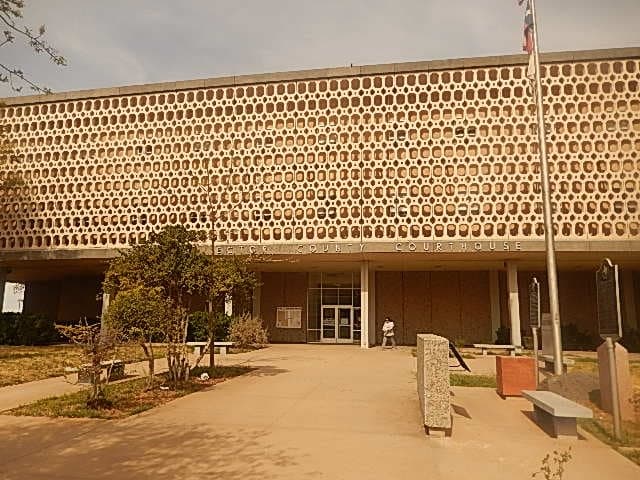
Photo: Wikipedia
Demographics of Ector County
Affluence Level in Ector County
A below-average socioeconomic profile. Incomes, home values, and educational attainment trail the U.S., with higher poverty and unemployment.
People of Ector County
Ector County, anchored by the city of Odessa, is home to 163,206 residents, a population defined by its strong Hispanic majority (62.3%) and a White non-Hispanic share of 30.0%. The county’s character is distinctly West Texan—rooted in the oil boom, ranching, and a working-class ethos—with a foreign-born population of 10.2% and a relatively young median age driven by family formation. Its people are notably less college-educated (16.6%) than the national average, reflecting an economy historically built on blue-collar energy and agricultural labor.
Settlement & growth (pre-1960)
Before American settlement, the land now comprising Ector County was part of the traditional territory of the Comanche and Apache nations, who followed bison herds across the Southern Plains. Spanish and Mexican expeditions passed through but established no permanent settlements; the region remained a sparsely populated frontier through the mid-19th century. The first Anglo-American ranchers arrived after the Texas annexation in 1845, but significant settlement did not begin until the Texas and Pacific Railway laid tracks through the area in 1881, founding the town of Odessa as a water stop and cattle-shipping point.
The county’s population exploded after the discovery of oil in the Permian Basin in the 1920s. The Santa Rita No. 1 well in 1923 triggered a rush of speculators, roughnecks, and wildcatters, many from the oil fields of Oklahoma, Kansas, and the Rust Belt. This first wave was overwhelmingly White and native-born, drawn by high wages and the promise of boomtown wealth. The Dust Bowl of the 1930s pushed additional migrants—often called “Okies” and “Arkies”—into Ector County, where they found work in the oil fields or on ranches. By 1940, Odessa’s population had reached 9,573, and the county was nearly 90% White, with a small Black community employed in domestic service and manual labor.
World War II and the subsequent Cold War deepened the county’s industrial base. The construction of Odessa Army Air Field (later Odessa-Schlemeyer Field) and the expansion of petrochemical refining brought a second wave of domestic migrants, including veterans and their families. The 1950s saw the rise of West Odessa as an unincorporated working-class suburb, while the town of Goldsmith (population roughly 300) remained a small agricultural and oil-service outpost. By 1960, Ector County’s population had surged to 90,995, still overwhelmingly White and native-born, with Hispanics comprising perhaps 10-15% of residents, mostly concentrated in Odessa’s south side.
Modern era (post-1965)
The 1965 Hart-Cellar Act fundamentally reshaped Ector County’s demographics, though the change was slower than in coastal cities. The primary driver of modern diversity has been domestic migration from the Rio Grande Valley and northern Mexico, not overseas immigration. From the 1970s onward, Hispanic families moved into Odessa and Gardendale (a small community north of the city) seeking oil-field jobs and lower housing costs. By 1990, the county’s Hispanic share had risen to roughly 35%, and by 2020 it had become the majority at 62.3%.
The foreign-born population today stands at 10.2%, with the vast majority being first-generation immigrants from Mexico and Central America. These newer arrivals tend to settle in Odessa’s older neighborhoods near the downtown core and along the Interstate 20 corridor, where affordable housing and Spanish-language services are concentrated. Unlike in many Texas metros, there is no significant East/Southeast Asian enclave (0.8%) or Indian-subcontinent community (0.3%) in Ector County; these groups are present in very small numbers, mostly as professionals in the energy sector or healthcare. The Black population (4.7%) is largely native-born and concentrated in Odessa’s east side, a legacy of mid-century oil-field migration from East Texas and Louisiana.
The post-1965 period also saw the rise of suburban-style development in South Odessa and along the Highway 191 corridor, where newer, larger homes attracted White and Hispanic middle-class families alike. The 2010s oil boom (the Permian Basin’s second major surge) brought a fresh wave of domestic migrants from Colorado, North Dakota, and other energy states, many of whom settled temporarily in man camps or apartment complexes near Penwell and Notrees, small unincorporated communities west of Odessa. This boom-bust cycle has kept the county’s population volatile: it peaked at 166,223 in 2019 before dipping slightly during the 2020 oil-price crash.
The future
Ector County is projected to become more Hispanic over the next two decades, driven by higher birth rates among Hispanic families and continued domestic migration from South Texas and Mexico. The White non-Hispanic share is likely to decline further, possibly to 20-25% by 2040, while the Black and Asian shares may grow modestly as the energy sector diversifies and healthcare expands. The foreign-born percentage is expected to remain stable or rise slightly, as oil-field labor demand continues to attract immigrants from Latin America.
New residential development is concentrating in West Odessa and the unincorporated areas along Highway 191, where master-planned communities are being built to accommodate growth. The county’s cultural identity is evolving from a historically Anglo-dominated oil town to a bilingual, bicultural region where Hispanic traditions—from quinceañeras to local Spanish-language media—are mainstream. However, the county remains politically conservative, with voters consistently supporting Republican candidates, reflecting the working-class values shared across ethnic lines.
For someone moving in now, Ector County offers a straightforward choice: it is a place where the oil economy still dominates, where family and church are central, and where the population is becoming younger and more Hispanic with each passing year. The county’s future is one of continued demographic transition, but its core identity—hardworking, resilient, and deeply tied to the land and the rig—shows no sign of fading.

* Values derived from national, state, county, city and local statistics and may differ in a specific area. Last updated: 2026-06-09T01:27:21.000Z
Narrative content on this page is AI-generated and may contain mistakes. Verify any details that matter before acting on them.
ReloMaps may earn a commission from affiliate links at no extra cost to you.

