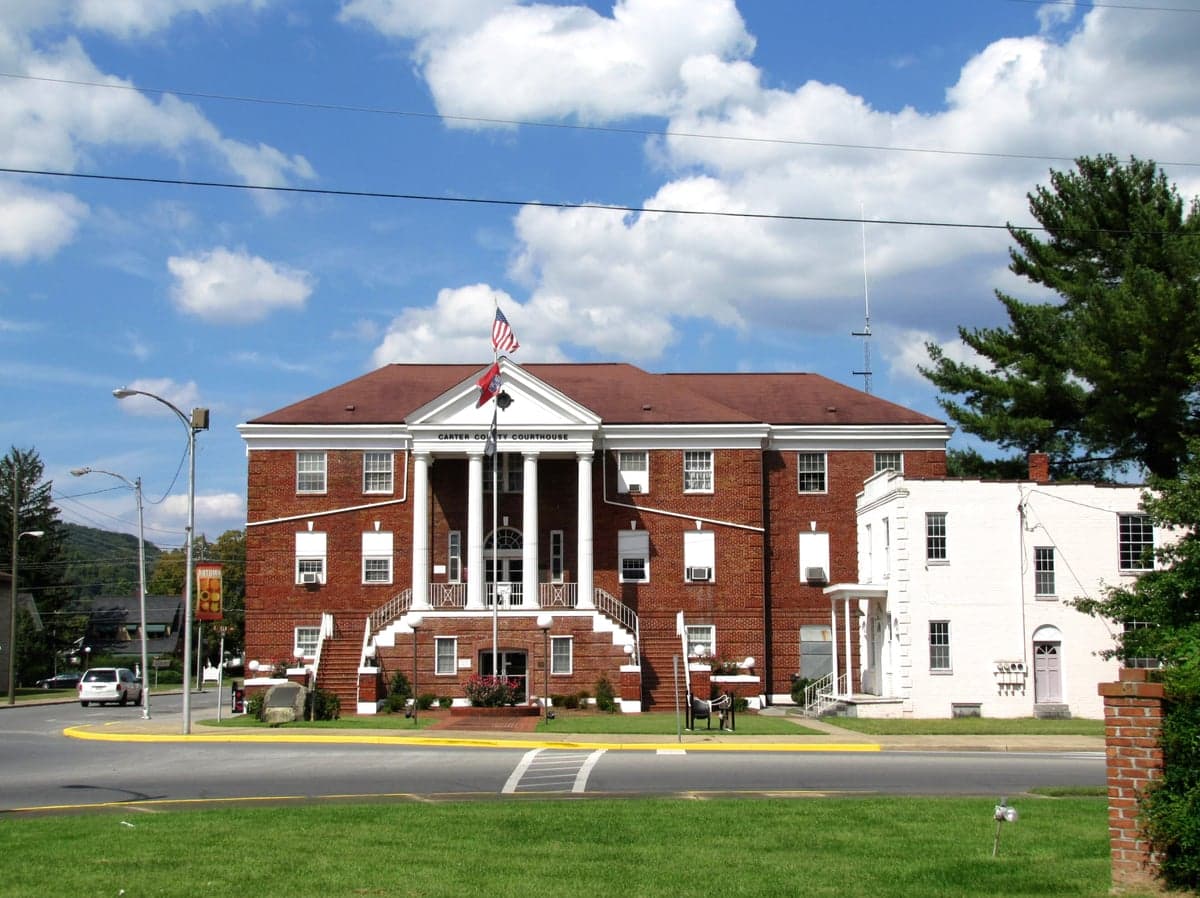
Photo: Wikipedia
Demographics of Carter County
Affluence Level in Carter County
A below-average socioeconomic profile. Incomes, home values, and educational attainment trail the U.S., with higher poverty and unemployment.
People of Carter County
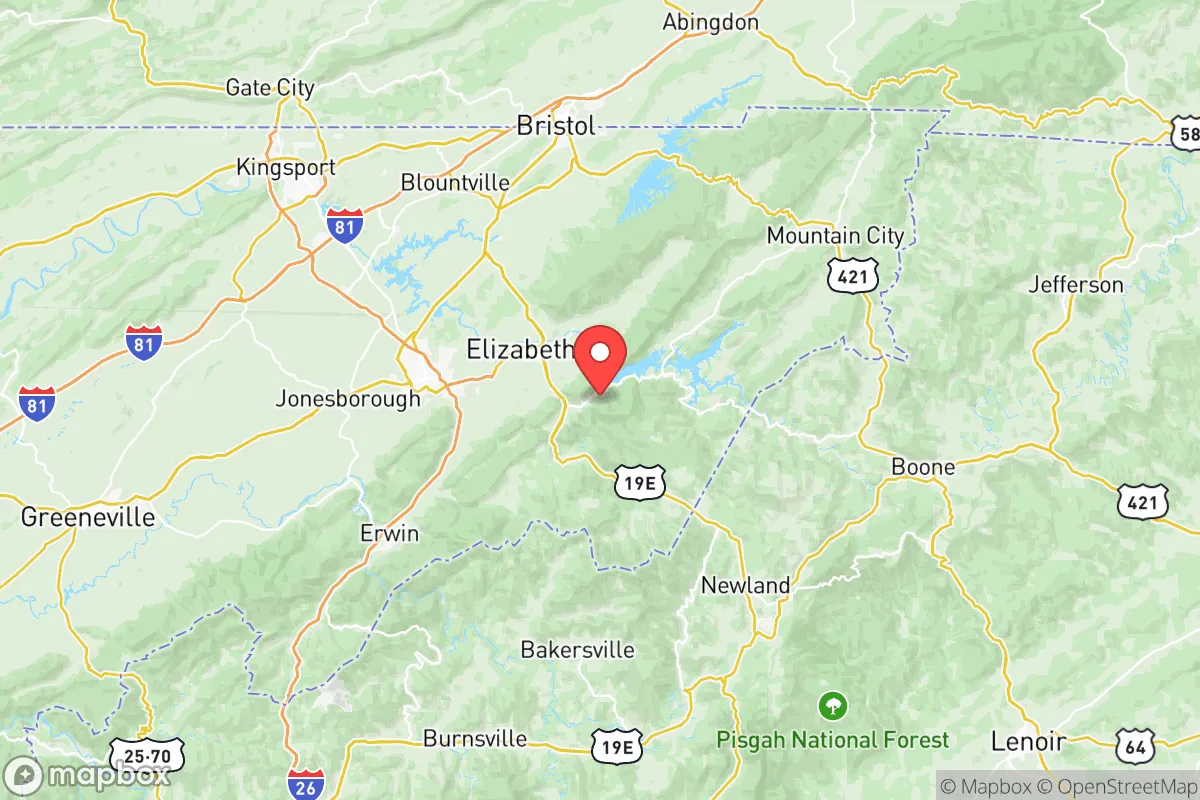
Carter County, Tennessee, is home to 56,462 residents who form one of the most ethnically homogeneous populations in the state, with 93.3% identifying as white and only 1.5% foreign-born. This is a deeply rooted Appalachian community where family lineages often stretch back to the 18th century, and the dominant cultural identity remains distinctly Southern Appalachian—shaped by Scots-Irish heritage, Baptist and Methodist traditions, and a self-reliant, conservative worldview. The population is spread across the county seat of Elizabethton, the small city of Johnson City (which extends into the county), and numerous unincorporated communities like Roan Mountain, Hampton, and Watauga, with a population density of roughly 140 people per square mile—rural but not remote.
Settlement & growth (pre-1960)
Long before European settlement, the area that is now Carter County was part of the hunting grounds of the Cherokee Nation, who used the Watauga River Valley and the highlands around Roan Mountain seasonally. The first permanent white settlers arrived in the late 1760s and 1770s, primarily Scots-Irish Presbyterians pushing westward from Virginia and North Carolina through the Watauga and Holston River valleys. These were frontier families—often landless younger sons of Ulster Scots—who claimed land under the Watauga Association, a self-governing compact that predated Tennessee statehood. The settlement of Elizabethton began in 1769, making it one of the oldest Anglo-American communities west of the Appalachian crest.
The early 19th century brought a second wave of Scots-Irish and English settlers, drawn by the promise of affordable land in the newly formed Carter County (1796). These families established farms along the Doe River and the Watauga River, founding communities like Hampton (originally a mill town) and the scattered hamlets of Stoney Creek and Valley Forge. The iron industry became a major economic pull: the Cranberry Iron Works, established in the 1820s near what is now Roan Mountain, attracted skilled ironworkers and laborers from England and Wales, though most remained native-born Americans. By 1850, the county's population had reached roughly 5,000, overwhelmingly white and native-born, with a small number of enslaved African Americans (about 8% of the population in 1860, concentrated in Elizabethton and along the Watauga River bottomlands).
The post-Civil War era saw little new immigration. The county's economy shifted from iron to timber and subsistence agriculture, and the population grew slowly through natural increase. The arrival of the East Tennessee and Western North Carolina Railroad (the "Tweetsie") in the 1880s connected Elizabethton and Hampton to regional markets, but it did not trigger a wave of foreign immigration. Instead, the railroad enabled local families to ship timber and later, in the 1920s, to commute to new factory jobs. The single largest demographic event of the 20th century was the construction of the Tennessee Valley Authority's Watauga Dam (completed 1948) and Wilbur Dam (1912), which flooded large tracts of farmland and displaced hundreds of families, many of whom relocated to Elizabethton or left the county entirely. By 1960, Carter County's population stood at about 42,000, still 98% white and native-born, with a small African American community concentrated in Elizabethton's "The Hill" neighborhood.
Modern era (post-1965)
The 1965 Hart-Cellar Act had almost no effect on Carter County. The foreign-born population today is just 1.5%, and the county has not developed any immigrant enclaves. The modest Hispanic population (2.4%) is largely a product of domestic migration—primarily Mexican-American families moving from Texas and the Southwest for work in construction, landscaping, and poultry processing at plants in nearby Johnson City and Greeneville. These families are dispersed across the county, with small clusters in Elizabethton and Hampton, but no distinct ethnic neighborhood has formed. The Black population (2.0%) is also largely native-born, with roots in the pre-1960 community; there has been no significant Black in-migration from the Great Migration or later waves.
The most consequential demographic shift since 1965 has been domestic out-migration of young adults and the simultaneous in-migration of retirees and second-home buyers. From the 1970s through the 1990s, Carter County lost many of its college-bound and job-seeking young people to Knoxville, Nashville, and Charlotte. At the same time, the natural beauty of the Roan Mountain area and the Watauga Lake region began attracting retirees from Florida, Ohio, and Michigan, who built homes in gated communities and lakefront subdivisions around Hampton and Roan Mountain. This trend accelerated after 2000, as the county's low cost of living and relatively low crime rates appealed to conservative-leaning families from the Northeast and Midwest. The population grew from 51,356 in 1990 to 56,462 in 2020, a modest 10% increase, driven almost entirely by domestic in-migration of white retirees and remote workers.
Suburbanization has been limited. Elizabethton remains the commercial and civic center, but its population has stagnated at roughly 14,000. The fastest-growing area is the southern edge of the county, adjacent to Johnson City, where new subdivisions have attracted commuters who work at East Tennessee State University or the Johnson City Medical Center. This area—roughly along U.S. Highway 321 and State Route 91—has seen the most new construction, but it remains overwhelmingly white and native-born.
The future
Carter County is likely to become slightly more diverse over the next 10-20 years, but the change will be incremental. The Hispanic share of the population is projected to rise to 4-5% by 2040, driven by continued domestic migration of Mexican-American families and a small number of Central American workers in the poultry and construction industries. The Asian population (currently 0.3%) may grow modestly as a handful of East Asian professionals—engineers, professors, medical staff—are drawn to jobs at East Tennessee State University or the VA Medical Center in Johnson City, but no Asian enclave is expected to form. The Black population will likely remain stable at 2-3%, as there are no strong pull factors for Black in-migration.
The dominant trend will be continued white domestic in-migration, particularly of retirees and remote workers from higher-cost states. The county's cultural identity—conservative, religious, and rooted in Appalachian traditions—will persist, but it may soften slightly as newcomers bring different political and social expectations. The population will continue to concentrate in the southern corridor near Johnson City and around Watauga Lake, while the more remote areas like Roan Mountain and Stoney Creek will see slower growth or slight decline as young people leave and the remaining population ages.
For someone moving in now, Carter County is becoming a place where the old Appalachian character is preserved but gradually blending with a more transient, amenity-seeking population. It remains one of the whitest and least diverse counties in Tennessee, and that is unlikely to change dramatically. The draw is not urban energy or ethnic variety, but low cost of living, mountain scenery, and a pace of life that feels increasingly rare in the broader United States.

* Values derived from national, state, county, city and local statistics and may differ in a specific area. Last updated: 2026-10-05T13:01:46.000Z
Narrative content on this page is AI-generated and may contain mistakes. Verify any details that matter before acting on them.
ReloMaps may earn a commission from affiliate links at no extra cost to you.

