Photo: Wikipedia
Demographics of Tahlequah, OK
Affluence Level in Tahlequah, OK
A low-income area with significant economic hardship. Household wealth and educational attainment are well below national averages.
People of Tahlequah, OK
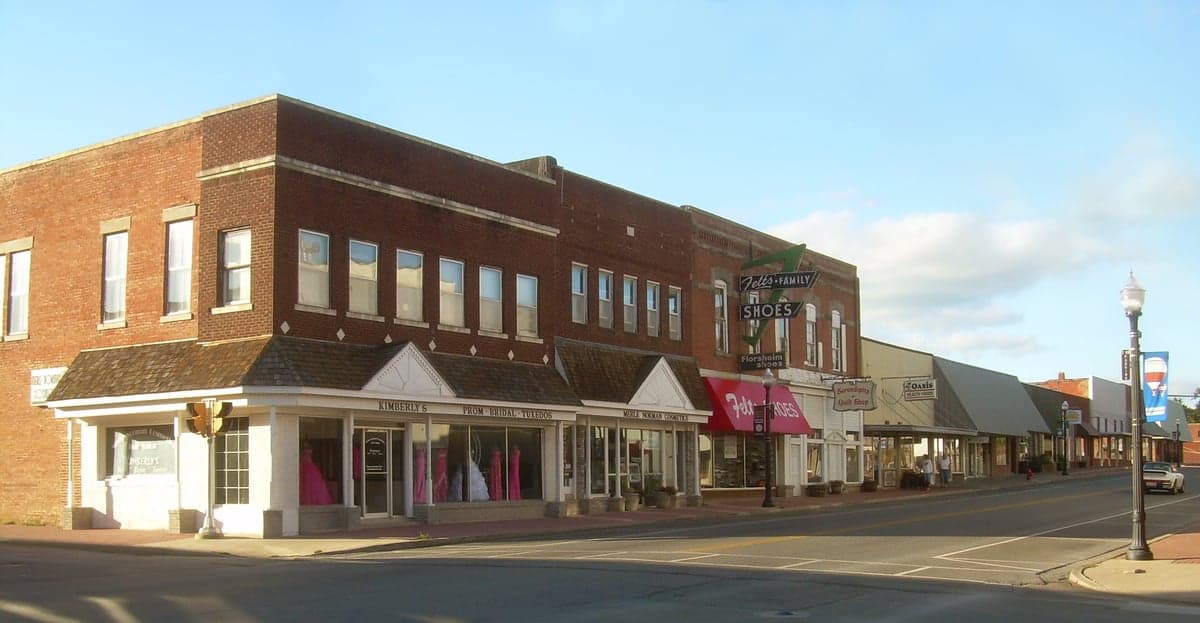
The people of Tahlequah, Oklahoma are defined by a unique dual identity: the city serves as the capital of the Cherokee Nation and is home to a population that is 43.7% White, 2.9% foreign-born, and 9.3% Hispanic, with a college attainment rate of 34.9%. With a population of 16,513, Tahlequah is a small, culturally dense city where Cherokee sovereignty, university life, and a growing service economy intersect. The city’s character is neither a typical Oklahoma small town nor a suburban bedroom community—it is a tribal capital and college town where Native identity, local government, and Northeastern State University (NSU) shape daily life.
How the city was settled and grew
Tahlequah was founded in 1839 as the capital of the Cherokee Nation following the Trail of Tears, when the Cherokee people were forcibly relocated from the southeastern United States. The original population was overwhelmingly Cherokee, with the town laid out around a central square that remains the historic and commercial heart of the city. The Cherokee National Capitol building, now the Cherokee Nation Judicial Branch, anchors the downtown historic district, where the earliest Cherokee families built homes and government offices. By the late 19th century, a small number of White traders and missionaries settled in the Goingsnake District area, a historic Cherokee judicial district that now encompasses parts of western Tahlequah. The arrival of the railroad in the early 1900s brought a modest wave of White and Black settlers, who established homes in the Park Hill neighborhood, a historic area just south of downtown that became a hub for non-Native families. Through the mid-20th century, Tahlequah remained predominantly Cherokee and White, with the population growing slowly as NSU (founded in 1846 as the Cherokee National Female Seminary) expanded and attracted faculty and students from across the region.
Modern era (post-1965)
After the 1965 Hart-Cellar Act, Tahlequah saw only a small increase in foreign-born residents, with the current foreign-born share at just 2.9%. The most significant demographic shift since the 1970s has been the growth of the Hispanic population, now at 9.3%, driven by labor demand in construction, hospitality, and the Cherokee Nation’s expanding health and casino sectors. Hispanic families have concentrated in the Southridge area, a newer residential district south of the NSU campus, and in the Thompson Corner neighborhood near the Cherokee Nation’s W.W. Hastings Hospital. The Black population remains small at 2.3%, with most Black residents living in the Eastside neighborhood, a historically integrated area near the Cherokee Nation’s administrative offices. East and Southeast Asian residents (0.6%) and Indian subcontinent residents (0.3%) are a very small presence, primarily faculty and medical professionals associated with NSU and the Cherokee Nation Health Services. The White population, while still the largest single group at 43.7%, has declined relative to the growing Hispanic and Cherokee populations, as many White families have moved to newer subdivisions in Pebble Creek and Woodland Hills on the city’s northern and western edges.
The future
Tahlequah’s population is heading toward a more tri-ethnic composition of Cherokee, White, and Hispanic residents, with the Cherokee Nation’s sovereignty and economic growth acting as the primary drivers. The Hispanic share is likely to continue rising, as the Cherokee Nation’s casino and health sectors create steady demand for service workers, and as housing costs in nearby Muskogee push families north. The foreign-born share may increase modestly but will remain low, as Tahlequah lacks the industrial base or refugee resettlement programs that drive immigration in larger Oklahoma cities. The White population is expected to continue a slow decline in share, as younger White residents leave for college or jobs in Tulsa or Oklahoma City, while the Cherokee population remains stable due to tribal citizenship and cultural ties. The city is not tribalizing into distinct ethnic enclaves—neighborhoods remain relatively mixed—but the downtown historic district is becoming more Cherokee-centric, with tribal government offices and cultural centers, while the Pebble Creek and Woodland Hills subdivisions are predominantly White and Hispanic. Over the next 10-20 years, Tahlequah will likely become a more Hispanic-influenced Cherokee capital, with a stable but shrinking White minority.
For someone moving in now, Tahlequah offers a small-city experience where Cherokee Nation governance and NSU dominate the economy and culture. The population is stable and growing slowly, with a clear trajectory toward greater Hispanic representation and continued Cherokee political dominance. New residents should expect a community where tribal sovereignty is the central fact of civic life, and where the cost of living remains low relative to the rest of the state.

* Values derived from national, state, county, city and local statistics and may differ in a specific area. Last updated: 2026-04-25T13:51:00.000Z
Narrative content on this page is AI-generated and may contain mistakes. Verify any details that matter before acting on them.
ReloMaps may earn a commission from affiliate links at no extra cost to you.

