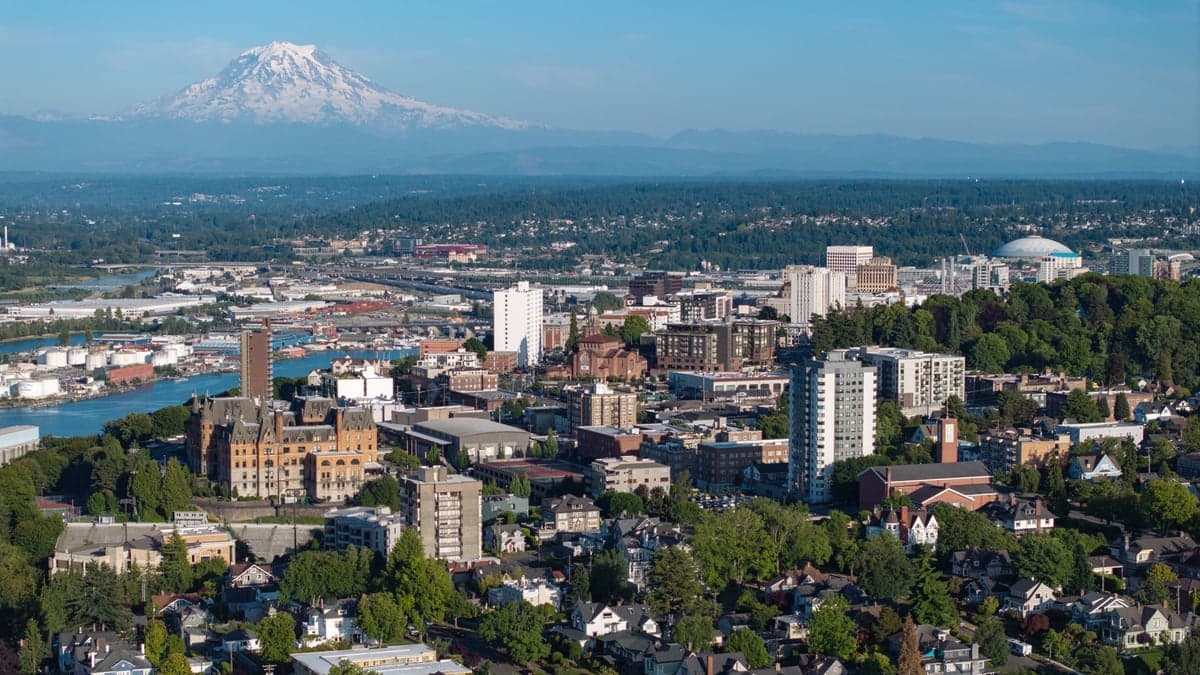
Photo: Wikipedia
Personal Sovereignty in Tacoma, WA
Viable for self-reliance. Generally workable, though some barriers may limit total independence.
What does Personal Sovereignty tell us?
Personal Sovereignty measures your capacity for self-reliance and independence with minimal government friction. Higher scores mean fewer barriers between you and the way you want to live... but it assumes you have the space you need and good neighbors.
What does this tell us?
Personal Sovereignty measures your capacity for self-reliance and independence with minimal government friction. Higher scores mean fewer barriers between you and the way you want to live... but it assumes you have the space you need and good neighbors.
State Policy
Energy independence: Importer (55% of energy produced in-state)
Personal Liberty
Homesteading

Personal Liberty Analysis
Tacoma, Washington, presents a complex and often contradictory environment for personal sovereignty, one that demands careful scrutiny from anyone prioritizing autonomy, self-reliance, and minimal government overreach. While the Pacific Northwest carries a reputation for rugged individualism, the reality on the ground in Tacoma is heavily shaped by Washington State’s aggressively progressive legislative agenda, which consistently erodes local control and individual freedoms. For the strategic relocator—whether a single prepper or a family seeking to insulate themselves from state-level overreach—Tacoma offers a few tactical advantages in its geography and community networks, but these are constantly under pressure from a state government that views personal sovereignty as an obstacle to be managed rather than a right to be protected. The net assessment is that Tacoma sits within a state that ranks among the most restrictive in the nation for gun rights, parental autonomy, and economic freedom, making it a location where sovereignty must be actively defended rather than assumed.
Tax burden and regulatory climate for individuals and small operators
Washington State’s tax structure is a double-edged sword for those seeking financial sovereignty. The lack of a state income tax is a significant advantage, allowing earners to keep more of their gross income—a rare bright spot in a high-cost region. However, this is offset by some of the highest combined state and local sales tax rates in the country, with Tacoma’s rate hovering around 10.1% as of 2025. This effectively functions as a regressive consumption tax that hits daily purchases hard. Property taxes in Pierce County are moderate compared to the Seattle metro core, but they have risen steadily, tracking with the state’s insatiable appetite for funding public-sector expansion. More concerning for the sovereignty-minded is the regulatory posture. Washington operates under a strict State Environmental Policy Act (SEPA) that can be weaponized by neighbors or activist groups to delay or kill any development, from a backyard workshop to a small farm operation. The state’s Business and Occupation (B&O) tax, which taxes gross receipts rather than profit, punishes small operators and side hustles—a direct disincentive to the kind of informal economy that builds true self-reliance. For anyone trying to operate a small-scale trade or homestead business, the paperwork and compliance costs are a hidden tax on personal initiative.
Self-defense rights and Washington's restrictive gun laws
This is the most critical sovereignty battleground in Tacoma. Washington State has, in the last few years, enacted a comprehensive assault weapons ban (HB 1240), a ban on standard-capacity magazines over ten rounds (HB 1143), and a mandatory 10-day waiting period for all firearm purchases. These laws, passed without a public vote, represent a direct legislative assault on the Second Amendment and the principle of armed self-defense. Tacoma itself is a city with significant violent crime challenges—property crime rates are well above national averages, and gang-related shootings are a persistent issue—yet the state has simultaneously disarmed law-abiding citizens of the most effective tools for personal and home defense. Concealed carry is still shall-issue, but the training requirements have been made more onerous, and permit wait times can stretch for months in Pierce County. The practical reality for a survivalist mindset is that you will be legally limited to a 10-round magazine and a roster of approved handguns and manually operated rifles. Building a defensive capability here requires navigating a hostile legal framework, and any future legislative session could bring further restrictions. This is not a state that respects the individual's right to determine their own security.
Self-reliance, homesteading viability, and off-grid feasibility
Tacoma’s urban and suburban zoning presents a mixed picture for those seeking a self-reliant lifestyle. Standard residential lots in the city proper are typically 5,000 to 7,000 square feet, which severely limits any meaningful food production or livestock. City code restricts chickens (hens only, no roosters) and outright bans goats, pigs, or any large livestock within city limits. For a serious homesteading operation, you must look to unincorporated Pierce County or the more rural outskirts like Graham, Eatonville, or the Key Peninsula, where zoning allows for acreage and livestock. Even there, the state’s water rights laws are restrictive—rainwater collection is legal but regulated, and any well drilling requires a permit that can be difficult to obtain for non-primary residences. Off-grid living is functionally illegal in most of the county, as building codes require connection to the electrical grid and adherence to state energy codes that make solar-only setups a bureaucratic nightmare. The state’s Growth Management Act forces dense development patterns, making it increasingly difficult to find affordable land where you can truly live by your own rules. The best bet for a prepper is to find a property with existing infrastructure outside the Urban Growth Boundary, but prices for such parcels have skyrocketed as others flee the city core.
Personal liberties: parental rights, medical autonomy, speech, and property
On parental rights, Washington State is among the most aggressive in the nation in asserting state authority over children. The state’s "gender-affirming care" laws explicitly allow minors to receive hormone therapy and surgical interventions without parental consent in certain circumstances, and the state has declared itself a "sanctuary" for such procedures, actively shielding providers from out-of-state legal actions. This represents a profound erosion of the family as the primary unit of authority. Medical autonomy for adults is also under threat, with the state maintaining strict vaccine mandates for healthcare workers and school attendance, and a general public health apparatus that showed during the pandemic it was willing to use emergency powers to compel compliance. Free speech is constitutionally protected, but the state’s political culture is overwhelmingly left-leaning, and social or professional consequences for expressing dissenting views on topics like immigration, gender, or public health are real and can be severe. Property rights are weak—the state’s regulatory takings doctrine is hostile to landowners, and the Shoreline Management Act gives the government broad authority over any property near water. Eminent domain is used freely for transit and development projects. In short, the individual in Tacoma operates at the pleasure of the state, not as a sovereign actor.
In the final analysis, Tacoma offers a tactical location—proximity to military bases, a deep-water port, and diverse terrain for bug-out scenarios—but the strategic environment is hostile to personal sovereignty. Compared to states like Idaho, Montana, or even eastern Oregon, Washington is a high-control jurisdiction where the government actively works to reduce individual autonomy in the name of collective safety and equity. For the survivalist or conservative relocator, Tacoma is a place to be from, not a place to dig in. If you must be here for work or family, the play is to keep a low profile, build strong local networks of like-minded individuals, and maintain a clear exit plan. The sovereignty you can carve out here will be hard-won and constantly contested.

* Values derived from national, state, county, city and local statistics and may differ in a specific area. Last updated: 2026-04-21T11:00:53.000Z
Narrative content on this page is AI-generated and may contain mistakes. Verify any details that matter before acting on them.
ReloMaps may earn a commission from affiliate links at no extra cost to you.

