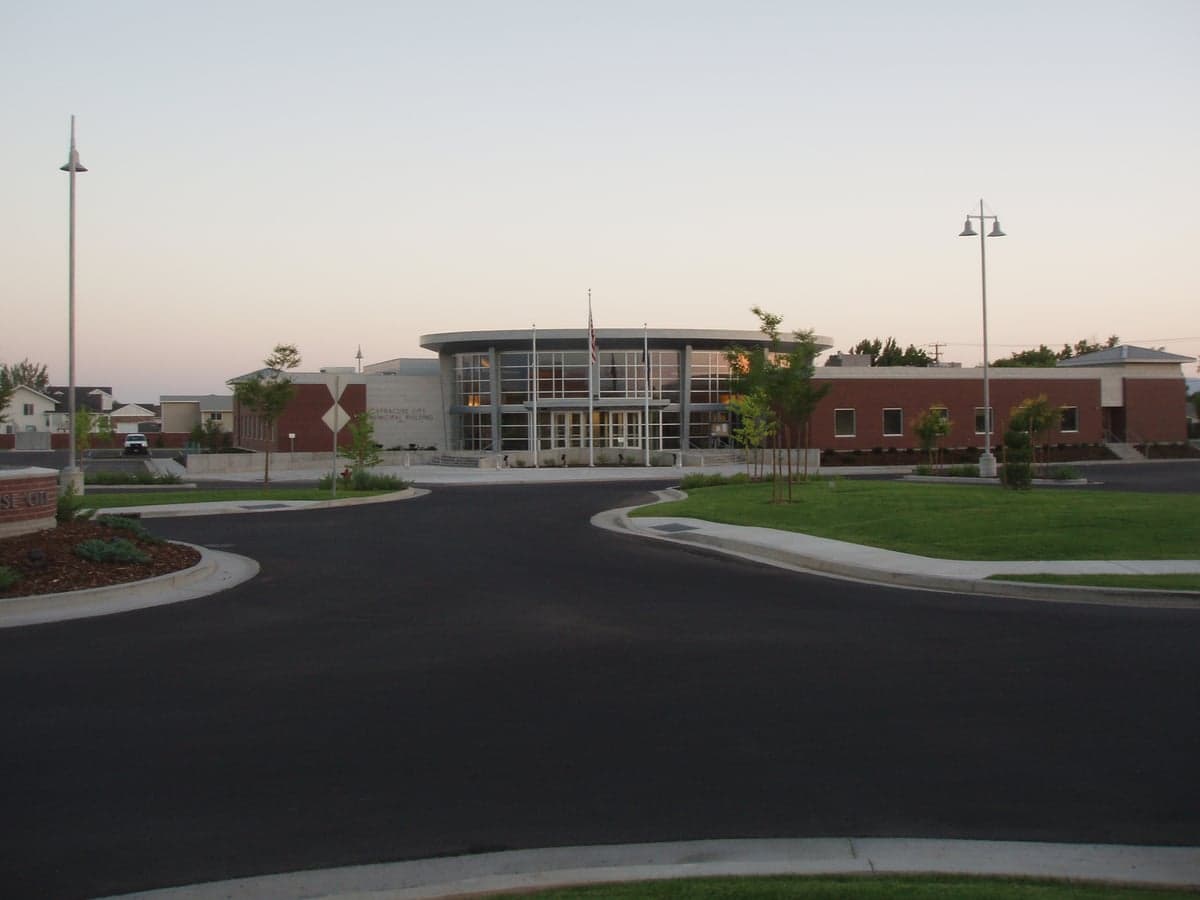
Photo: Wikipedia
Personal Sovereignty in Syracuse, UT
Viable for self-reliance. Generally workable, though some barriers may limit total independence.
What does Personal Sovereignty tell us?
Personal Sovereignty measures your capacity for self-reliance and independence with minimal government friction. Higher scores mean fewer barriers between you and the way you want to live... but it assumes you have the space you need and good neighbors.
What does this tell us?
Personal Sovereignty measures your capacity for self-reliance and independence with minimal government friction. Higher scores mean fewer barriers between you and the way you want to live... but it assumes you have the space you need and good neighbors.
State Policy
Energy independence: Self-sufficient (80% of energy produced in-state)
Personal Liberty
Homesteading

Personal Liberty Analysis
Syracuse, Utah, offers a notably high degree of personal sovereignty compared to many other Wasatch Front suburbs, largely due to Utah’s strong state-level preemption laws and a local culture that prizes self-reliance. While no city is a libertarian utopia, Syracuse provides a legal and social environment where residents can largely live as they see fit, with minimal interference from local government on issues like firearms, property use, and family decisions. The key trade-off is that this autonomy exists within a growing, family-oriented community that still enforces standard municipal codes, meaning you won’t find complete freedom from zoning or noise ordinances, but you will find a government that generally stays out of your personal business.
Tax burden and regulatory posture: How Utah’s fiscal conservatism protects your wallet
Utah’s tax structure is a major pillar of personal sovereignty in Syracuse. The state levies a flat income tax of 4.65% (as of 2025), with no progressive brackets that penalize higher earners. Property taxes in Davis County are among the lowest in the state, with Syracuse’s effective rate hovering around 0.6% of assessed value—significantly less than in neighboring Weber County or most of California or the Northeast. There is no state-level estate tax or inheritance tax, meaning you can pass assets to heirs without the government taking a cut. On the regulatory front, Utah is a right-to-work state, and Syracuse does not impose any local business licensing beyond basic state requirements for most home-based operations. The city’s planning department is known for being pragmatic rather than obstructionist, with building permits typically issued within a few weeks for standard projects. This low-tax, low-red-tape environment gives residents more disposable income and freedom to invest in their own property and preparedness efforts without bureaucratic friction.
Self-defense and gun law specifics: Constitutional carry and castle doctrine in Syracuse
For those prioritizing the right to self-defense, Syracuse sits in one of the most firearm-friendly states in the nation. Utah is a constitutional carry state, meaning any law-abiding adult 21 or older can carry a concealed firearm without a permit. Syracuse itself has no local ordinances that restrict magazine capacity, firearm types, or storage requirements—state preemption law (Utah Code 53-5a-102) explicitly prohibits cities from enacting their own gun control measures. The state’s castle doctrine is strong: there is no duty to retreat in your home, vehicle, or place of business, and you are legally presumed to have acted in self-defense if an intruder unlawfully enters. Stand-your-ground laws extend to any place you have a legal right to be. The Davis County Sheriff’s Office, which patrols Syracuse, is known for a pro-Second Amendment stance and does not engage in “red flag” enforcement beyond what state law mandates. For preppers, this means you can store firearms and ammunition without fear of local confiscation orders or storage mandates, though you should still be mindful of federal laws regarding NFA items.
Self-reliance and homesteading viability: Lot sizes, zoning, and off-grid feasibility
Syracuse’s zoning and lot sizes offer moderate opportunities for self-reliance, though it’s not a rural homesteading paradise. Most residential lots in established neighborhoods range from 0.25 to 0.5 acres, with newer developments often squeezing to 0.15 acres. However, the city’s agricultural zone (A-1) still exists on the western edge near the Great Salt Lake, where lots can be 1-5 acres and allow for chickens, goats, and even small livestock with a permit. Backyard chickens are allowed in most residential zones, but roosters are prohibited, and coop setbacks apply. Gardening is unrestricted, and many residents maintain substantial vegetable plots. Off-grid living is effectively impossible within city limits: Syracuse requires connection to municipal water and sewer, and solar panels must be grid-tied per Rocky Mountain Power’s interconnection agreement. Rainwater collection is legal but limited to 2,500 gallons per property without a water right. For serious preppers, the best bet is to buy in the unincorporated areas of western Davis County, just outside Syracuse’s jurisdiction, where well water, septic systems, and larger parcels are still available. Within town, you can be self-reliant in food production and energy efficiency, but you’ll remain tied to municipal infrastructure.
Personal liberties: Parental rights, medical autonomy, speech, and property
Utah’s legal framework strongly protects parental rights, and Syracuse reflects that culture. The state’s “Parental Rights in Education” laws require schools to notify parents of any curriculum changes and allow opt-outs for sensitive topics. Medical autonomy is robust: Utah does not mandate COVID-19 or childhood vaccines for school attendance (though religious exemptions are available for those that are required), and the state has banned gender-affirming surgeries for minors. Free speech is protected under both the U.S. and Utah constitutions, and Syracuse has no local ordinances restricting political signage or public assembly beyond standard time-place-manner rules. Property rights are reinforced by Utah’s strict eminent domain laws, which require “public use” (not just “public benefit”) and full market-value compensation. The city’s planning department is generally deferential to property owners, with variances for fences, sheds, and home businesses often approved if they don’t impact neighbors. One notable limitation: Syracuse enforces a strict noise ordinance after 10 p.m., and off-road vehicles are restricted to designated trails, so don’t expect to run a generator or ATV late at night without a warning.
Overall, Syracuse ranks as a strong choice for those seeking personal sovereignty within a suburban framework. It lacks the complete autonomy of rural Utah counties like Box Elder or Juab, where you can truly live off-grid and shoot on your own land, but it offers a far more permissive environment than cities like Salt Lake City or Park City. The combination of constitutional carry, low taxes, strong parental rights, and a pragmatic local government makes Syracuse a solid base for a prepared, self-reliant lifestyle—provided you accept the trade-offs of municipal water, grid-tied power, and suburban lot sizes. For a conservative-leaning individual or family who wants to live free without moving to the middle of nowhere, Syracuse delivers a rare balance of liberty and community.

* Values derived from national, state, county, city and local statistics and may differ in a specific area. Last updated: 2026-04-21T12:57:51.000Z
Narrative content on this page is AI-generated and may contain mistakes. Verify any details that matter before acting on them.
ReloMaps may earn a commission from affiliate links at no extra cost to you.

