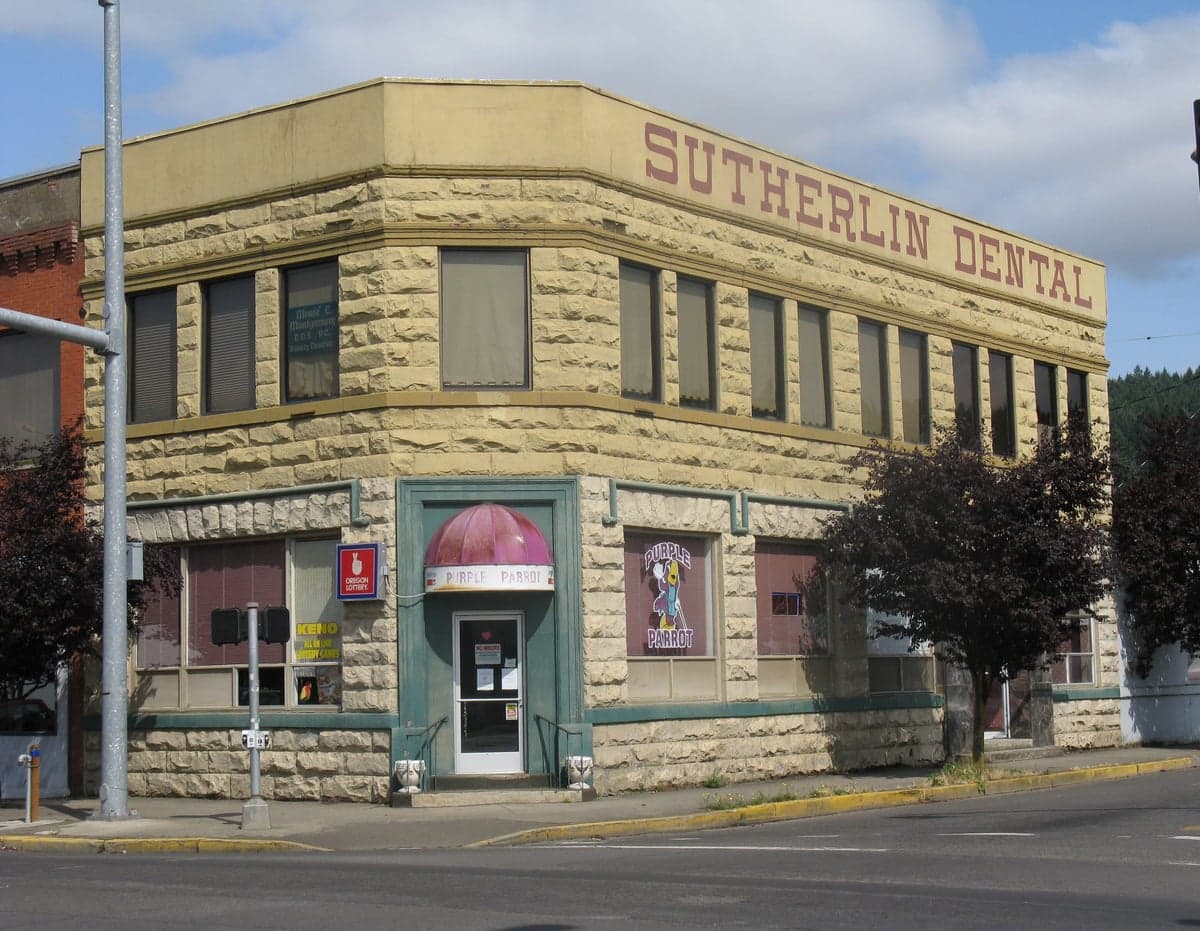
Photo: Wikipedia
Demographics of Sutherlin, OR
Affluence Level in Sutherlin, OR
A middle-class area roughly in line with national averages across income, home values, education, and employment.
People of Sutherlin, OR
The people of Sutherlin, Oregon, today form a small, predominantly white community of 8,574 residents, characterized by a notably low foreign-born population of just 0.1% and a college attainment rate of 15.7%. The city’s identity is rooted in its working-class timber and railroad history, with a population that is 91.5% white, 2.0% Hispanic, 1.3% Black, and 0.2% East/Southeast Asian. This is a place where generational roots run deep, and newcomers often find a quiet, rural lifestyle centered on the Umpqua River and nearby outdoor recreation.
How the city was settled and grew
Sutherlin’s human history begins not with colonial settlement but with the arrival of the Oregon & California Railroad in the 1880s, which transformed a sparsely populated area into a railroad town. The city was officially platted in 1911 and named after F. A. Sutherlin, a local landowner. The first major wave of settlers were white homesteaders and railroad workers, many of whom built homes in the Historic Downtown Sutherlin district, near the depot and along Central Avenue. These early residents were drawn by the promise of land under the Donation Land Claim Act and later by jobs in the region’s booming timber industry. By the 1920s, a second wave of white migrants from the Midwest and other parts of Oregon arrived to work in the sawmills and planing mills, settling in the East Sutherlin neighborhood, where modest worker cottages still stand. The city’s population remained overwhelmingly white and native-born through the mid-20th century, with the 1950 census recording fewer than 1,500 residents, almost all of European descent.
Modern era (post-1965)
After the 1965 Hart-Cellar Act, Sutherlin saw virtually no increase in foreign-born residents, a pattern that continues today with a foreign-born share of just 0.1%. Instead, the modern era has been defined by domestic in-migration from other parts of Oregon and the Pacific Northwest, particularly retirees and families seeking affordable housing. The West Sutherlin area, near the Umpqua River, absorbed many of these newcomers in the 1970s and 1980s, with new subdivisions like Riverbend Estates attracting white middle-class families. The city’s racial composition has remained remarkably stable: the Hispanic share grew from negligible to 2.0% by 2020, and the Black population rose to 1.3%, with most Black and Hispanic residents concentrated in the South Sutherlin neighborhood, near the industrial zone along Highway 99. The East/Southeast Asian population (0.2%) is tiny and dispersed, with no distinct ethnic enclave. The Indian subcontinent population is 0.0%. The city’s low college attainment rate (15.7%) reflects the enduring dominance of blue-collar employment in timber, manufacturing, and local services.
The future
Demographic projections suggest Sutherlin will remain a predominantly white, native-born community for the foreseeable future, with only modest diversification. The Hispanic share may rise to 3-4% by 2040, driven by agricultural and service-sector jobs in Douglas County, but the foreign-born population is unlikely to exceed 1%. New residential development is concentrated in the North Sutherlin area, near the new high school and along the I-5 corridor, where subdivisions like Cedar Ridge are attracting younger families from the Eugene-Springfield metro area. These newcomers are slightly more diverse—some are mixed-race couples or Hispanic—but the overall cultural identity remains rooted in rural, working-class values. The city’s population is aging, with a median age of 45.3, and the next decade will likely see continued slow growth (0.5-1% annually) as retirees and remote workers are drawn by lower housing costs compared to the Willamette Valley.
For someone moving in now, Sutherlin offers a stable, low-diversity community where the pace of life is slow and the social fabric is built on long-standing local ties. The city is not becoming a melting pot, but it is gradually absorbing a thin layer of new residents from elsewhere in Oregon, which may slowly shift its cultural identity toward a more suburban, less timber-dependent character. The bottom line: Sutherlin is a place for those who value quiet, affordability, and a population that largely shares a common background, with the understanding that demographic change will be incremental, not transformative.

* Values derived from national, state, county, city and local statistics and may differ in a specific area. Last updated: 2026-07-30T14:16:47.000Z
Narrative content on this page is AI-generated and may contain mistakes. Verify any details that matter before acting on them.
ReloMaps may earn a commission from affiliate links at no extra cost to you.

