Photo: Wikipedia
Demographics of Sun Prairie, WI
Affluence Level in Sun Prairie, WI
A middle-class area roughly in line with national averages across income, home values, education, and employment.
People of Sun Prairie, WI
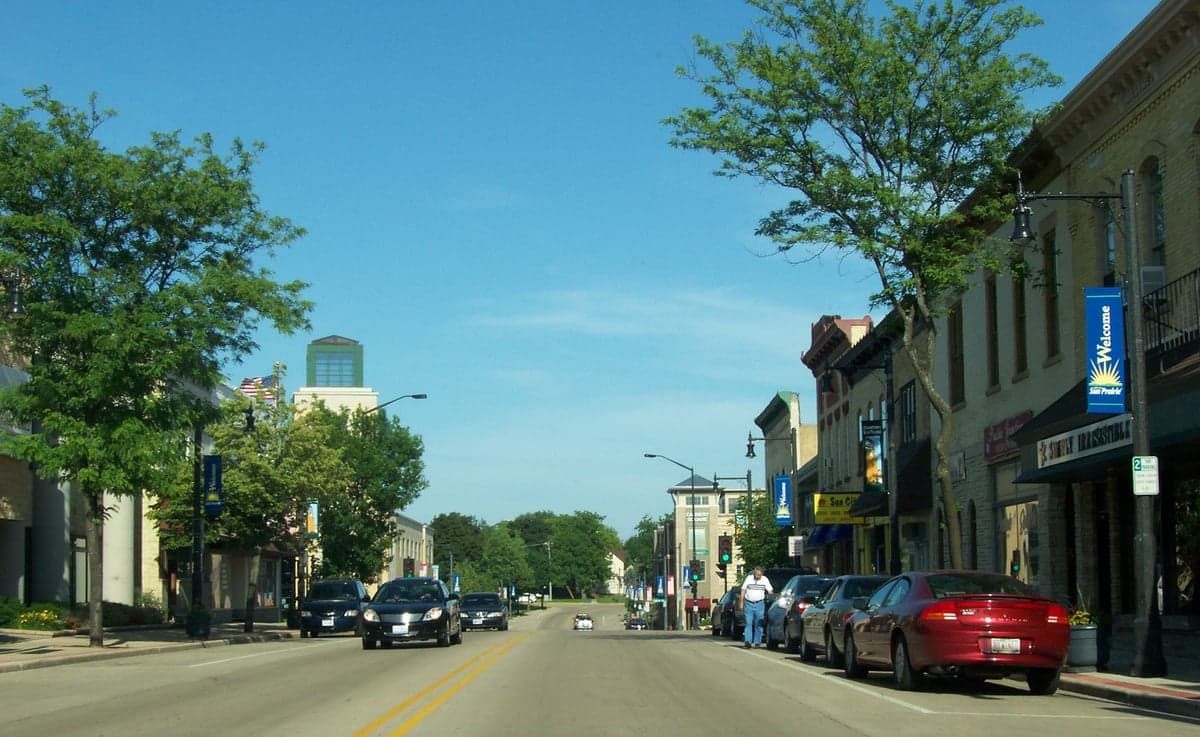
The people of Sun Prairie, Wisconsin, today number 36,455, forming a predominantly white (74.9%) and college-educated (50.9%) community that blends small-town roots with suburban growth. The city’s identity is shaped by a strong sense of civic pride, anchored by its historic downtown and a rapidly expanding residential footprint. While still overwhelmingly white, Sun Prairie has become notably more diverse since 2000, with growing Black (8.2%), Indian subcontinent (3.7%), East/Southeast Asian (3.6%), and Hispanic (4.6%) populations. This is a community where long-time German and Irish Catholic families live alongside newer immigrant and professional arrivals, creating a dynamic that is both welcoming and quietly traditional.
How the city was settled and grew
Sun Prairie’s human history begins with the Ho-Chunk and Potawatomi peoples, who used the area as hunting grounds before European-American settlement. The first permanent white settlers arrived in the 1830s and 1840s, drawn by the fertile glacial soils of the Yahara River valley. These were primarily Yankee migrants from New England and New York, who established farms and a small village center. The arrival of the Milwaukee and St. Paul Railroad in 1853 transformed the hamlet into a shipping point for grain and livestock. The original settlement clustered around what is now the Historic Downtown district, centered on Main Street and Columbus Street. By the late 19th century, German and Irish Catholic immigrants began arriving, drawn by railroad construction and agricultural labor. They settled in the South Side neighborhoods near the rail yards and St. Albert the Great parish, establishing a distinct working-class Catholic identity that persists today. A smaller wave of Scandinavian (Norwegian and Swedish) farmers arrived in the 1880s-1900s, settling on the northern and western fringes, an area now part of the Northside and Westside subdivisions. The population remained under 2,000 until after World War II.
Modern era (post-1965)
The post-1965 era brought dramatic change. The Immigration and Nationality Act of 1965 opened doors for non-European immigration, but Sun Prairie’s first major modern demographic shift was domestic: white flight from Madison and the expansion of the Madison metropolitan area. From the 1970s through the 1990s, Sun Prairie absorbed thousands of middle-class white families seeking larger lots, newer schools, and lower taxes. This suburban boom filled the Prairie Lakes and Prairie Hills subdivisions with single-family homes. The city’s population surged from 4,000 in 1970 to over 20,000 by 2000. The first significant non-white arrivals were Black families, many relocating from Chicago and Milwaukee for manufacturing and service jobs; they concentrated in the Eastside neighborhoods near the industrial parks off Highway 151. The 1990s and 2000s saw the arrival of East/Southeast Asian communities (primarily Hmong and Vietnamese), drawn by chain migration and employment at the nearby Oscar Mayer plant and Epic Systems. They settled in the Westside and Prairie Lakes areas. The most recent wave, beginning around 2010, is Indian subcontinent professionals (engineers, IT workers, healthcare professionals) employed at Epic Systems in Verona and UW Health in Madison. They have concentrated in the newer Prairie Hills and Westside subdivisions, where larger homes and top-rated schools are located. The Hispanic population (4.6%) is largely Mexican-American, with roots in agricultural labor and construction, and is dispersed across the city, with a small cluster near the South Side industrial corridor.
The future
Sun Prairie’s population is heading toward continued diversification, but the pattern is one of tribalization into distinct enclaves rather than wholesale integration. The white share has declined from roughly 90% in 2000 to 74.9% today, a trend that will likely continue as the city adds 1,000-1,500 new residents annually. The Indian subcontinent community (3.7%) is the fastest-growing group, driven by high-skilled immigration and a high birth rate; it is projected to reach 5-6% by 2035. The East/Southeast Asian population (3.6%) is stable or slowly growing, with second-generation Hmong and Vietnamese families assimilating into the broader middle class. The Black population (8.2%) is growing modestly, primarily through domestic migration from Chicago and Milwaukee. The Hispanic population (4.6%) is growing steadily through both immigration and natural increase. The city is not homogenizing; rather, Prairie Hills and Westside are becoming majority-Asian and Indian professional enclaves, while Eastside and South Side remain more working-class and Black/Hispanic. The Historic Downtown and Northside remain overwhelmingly white and older. The next 10-20 years will likely see Sun Prairie become a majority-minority city by 2040-2045, but with strong economic and educational stratification along neighborhood lines.
For someone moving in now, Sun Prairie is becoming a diverse, economically stratified suburb where opportunity is tied to neighborhood and school attendance boundaries. The city offers excellent schools, low crime, and a strong tax base, but the social fabric is increasingly fragmented by income and ethnicity. New arrivals should research specific neighborhoods carefully, as the experience of living in Prairie Hills (highly educated, Asian/Indian, affluent) is very different from the South Side (working-class, Black/Hispanic, older housing stock). The city’s trajectory is toward a more diverse, but not necessarily more integrated, future.

* Values derived from national, state, county, city and local statistics and may differ in a specific area. Last updated: 2026-04-21T10:26:24.000Z
Narrative content on this page is AI-generated and may contain mistakes. Verify any details that matter before acting on them.
ReloMaps may earn a commission from affiliate links at no extra cost to you.

