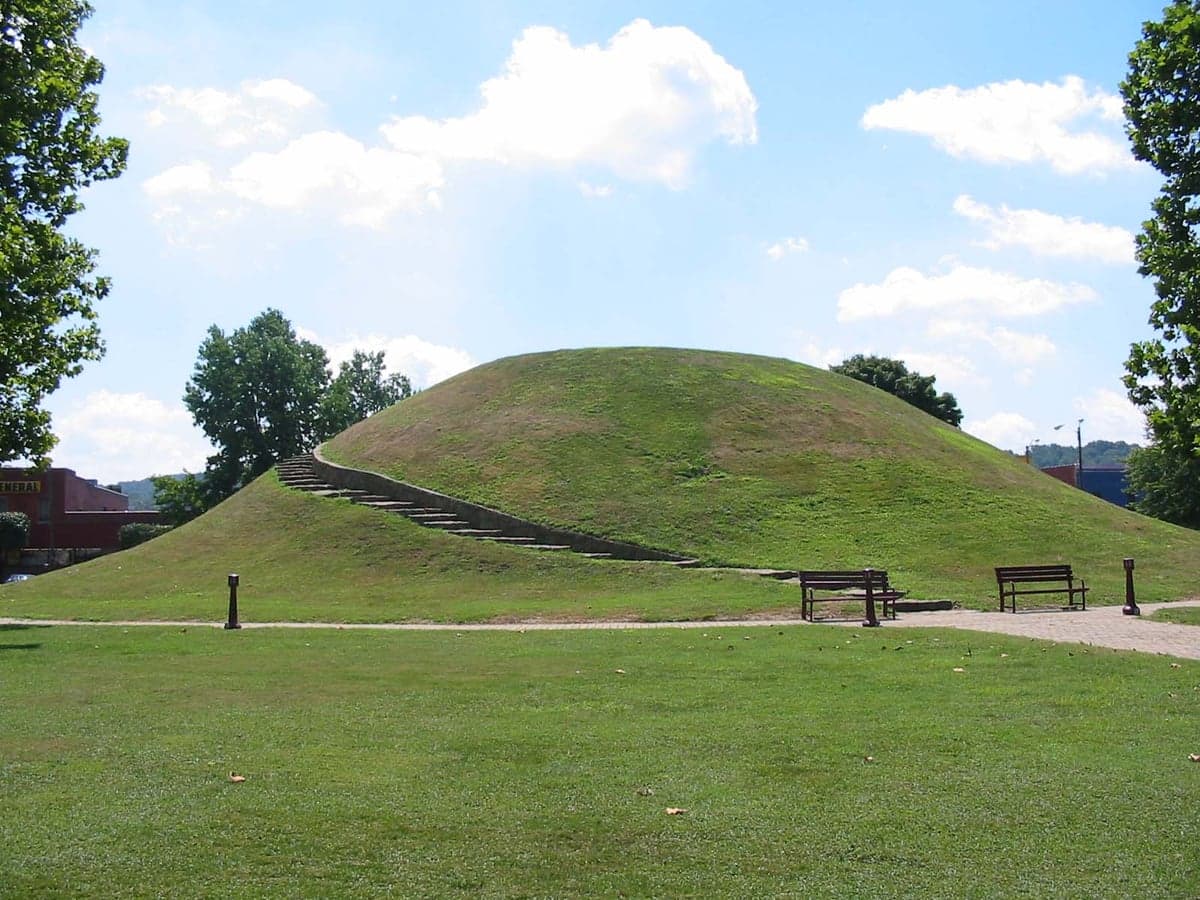
Photo: Wikipedia
Demographics of South Charleston, WV
Affluence Level in South Charleston, WV
A below-average socioeconomic profile. Incomes, home values, and educational attainment trail the U.S., with higher poverty and unemployment.
People of South Charleston, WV
South Charleston, West Virginia, is a city of 13,594 residents that remains predominantly white (84.9%) with a small but established Black community (7.4%) and minimal foreign-born presence (0.2%). Its population density and character reflect a working-to-middle-class Kanawha Valley suburb that has held steady through deindustrialization, with a college-educated share of 35.3% that slightly trails the national average. The city’s identity is rooted in its industrial past and its role as a stable, family-oriented alternative to the state capital across the river.
How the city was settled and grew
South Charleston was not a colonial-era settlement but a product of the late 19th and early 20th centuries, when the Kanawha Valley’s natural gas and coal fields drew heavy industry. The city incorporated in 1919, built around the massive Libbey-Owens-Ford glass plant and later Union Carbide’s chemical complex. The original population was overwhelmingly native-born white workers from the surrounding Appalachian region, many of whom settled in the Montrose and Jefferson neighborhoods, where modest frame houses still line the streets. A smaller wave of Black workers arrived during the World War I and World War II industrial booms, finding employment in the plants and establishing a community concentrated in the Riverside area near the Kanawha River. By 1950, South Charleston’s population peaked near 19,000, with a nearly all-white, native-born character and a strong unionized workforce.
Modern era (post-1965)
After the 1965 Hart-Cellar Act, South Charleston saw virtually no new immigration—its foreign-born share today is just 0.2%, one of the lowest in any U.S. city of its size. The post-1965 story is instead one of domestic out-migration and suburban consolidation. As the chemical industry downsized from the 1970s onward, younger families left for larger metros, and the city’s population declined by roughly 30% from its peak. The Black population, which had been as high as 10-12% in the 1970s, settled into the Oakwood and Riverside neighborhoods, while white residents remained dominant in Montrose, Jefferson, and the newer Greenbrier subdivision built in the 1960s and 1970s. The city’s Hispanic share (1.2%) and East/Southeast Asian share (0.9%) are negligible, largely consisting of a few families employed at the remaining industrial sites or at nearby Charleston-area hospitals. The Indian-subcontinent population (0.6%) is similarly tiny, with no distinct enclave.
The future
South Charleston’s demographic trajectory points toward continued stability and gradual homogenization. The city is not experiencing significant immigration or ethnic diversification; the foreign-born share is statistically zero, and the Black population has held steady at 7-8% for decades without major growth. The white share, while still dominant, is aging—the median age is above 40—and younger residents are more likely to move to Charleston’s eastern suburbs or out of state entirely. No single neighborhood is tribalizing into a distinct ethnic enclave; instead, the city is becoming more uniformly white and native-born, with the small Black community concentrated in Oakwood and Riverside but not expanding. The next 10-20 years will likely see a slow population decline to around 12,000-12,500, with the remaining residents being older homeowners and a modest number of families attracted by the city’s low housing costs and proximity to Charleston’s jobs.
For someone moving in now, South Charleston offers a stable, low-diversity, family-oriented environment with a strong sense of local history but limited demographic change. It is becoming a quieter, older suburb—not a destination for newcomers from abroad or from other regions, but a reliable choice for those seeking affordable homes in a predominantly white, working-to-middle-class Kanawha Valley setting.

* Values derived from national, state, county, city and local statistics and may differ in a specific area. Last updated: 2026-04-23T06:05:34.000Z
Narrative content on this page is AI-generated and may contain mistakes. Verify any details that matter before acting on them.
ReloMaps may earn a commission from affiliate links at no extra cost to you.

