Photo: Wikipedia
Political ClimatePolitical Climate in Horry County
Showing district-level results — no local-only data available.
Local Political AnalysisPolitical Analysis of Horry County
Horry County, the heart of the Grand Strand, has long been a Republican stronghold, and that’s still the case today. The Cook Partisan Voting Index (PVI) gives it a solid R+12 rating, meaning it votes about 12 points more Republican than the national average. That’s a good four points redder than the rest of South Carolina, which sits at R+8. But if you’ve been around here as long as I have, you’ve seen the political winds shifting, especially in the more crowded parts of the county. The old guard is still in charge, but the newcomers are bringing some different ideas, and it’s worth keeping an eye on.
How it compares
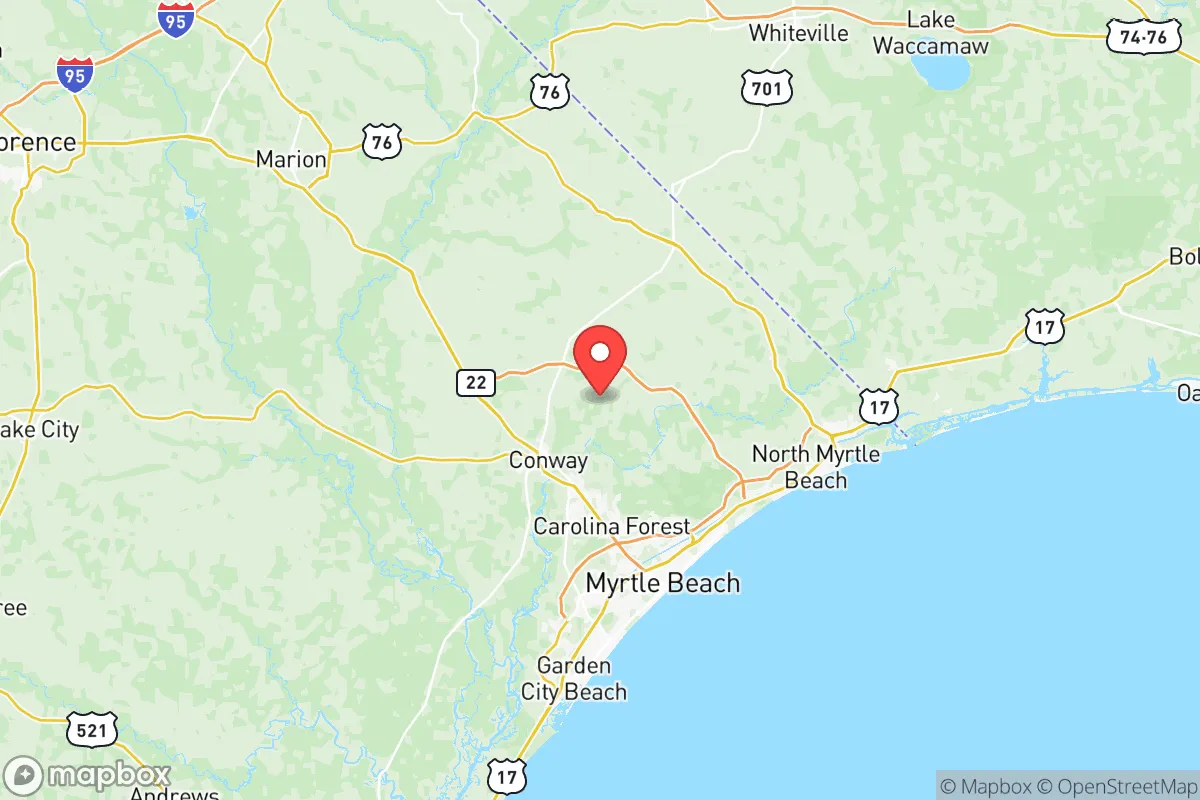
When you stack Horry County up against the rest of South Carolina, the difference is mostly about growth. The state as a whole is reliably red, but Horry County is a bit of a mixed bag depending on where you stand. The rural areas—places like Green Sea, Aynor, and Galivants Ferry—are as deep red as they come. You won’t find many progressive yard signs out there. But then you’ve got the coastal towns like Myrtle Beach and North Myrtle Beach, where the tourism and retirement crowd has brought in a more moderate, sometimes even blue-leaning, vibe. The swing precincts are mostly around the Carolina Forest area and parts of Surfside Beach, where transplants from up North and the Midwest have settled. These folks aren’t all Democrats, but they’re not the rock-ribbed conservatives we grew up with either. They tend to vote for lower taxes and less regulation, but they’re also more open to things like zoning laws and environmental restrictions that can feel like government overreach to old-timers.
What this means for residents
For those of us who value personal freedoms and limited government, the trend is a little concerning. The county council has stayed mostly conservative, but you can feel the pressure to adopt more progressive policies, especially around development and public health. There’s been talk of stricter building codes and even some noise about mask mandates in public buildings, which would have been unthinkable a decade ago. The local school board has also seen some heated races, with candidates pushing for more state control over curriculum—something that rubs many of us the wrong way. If you’re a conservative who moved here to escape the overreach you saw up North, you’re probably watching these shifts with a wary eye. The good news is that the rural precincts still carry a lot of weight in countywide elections, so the core values haven’t flipped yet. But the margin is shrinking, and every election cycle brings more new faces who don’t share the same instinctive distrust of government power.
One thing that sets Horry County apart is its fierce independence from state-level politics. While Columbia might pass laws that feel like they’re written by bureaucrats who’ve never set foot on the Strand, locals here tend to do things their own way. For example, the county has fought tooth and nail against state efforts to centralize tourism tax dollars, arguing that local control is the only way to keep the money where it belongs—in our communities, not in some politician’s pet project. That’s the kind of attitude that keeps Horry County from sliding too far into the progressive swamp. But if you’re thinking of moving here, just know that the political landscape is changing. The old-timers are still holding the line, but the newcomers are knocking at the door, and they’ve got different ideas about what freedom looks like. Keep your ear to the ground, and vote like your rights depend on it—because they just might.

State Political ClimatePolitical Climate in South Carolina
State Political AnalysisPolitical Environment in the State
South Carolina is a solidly Republican state with a Cook PVI of R+8, meaning it typically votes about eight points more Republican than the national average. The dominant coalition is a blend of traditional conservatives, evangelical Christians, and a growing number of transplants from the Northeast and Midwest who are drawn by lower taxes and a slower pace of life. Over the past 10-20 years, the state has shifted rightward in presidential races—George W. Bush won it by 17 points in 2004, Trump by 12 in 2020—but the real story is the hardening of the rural-urban divide and the quiet erosion of conservative dominance in the fast-growing suburbs.
Urban vs. rural divide
The political map of South Carolina is a tale of two landscapes. The rural Lowcountry and Upstate counties—places like Oconee, Pickens, and Laurens—vote Republican by 30-40 points, driven by gun culture, church attendance, and a deep skepticism of federal power. The coastal resort areas, like Hilton Head and Beaufort, lean red but are softening as retirees from blue states bring more moderate views on taxes and the environment. The real blue islands are the urban cores: Charleston (Charleston County) voted for Biden by 16 points in 2020, and Columbia (Richland County) went for Biden by 18 points. Greenville County, once a GOP stronghold, is now a battleground—it voted for Trump by only 4 points in 2020, down from 18 points in 2012. The Myrtle Beach area (Horry County) remains reliably red, but the transplants filling the new subdivisions there are less reliably conservative on social issues. The key takeaway: if you want a reliably conservative environment, you’re looking at the rural counties and smaller towns like Lexington or Simpsonville, not the downtowns of the big three metros.
Policy environment
South Carolina’s policy environment is broadly conservative, but with some notable exceptions. The state has a flat income tax rate of 6.2% (set to drop to 6.0% in 2026), and no estate tax. Property taxes are low—the effective rate is about 0.55% of home value—but there’s a 6% sales tax on most goods. The regulatory posture is business-friendly: South Carolina is a right-to-work state, and the state government has actively courted manufacturing (BMW, Boeing, Volvo) with tax incentives. On education, the state has a school choice program (the Education Scholarship Trust Fund) that allows families to use state funds for private school tuition, but it’s capped at about 5,000 students and faces legal challenges. Healthcare is a mixed bag: the state did not expand Medicaid under the ACA, which keeps costs lower for taxpayers but leaves a coverage gap for low-income adults. Election laws are among the strictest in the South: you need a photo ID to vote, early voting is limited to two weeks, and absentee voting requires an excuse. The state also passed a fetal heartbeat abortion ban in 2023, which is currently blocked by court order. Overall, the policy environment is friendly to traditional values and economic freedom, but the state’s reliance on corporate incentives and the ongoing legal battles over school choice and abortion create uncertainty.
Trajectory & freedom
South Carolina is trending in a mixed direction on personal freedom. On the positive side, the state has expanded gun rights: in 2024, the legislature passed constitutional carry (permitless carry of handguns), making South Carolina the 29th state to do so. The state also passed a parental rights bill in 2023 that requires schools to notify parents of any changes to a child’s health or well-being, and it bans instruction on sexual orientation and gender identity in K-5 classrooms. On the negative side, the state has seen a creeping expansion of government power in the name of public health and safety. During COVID, Governor McMaster kept the state open longer than most, but local governments in Charleston and Columbia imposed mask mandates and business restrictions that were later struck down by the courts. More concerning for conservatives is the growth of HOA and municipal overreach in the suburbs—new developments in Fort Mill and Bluffton often come with strict HOA covenants that limit property rights (e.g., banning fences, restricting parking). The state legislature has been slow to rein in HOAs. On medical autonomy, the state has a medical marijuana bill that has stalled for years, and the abortion ban is tied up in court. The trajectory is toward more freedom on guns and parental rights, but less freedom on property and medical choices, especially in the growing suburbs.
Civil unrest & political movements
South Carolina has a relatively low level of visible civil unrest compared to states like Oregon or Georgia, but there are flashpoints. The Confederate flag removal from the Statehouse grounds in 2015 after the Charleston church shooting was a major cultural moment that still divides residents—many rural conservatives saw it as government overreach into heritage, while urban progressives saw it as long-overdue. Since then, there have been periodic protests over Confederate monuments in Charleston and Columbia, but they’ve been small and mostly peaceful. The Black Lives Matter protests in 2020 were concentrated in downtown Charleston and Columbia, with some property damage but no widespread looting. On the right, the Moms for Liberty movement has been active in school board meetings in Greenville and Lexington, pushing back on critical race theory and LGBTQ curriculum. Immigration politics are relatively quiet—South Carolina is not a border state, and the undocumented population is small (about 2% of the population). There’s no sanctuary city policy anywhere in the state. Election integrity controversies flared up after 2020, with the state GOP pushing for stricter voter ID laws and a ban on ballot drop boxes, which passed in 2021. The most visible flashpoint for a new resident would be the culture war in public schools—expect to see heated debates at school board meetings in the suburbs, especially around book bans and transgender policies.
Projection
Over the next 5-10 years, South Carolina will likely become more purple at the state level but remain red in presidential races. The key demographic shift is the influx of retirees and remote workers from New York, New Jersey, and California, who are moving to the Charleston suburbs (Mount Pleasant, Summerville) and the Greenville-Spartanburg corridor. These transplants tend to be fiscally conservative but socially moderate—they want low taxes and good schools, but they’re less enthusiastic about the culture war issues that drive the rural base. This could lead to a split: the state legislature will remain solidly Republican due to gerrymandering, but the governor’s race and some congressional districts (like the 1st District, which includes Charleston) could become competitive. The rural counties will stay deep red, but their population share is shrinking. The biggest wildcard is school choice—if the current program survives legal challenges and expands, it could cement the state as a conservative haven for families. If it’s struck down, expect more suburban parents to push for moderate Republican candidates who prioritize education funding over culture war battles. The bottom line: if you’re moving to South Carolina for the conservative culture, pick a rural county or a small town like Lexington or Simpsonville, not the urban cores or the transplant-heavy suburbs.
For a new resident, the practical takeaway is this: South Carolina offers a strong conservative foundation—low taxes, gun rights, parental rights in schools, and a business-friendly climate—but the culture is shifting in the growing metros. If you want to avoid the progressive drift, avoid downtown Charleston, Columbia, and Greenville. Stick to the rural counties and the smaller towns where the values are still traditional and the government stays out of your life. The state is still a net positive for freedom, but you have to choose your location carefully.
* Values derived from national, state, county, city and local statistics and may differ in a specific area. Last updated: 2026-05-27T16:55:40.000Z
Narrative content on this page is AI-generated and may contain mistakes. Verify any details that matter before acting on them.
ReloMaps may earn a commission from affiliate links at no extra cost to you.

