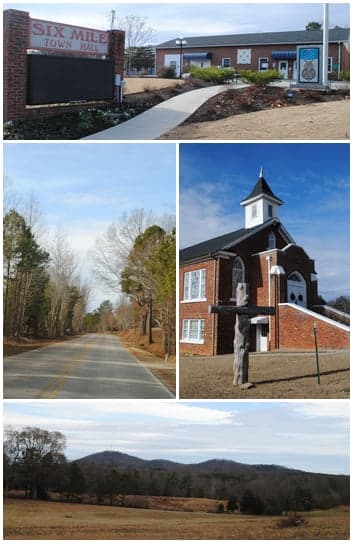
Photo: Wikipedia
Political ClimatePolitical Climate in Six Mile, SC
District shown is the primary district for this city’s centroid. Cities may span multiple districts.
Local Political AnalysisPolitical Analysis of Six Mile, SC
Six Mile is about as reliably Republican as it gets in the Upstate, with a Cook PVI of R+21 that puts it deep in the red column. That’s a far cry from the state’s overall R+8 rating, and it’s not a recent development—this corner of Pickens County has voted solidly conservative for decades, and the trajectory is only getting more pronounced as new development pushes in from the Greenville side.
How it compares
To put that R+21 in perspective, it’s roughly the same partisan lean you’d find in places like rural Oklahoma or West Texas. The state of South Carolina as a whole is competitive enough that Democrats can win statewide offices—look at the current governor’s race or the close Senate contests—but that’s not the reality here. In Six Mile, the local GOP is essentially uncontested in most elections. The contrast is stark when you drive 15 miles east to Clemson or 20 miles north to Pickens, where you’ll find a mix of college-town voters and a more moderate Republican base. Even nearby Easley, just 10 minutes down Highway 123, has a slightly more varied political makeup thanks to its larger population and commuter base. But Six Mile itself? It’s a small, tight-knit community where the county GOP chair probably knows most voters by name.
What this means for residents
For conservative residents, the practical effect is that their votes carry real weight in primaries, not general elections. The real political action here is in the Republican primary—whoever wins that in March is effectively the officeholder by November. You’ll see more yard signs for sheriff and county council races than for president, because those local races are where the actual decisions get made. For liberal residents, the reality is more about finding your people in smaller circles. There’s no active Democratic precinct organization in Six Mile itself, but you’ll find like-minded folks at Clemson or in Greenville, which is a 25-minute drive and votes blue by a solid margin. It’s not hostile—people here are generally polite and neighborly—but you’re not going to find a progressive book club at the local coffee shop. The practical trade-off is that property taxes stay low, zoning stays minimal, and the county government tends to be hands-off on most issues.
What this means for residents
The cultural and policy distinctions are subtle but real. Six Mile is one of those places where the Second Amendment isn’t a talking point—it’s just a given. You’ll see pickup trucks with gun racks at the Piggly Wiggly, and nobody bats an eye. The county has resisted most forms of land-use regulation, which is why you still see large rural lots and working farms mixed in with new subdivisions. There’s also a strong strain of fiscal conservatism that shows up in the school board meetings—bond referendums for new schools often pass, but only after a fight. The one thing that’s changing the political character is growth. As Greenville’s sprawl creeps westward, you’re getting more transplants from out of state, and while most of them are conservative too, they’re bringing a different flavor—more country-club Republican than rural populist. That’s a shift worth watching over the next decade, because it could soften the edges of this R+21 district even if it doesn’t flip it.

State Political ClimatePolitical Climate in South Carolina
State Political AnalysisPolitical Environment in the State
South Carolina is a solidly Republican state, carrying a Cook PVI of R+8, meaning it votes about eight points more Republican than the national average in presidential elections. The dominant coalition is a mix of traditional conservatives in the suburbs and rural areas, evangelical Christians in the Upstate and Midlands, and a growing number of fiscally conservative transplants from the Northeast and Midwest. Over the last 10-20 years, the state has shifted rightward, driven by rapid population growth in the coastal and Upstate regions, while the Democratic base has become increasingly concentrated in the urban cores of Charleston, Columbia, and Greenville, and among the state’s sizable African American population (about 27% of residents). The 2024 presidential race saw Trump win the state by roughly 18 points, a margin that has held steady or widened slightly since 2016, despite national trends.
Urban vs. rural divide
The political map of South Carolina is a classic story of urban islands in a red sea. The three major metros—Charleston, Columbia, and Greenville—are the only areas where Democrats can consistently compete. Charleston County, with its booming tourism and tech sectors, has trended blue in recent cycles, voting for Biden in 2020 and Harris in 2024 by narrow margins. Richland County (Columbia) is a Democratic stronghold, driven by the state capital’s government workforce and the large student population at the University of South Carolina. Greenville County, once reliably red, has become a battleground as transplants from the Northeast and California flood into the Upstate; it voted for Trump in 2024 but by a single-digit margin, a shift from the 20-point leads of a decade ago. Outside these metros, the state is deeply conservative. The Lowcountry’s rural counties like Beaufort and Colleton are solidly red, while the Pee Dee region around Florence and Myrtle Beach leans Republican, though with a significant Democratic minority among Black voters. The Upstate’s Spartanburg and Anderson counties are among the most Republican in the state, with Trump winning them by 30+ points in 2024. The key takeaway: if you live in a city center, you’ll see a mix of politics; if you’re in the suburbs or exurbs, expect a red wave.
Policy environment
South Carolina’s policy environment is shaped by a low-tax, limited-government philosophy that appeals to conservative relocators. The state has a flat income tax rate of 6.2%, which is being phased down to 6.0% by 2026 under a 2022 law, and no state tax on Social Security benefits. Property taxes are among the lowest in the Southeast, with a median effective rate of 0.55%, though they vary by county—Charleston County is higher due to school funding, while rural counties like Chesterfield are lower. The state is a “right-to-work” state with a unionization rate of just 2.5%, and it has no state minimum wage above the federal $7.25. Education policy is a flashpoint: the state has a robust school voucher program (the “Education Scholarship Trust Fund” passed in 2023), which allows families to use public funds for private school tuition, and it has one of the highest rates of charter school enrollment in the South. Healthcare is a mixed bag—South Carolina did not expand Medicaid under the Affordable Care Act, leaving about 200,000 low-income adults in the coverage gap, but the state has a thriving telehealth sector and a growing number of direct primary care clinics. Election laws are restrictive by national standards: the state requires a photo ID to vote, has strict absentee ballot rules, and passed a 2021 law (H 3522) that limited drop boxes and shortened the early voting window to two weeks. For a conservative resident, this environment feels like a haven of fiscal discipline and school choice; for a liberal resident, it can feel like a struggle for access to healthcare and voting rights.
Recent policy direction
Over the last five years, South Carolina has moved decisively to the right on a range of issues that matter to relocators. On gun and self-defense law, the state became a “constitutional carry” state in 2024, allowing permitless carry of concealed handguns for anyone 18 or older who can legally possess a firearm—a major shift from the previous permit system. Parental and education rights have been a priority: the 2023 “Parents’ Bill of Rights” (H 3728) requires schools to notify parents about curriculum changes and allows them to opt their children out of sex education, while a 2022 law banned instruction on sexual orientation and gender identity in K-5 classrooms (the “Don’t Say Gay” law, modeled on Florida’s). On speech and privacy, the state has no broad privacy law like California’s, but it does have a 2023 law restricting social media platforms from censoring political speech (the “Stop Social Media Censorship Act”), which is currently tied up in court. Medical and bodily autonomy is a sharp divide: South Carolina has a near-total abortion ban (the “Fetal Heartbeat Act”) that prohibits abortions after about six weeks, with exceptions only for rape, incest, and life of the mother, and it was upheld by the state Supreme Court in 2023. Property rights are strongly protected—the state has a “right to farm” law that shields agricultural operations from nuisance lawsuits, and it does not have a statewide rent control ban (though local rent control is rare). On taxation, the trend is toward cuts: the 2022 tax reform law is gradually reducing the flat income tax from 7% to 6%, and the state eliminated the corporate license fee for small businesses in 2023. Voting and ballot access has tightened: the 2021 law (H 3522) shortened early voting from 14 days to 10, eliminated same-day registration, and required a notarized signature for absentee ballots. For a conservative moving in, this is a state that has delivered on core priorities; for a liberal, it’s a place where you’ll need to be strategic about where you live and how you engage politically.
Civil unrest & political movements
South Carolina has a history of political activism that is both visible and localized. The Confederate flag removal from the Statehouse grounds in 2015 after the Charleston church shooting was a watershed moment, sparking a wave of racial justice protests that continue in smaller forms today. The Black Lives Matter movement has a strong presence in Charleston and Columbia, with regular protests outside the Statehouse, particularly after the 2020 murder of George Floyd. On the right, the state has a robust “Moms for Liberty” chapter network, which has been active in school board meetings across the Upstate and Lowcountry, pushing for book bans and curriculum transparency. Immigration politics are less heated than in border states, but there is a vocal minority pushing for stricter enforcement; the state has a 2011 law (the “South Carolina Illegal Immigration Reform Act”) that requires employers to use E-Verify and allows police to check immigration status during traffic stops. There is no serious secession or nullification movement, though some rural counties have passed symbolic “Second Amendment sanctuary” resolutions. Election integrity controversies flared after 2020, with the state GOP launching a “voter integrity” task force that found no widespread fraud but led to the 2021 voting restrictions. A new resident would notice that political activism is mostly channeled through local government—school boards, county councils, and city elections—rather than street protests, though the Statehouse in Columbia sees regular rallies on both sides during legislative sessions.
Projection
Over the next 5-10 years, South Carolina is likely to remain solidly Republican, but the margins will narrow in the metros. The state is one of the fastest-growing in the country, adding about 100,000 new residents per year, many of them from blue states like New York, California, and Illinois. These transplants tend to be more moderate or even liberal on social issues, but they are often drawn by the low taxes and business climate, which keeps the state’s overall conservative tilt intact. The Upstate, particularly Greenville and Spartanburg, will continue to trend purple as the tech and manufacturing sectors expand—BMW, Michelin, and Proterra are major employers there. The Lowcountry, including Charleston and Hilton Head, will see a similar shift as retirees and remote workers flood in. Rural areas, especially the Pee Dee and the Midlands, will remain deeply red, but their political influence will wane as population growth concentrates in the suburbs. The state’s Republican Party is likely to remain dominated by the evangelical and business wings, but a growing libertarian faction—focused on tax cuts and gun rights—could push the party further right on fiscal issues. For a new resident, the trajectory means that the state will feel more politically diverse in the cities, but the overall policy direction—low taxes, school choice, gun rights, and abortion restrictions—will remain stable. The biggest wildcard is the impact of climate change on the coast: if sea-level rise and hurricanes accelerate, it could reshape the economy and politics of the Lowcountry, potentially driving a more interventionist government response.
For someone moving to South Carolina, the practical takeaway is that you’ll find a state that delivers on conservative promises—low taxes, strong gun rights, school choice, and a business-friendly environment—but also one where the urban centers offer a more mixed political experience. If you’re conservative, you’ll feel at home almost anywhere, but especially in the suburbs of Greenville or the rural Lowcountry. If you’re liberal, you’ll want to target Charleston, Columbia, or the Mount Pleasant area, where you’ll find like-minded neighbors and a vibrant cultural scene, but you’ll need to accept that state-level policy will often run counter to your values. The state’s political climate is stable, predictable, and increasingly shaped by the newcomers who are changing its face—so the South Carolina of 2035 will look different from today, but it will still be a reliably red state with a few blue pockets.
* Values derived from national, state, county, city and local statistics and may differ in a specific area. Last updated: 2026-10-20T05:46:57.000Z
Narrative content on this page is AI-generated and may contain mistakes. Verify any details that matter before acting on them.
ReloMaps may earn a commission from affiliate links at no extra cost to you.

