Photo: Wikipedia
Demographics of Sheridan, WY
Affluence Level in Sheridan, WY
A middle-class area roughly in line with national averages across income, home values, education, and employment.
People of Sheridan, WY
The people of Sheridan, Wyoming, today number 19,035 and form one of the most demographically homogeneous small cities in the Rocky Mountain West. The population is 87.6% white, with a Hispanic share of 6.2% and an East/Southeast Asian population of 1.5%; the foreign-born share is just 1.0%, among the lowest in any Wyoming municipality. The city’s identity is shaped by a deep-rooted ranching and energy heritage, a growing retiree and remote-worker influx, and a notably high college attainment rate of 34.8% that reflects its role as a regional service and cultural hub.
How the city was settled and grew
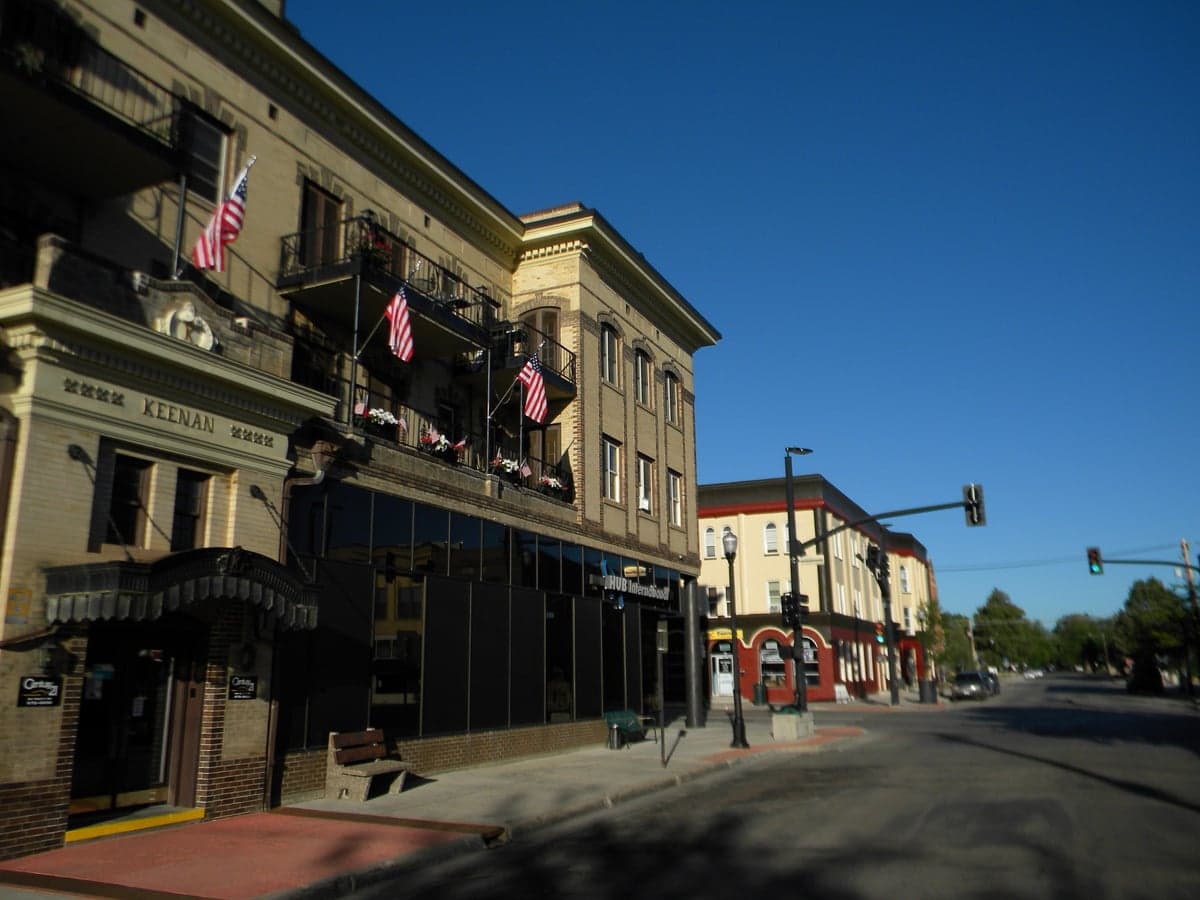
Sheridan’s founding population arrived with the railroad in the 1880s, when the Chicago, Burlington and Quincy Railroad extended its line into the Powder River Basin. The town was platted in 1882 and named after Union General Philip Sheridan, attracting a mix of Midwestern homesteaders, Irish and German railroad laborers, and cattle ranchers drawn by the open range. The original commercial core—now the Downtown Historic District along Main Street—was built by these early settlers, with brick storefronts and saloons serving cowboys and miners. The first major residential neighborhood, North Sheridan, developed north of the tracks as a working-class enclave for railroad employees and ranch hands, while wealthier ranchers and merchants built homes in the South Sheridan area near the Big Goose Creek corridor. By 1900, the population had reached roughly 1,500, and the city’s character was firmly Anglo-American, with small pockets of Chinese laborers who had worked on the railroad but largely dispersed by the 1920s. The discovery of oil in the nearby Salt Creek Field in the 1910s brought a second wave of domestic migrants—mostly white workers from Oklahoma and Texas—who settled in the East Side neighborhood around what is now Brundage Lane. The city’s growth remained steady but modest through the mid-20th century, reaching about 11,000 by 1960, with no significant foreign-born influx.
Modern era (post-1965)
Following the 1965 Hart-Cellar Act, Sheridan saw virtually no increase in immigration; the foreign-born share has never exceeded 2%. The post-1965 period instead brought domestic in-migration from two distinct streams. The first was a wave of retirees and second-home buyers from Colorado and California, drawn by the area’s low taxes, hunting access, and mountain scenery. These newcomers concentrated in the Big Horn foothills neighborhood west of town and in the newer subdivisions south of the city limits, such as Riverstone, a master-planned community developed in the 2000s. The second stream was a modest but steady inflow of Hispanic workers, primarily from New Mexico and Texas, who took jobs in construction, hospitality, and the energy sector. Today, Sheridan’s Hispanic population of 6.2% is concentrated in the East Side and along the Coffeen Avenue corridor, where several Spanish-language churches and small businesses have opened. The East/Southeast Asian population of 1.5% is largely composed of medical professionals employed at Sheridan Memorial Hospital and faculty at Sheridan College, living in the West Side neighborhoods near the college campus. The Black population remains negligible at 0.7%, and the Indian-subcontinent population is effectively zero. The city’s white share has declined only slightly from 92% in 1990 to 87.6% today, reflecting the slow diversification driven almost entirely by Hispanic growth.
The future
Sheridan’s population is projected to grow to roughly 22,000–24,000 by 2040, driven by continued domestic migration from high-cost Western states and by natural increase among the existing white population. The Hispanic share is likely to rise to 9–11% as younger families settle in the East Side and along the I-90 corridor, but the city will remain overwhelmingly white and native-born. The foreign-born share may inch up to 1.5–2% as a trickle of Asian medical professionals and a handful of European retirees arrive, but no large immigrant enclave is forming. The city is not tribalizing into distinct ethnic enclaves; rather, it is slowly homogenizing as newer subdivisions like Riverstone and the Kendrick Park area absorb both white and Hispanic middle-class families into mixed-income developments. The biggest demographic shift is age-related: Sheridan’s median age of 41 is rising as retirees continue to arrive, while younger adults leave for college and jobs in larger cities. This trend is creating a bifurcated housing market—high demand for low-maintenance condos and assisted-living facilities near the Downtown Historic District, alongside a shortage of affordable starter homes for working families.
For someone moving to Sheridan now, the bottom line is that this is a stable, culturally conservative community where demographic change is slow and incremental. The city is becoming slightly more diverse in its Hispanic population and slightly older in its overall age profile, but it remains a place where the dominant culture is white, Western, and rooted in ranching and energy. New arrivals—whether retirees, remote workers, or families—will find a welcoming but insular social fabric, where integration depends on participation in local institutions like the Sheridan WYO Rodeo, the college, and the many outdoor recreation groups. The city’s future is not one of rapid transformation but of steady, managed growth that preserves its character while slowly broadening its demographic base.

* Values derived from national, state, county, city and local statistics and may differ in a specific area. Last updated: 2026-04-21T11:22:59.000Z
Narrative content on this page is AI-generated and may contain mistakes. Verify any details that matter before acting on them.
ReloMaps may earn a commission from affiliate links at no extra cost to you.

