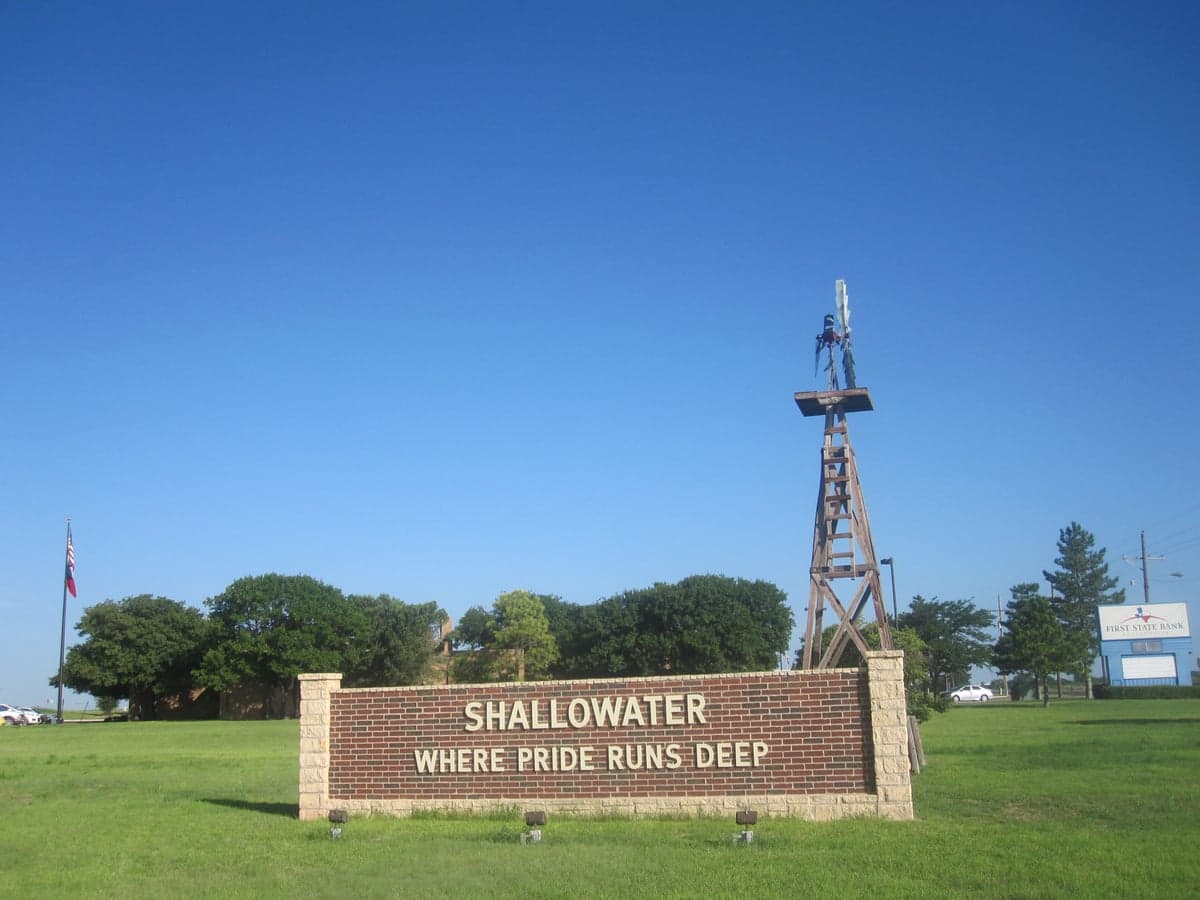
Photo: Wikipedia
Demographics of Shallowater, TX
Affluence Level in Shallowater, TX
A middle-class area roughly in line with national averages across income, home values, education, and employment.
People of Shallowater, TX
The people of Shallowater, Texas, today form a small, tight-knit community of 2,935 residents, characterized by a strong agricultural heritage and a notably high homeownership rate. The city is predominantly White (65.2%) with a substantial and growing Hispanic population (31.6%), reflecting a demographic shift that has accelerated since the late 20th century. With a low foreign-born share of just 2.5% and a college-educated rate of 26.7%, Shallowater remains a largely native-born, working-to-middle-class community where family ties and local institutions like the school system anchor daily life.
How the city was settled and grew
Shallowater was founded in 1909 as a planned agricultural colony along the Santa Fe Railroad, drawing its first settlers from the Midwest and the Deep South. The original plat, laid out by the Shallowater Townsite Company, attracted farmers and ranchers to the area’s fertile cotton and grain fields. The earliest residents—mostly White families of Anglo-American descent—built homes in the Original Townsite, the historic core centered around Avenue H and 9th Street. A second wave arrived during the Dust Bowl and Great Depression of the 1930s, when displaced farmers from Oklahoma and the Texas Panhandle moved in, settling in the Southside Addition, a modest neighborhood of small frame houses south of the railroad tracks. By mid-century, the population had stabilized around 1,000, with the economy revolving around cotton ginning, grain elevators, and the local school system. The North Park Addition, developed in the 1950s, became home to a growing number of teachers and small business owners, reflecting the town’s gradual shift from pure agriculture to a more diversified service economy.
Modern era (post-1965)
The post-1965 period brought significant demographic change, driven primarily by the expansion of Lubbock’s economy and the mechanization of agriculture. As cotton farming became less labor-intensive, many Anglo families moved to larger cities, while Hispanic families—many with roots in the Rio Grande Valley and northern Mexico—moved in to fill jobs in the remaining agricultural and service sectors. By the 1990s, the Hispanic share of the population had risen from under 10% to over 20%, a trend that continued into the 2020s. These newer residents concentrated in the Westside Addition, a neighborhood of newer homes built west of FM 1294, and in the Eastside Mobile Home Park, which offered affordable housing for working-class families. The Black population has remained negligible (0.7%), and East/Southeast Asian residents (0.2%) and Indian-subcontinent residents (0.0%) are virtually absent, making Shallowater’s diversity almost entirely a story of Anglo-Hispanic coexistence. The Shallowater Country Club Estates, a small subdivision of larger homes built in the 2000s, has attracted some professionals commuting to Lubbock, but the town’s overall character remains rooted in its agricultural and blue-collar identity.
The future
Shallowater’s population is projected to grow slowly, likely reaching 3,200–3,500 by 2040, driven by spillover from Lubbock’s suburban expansion. The Hispanic share is expected to continue rising, potentially approaching 40% by 2040, as younger Anglo families move to larger cities and Hispanic families have higher birth rates. New development is concentrating in the Prairie View Addition, a master-planned subdivision of single-family homes on the city’s eastern edge, which is attracting a mix of Anglo and Hispanic families seeking newer housing within the Shallowater Independent School District. The foreign-born share is likely to remain low, as most growth comes from domestic migration and natural increase. Culturally, the town is becoming more bilingual and bicultural, with Spanish increasingly heard in public spaces and at community events, though the overall conservative, family-oriented ethos remains intact. The next decade will likely see a gradual blending of traditions, with the annual Cotton Festival and school sports remaining central to community life.
For someone moving in now, Shallowater offers a stable, affordable, and safe environment with strong schools and a clear sense of place. The community is becoming more Hispanic and more suburban, but it retains its small-town, agricultural roots. New residents should expect a welcoming but close-knit atmosphere where involvement in local institutions—schools, churches, and the volunteer fire department—is the key to integration. The city is not becoming a diverse melting pot in the national sense, but it is quietly evolving into a more inclusive, bilingual version of its former self.

* Values derived from national, state, county, city and local statistics and may differ in a specific area. Last updated: 2026-08-25T23:35:17.000Z
Narrative content on this page is AI-generated and may contain mistakes. Verify any details that matter before acting on them.
ReloMaps may earn a commission from affiliate links at no extra cost to you.

