Photo: Wikipedia
Political ClimatePolitical Climate in Salinas, CA
District shown is the primary district for this city’s centroid. Cities may span multiple districts.
Local Political AnalysisPolitical Analysis of Salinas, CA
Salinas leans heavily Democratic, with a Cook PVI of D+17, meaning the city votes about 17 points more Democratic than the national average. That’s a big shift from even 20 years ago, when the area was more of a purple patch, with a mix of conservative farm families and union workers. Now, the local politics are dominated by progressive voices, and the trajectory is clearly moving further left, especially on issues like housing regulation, land use, and policing. If you’ve lived here as long as I have, you’ve watched the local government get more comfortable telling people what they can and can’t do with their property, their businesses, and even their speech.
How it compares
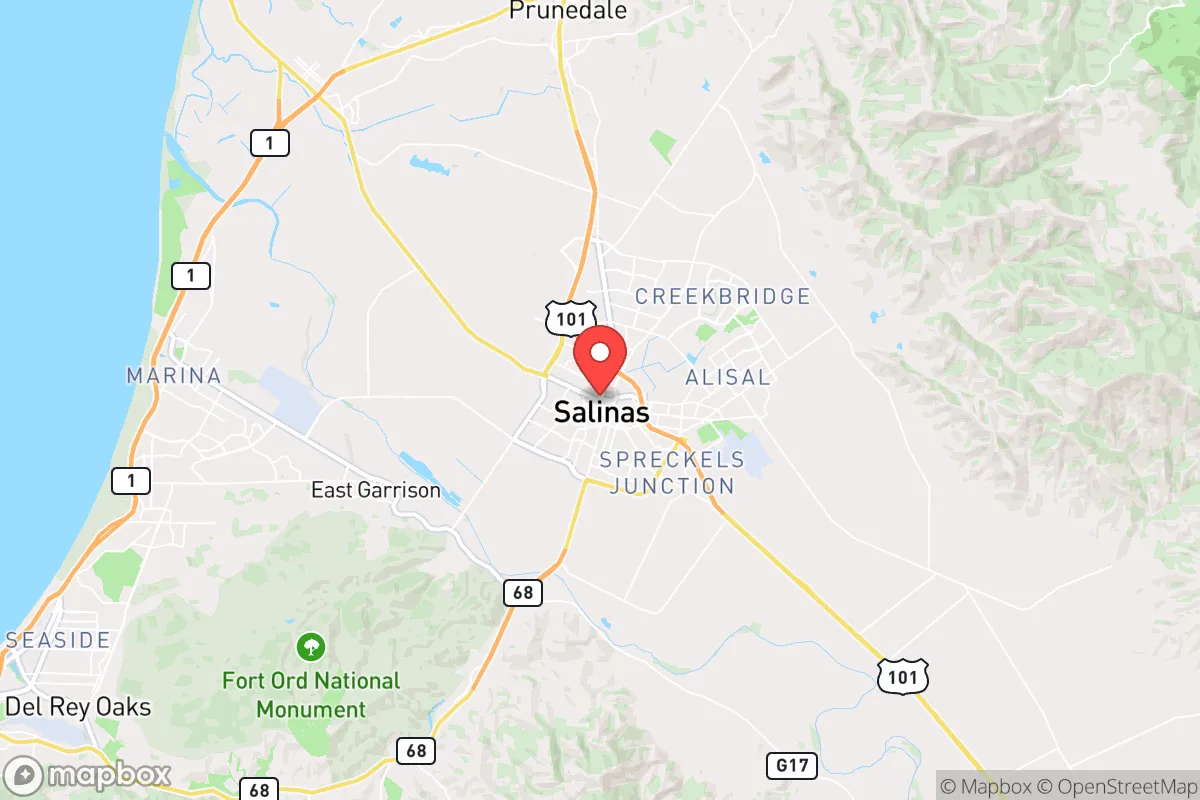
Salinas is the blue anchor of Monterey County, surrounded by towns that feel like a different world. Head east to Gonzales or Soledad, and you’ll find more conservative-leaning communities, where the county’s agricultural roots still hold sway and people are less likely to tolerate heavy-handed government. Drive west to Carmel-by-the-Sea or Monterey, and you’re in deep-blue territory, but it’s a different kind of blue—wealthy, coastal, and focused on environmentalism and tourism. Salinas’s D+17 rating puts it in the same league as San Francisco (D+26) or Oakland (D+28), but with a grittier, working-class reality. The contrast is stark: in Salinas, you’ll hear more Spanish than English at city council meetings, and the debates are about affordable housing mandates and police oversight, not bike lanes or organic farming. The surrounding rural areas, like San Ardo or King City, vote much more red, but their voices get drowned out by the city’s population.
What this means for residents
For the average person, the political climate here means more rules and less freedom. The city council has pushed through rent control measures that make it harder for landlords to manage their own property, and there’s constant talk of new zoning laws that limit what you can build or how you can use your land. If you run a small business, expect more paperwork and higher fees, especially if you’re in the food or agriculture sector. The school board has also shifted left, with critical race theory-inspired curriculum creeping into some classrooms, and there’s been a push to defund the police—though that effort stalled after crime spiked in 2023. For families, this means you’re paying higher taxes for programs you might not agree with, and your kids are exposed to ideology you’d rather they learn at home. The long-term trend is concerning: as the city grows more progressive, it’s getting harder to live here without feeling like the government is in your business.
One cultural distinction that stands out is the strong agricultural identity of Salinas, which creates a tension with the progressive politics. Many of the farmworkers and their families are socially conservative, especially on issues like abortion and religious freedom, but they vote Democratic because of union ties and immigration policies. That’s starting to crack, though. I’ve seen more people quietly voting Republican in local races, especially after the 2020 protests and the 2022 school board elections, where conservative candidates made surprising gains. The city also has a high rate of gun ownership among Latino families, which clashes with the city’s push for stricter gun laws. If you value personal liberty and minimal government interference, Salinas is becoming a tougher place to call home. The next few years will be telling—if the progressive agenda keeps accelerating, you might see more folks heading to Prunedale or Aromas, where the county line offers a little more breathing room.

State Political ClimatePolitical Climate in California
State Political AnalysisPolitical Environment in the State
California is a one-party Democratic state where registered Democrats outnumber Republicans by nearly 2-to-1, and the state has voted for the Democratic presidential candidate by double digits in every election since 2008. The dominant coalition is a mix of coastal progressives, unionized public-sector workers, and a growing bloc of Latino voters, but the state’s overall partisan lean has shifted leftward over the last 20 years—from a purple swing state that backed Arnold Schwarzenegger and gave George W. Bush a close race in 2004 to a deep-blue stronghold where Republicans now hold zero statewide offices. For a conservative considering relocation, the political climate is a major headwind, but the state’s sheer size and diversity mean the experience varies dramatically depending on where you land.
Urban vs. rural divide
The political map of California is a stark study in contrasts. The coastal metros—Los Angeles, San Francisco, San Diego, and Oakland—drive the state’s Democratic supermajority, with San Francisco County delivering 85% of its vote to Joe Biden in 2020. The Central Valley, by contrast, is a Republican stronghold in places like Bakersfield and Fresno, though even those areas are trending purple as Latino voters shift left. The inland rural counties—places like Shasta, Tehama, and Siskiyou in the far north—vote Republican by 30-40 point margins, but their populations are too small to offset the coastal juggernaut. A notable exception is Orange County, once a GOP bastion, which flipped to Biden in 2020 and now has a Democratic majority on its Board of Supervisors. Suburbs like Temecula and Murrieta in Riverside County remain reliably red, but they’re increasingly surrounded by blue-leaning exurbs. The bottom line: if you want a conservative community, you’re looking at the Central Valley, the Sierra foothills, or the far north—places like Redding or Yuba City—where the culture still feels like pre-2010 California.
Policy environment
California’s policy environment is a textbook case of progressive governance that conservatives find suffocating. The state has the highest income tax rate in the nation (13.3% for top earners), a 7.25% sales tax that local add-ons push to over 10% in many cities, and some of the highest gas taxes in the country (57 cents per gallon as of 2025). Property taxes are capped at 1% of assessed value under Prop 13, but annual increases and transfer taxes in cities like Los Angeles and San Francisco add layers of cost. On education, California has a top-down system with a powerful teachers’ union (CTA) that has blocked school choice expansions and parental notification laws; the state’s test scores rank near the bottom nationally despite per-pupil spending above the average. Healthcare is heavily regulated, with a state-run exchange (Covered California) and a push toward single-payer that has stalled but remains a goal. Election laws are among the most liberal in the country: universal mail-in ballots were made permanent in 2021, same-day registration is available, and ballot harvesting is legal. For a conservative, the policy environment feels like a constant expansion of government reach into daily life—from energy mandates banning new gas cars by 2035 to strict rent control laws in many cities.
Trajectory & freedom
California is becoming less free by almost any measure conservatives care about. The state’s trajectory on personal liberty has been a steady march toward more regulation and less individual autonomy. On gun rights, California has some of the strictest laws in the nation—an assault weapons ban, a 10-day waiting period, and a “may-issue” concealed carry system that was tightened further by the 2023 SB 2, which restricted carry in most public places. Parental rights took a hit with AB 1955 (2024), which prohibits school districts from requiring parental notification when a child changes their gender identity—a direct blow to family autonomy. On speech, the state’s AB 587 (2023) forces social media platforms to report on their content moderation policies, a move critics say chills free expression. Medical autonomy was curtailed by the state’s aggressive COVID-19 mandates, which included the nation’s first statewide vaccine mandate for schoolchildren (later paused) and prolonged business closures. Property rights are under constant pressure from rent control expansions (AB 1482 caps annual rent increases at 5% plus inflation) and the California Environmental Quality Act (CEQA), which is weaponized to block housing development. The only bright spot for conservatives was the 2024 passage of Prop 36, which reclassified some theft and drug offenses as felonies, rolling back parts of the 2014 Prop 47 that had decriminalized shoplifting—a rare win for public safety.
Civil unrest & political movements
California has been a flashpoint for civil unrest and political movements on both sides. The 2020 George Floyd protests in Los Angeles, Oakland, and San Francisco turned into widespread looting and property destruction, with billions in damages and a lasting sense of lawlessness that drove many residents to the suburbs. The state’s sanctuary policies—SB 54 (2017) limits local law enforcement cooperation with federal immigration authorities—have made California a magnet for border politics, with ongoing clashes between the state and the Trump administration over enforcement. The secessionist “Calexit” movement fizzled after 2016 but left a residue of anti-federal sentiment on the left. On the right, the “Recall Gavin Newsom” effort in 2021 gathered 1.7 million signatures and came within 4 points of ousting the governor, a sign of deep discontent even in a blue state. Election integrity remains a hot-button issue: the 2020 election saw universal mail-in ballots and no voter ID requirement, leading to ongoing distrust among conservatives. Visible flashpoints include the homeless encampments that dominate downtown areas of San Francisco and Los Angeles—a daily reminder of policy failures that a new resident will see immediately.
Projection
Over the next 5-10 years, California is likely to become more progressive, not less. Demographic trends favor the Democratic coalition: Latino voters, who now make up 40% of the population, are shifting leftward, while the white working-class base of the GOP is shrinking and aging out. In-migration patterns are a double-edged sword: the state lost population for three straight years (2020-2023) as high costs and crime drove out middle-class families, many of them conservative-leaning, but the people moving in—often from abroad or from other blue states—tend to be younger and more progressive. The state’s housing crisis, driven by restrictive zoning and CEQA, will continue to push families to the exurbs or out of state entirely, hollowing out the moderate middle. Expect more single-payer healthcare pushes, stricter environmental mandates, and further erosion of local control on education and policing. For a conservative moving in now, the realistic outlook is that your vote will be increasingly irrelevant in statewide elections, but you can still find refuge in conservative enclaves like Bakersfield, Temecula, or Redding—though even those areas will face pressure from state-level policies.
For a conservative considering California, the bottom line is this: you’re moving into a state where the government will actively work against many of your values on taxes, guns, education, and parental rights. The trade-off is access to the state’s natural beauty, economic opportunity, and diverse communities—but only if you can afford the cost of living and tolerate the political headwinds. If you’re a single professional in tech or a parent who can afford private school and lives in a red pocket like Orange County’s Yorba Linda or San Diego’s East County, you can carve out a decent life. But if you’re looking for a state that respects your freedom to live as you see fit, California is not that place—and it’s not getting better anytime soon.
* Values derived from national, state, county, city and local statistics and may differ in a specific area. Last updated: 2026-04-19T08:41:49.000Z
Narrative content on this page is AI-generated and may contain mistakes. Verify any details that matter before acting on them.
ReloMaps may earn a commission from affiliate links at no extra cost to you.

