Photo: Wikipedia
Demographics of Saguache, CO
Affluence Level in Saguache, CO
A middle-class area roughly in line with national averages across income, home values, education, and employment.
People of Saguache, CO
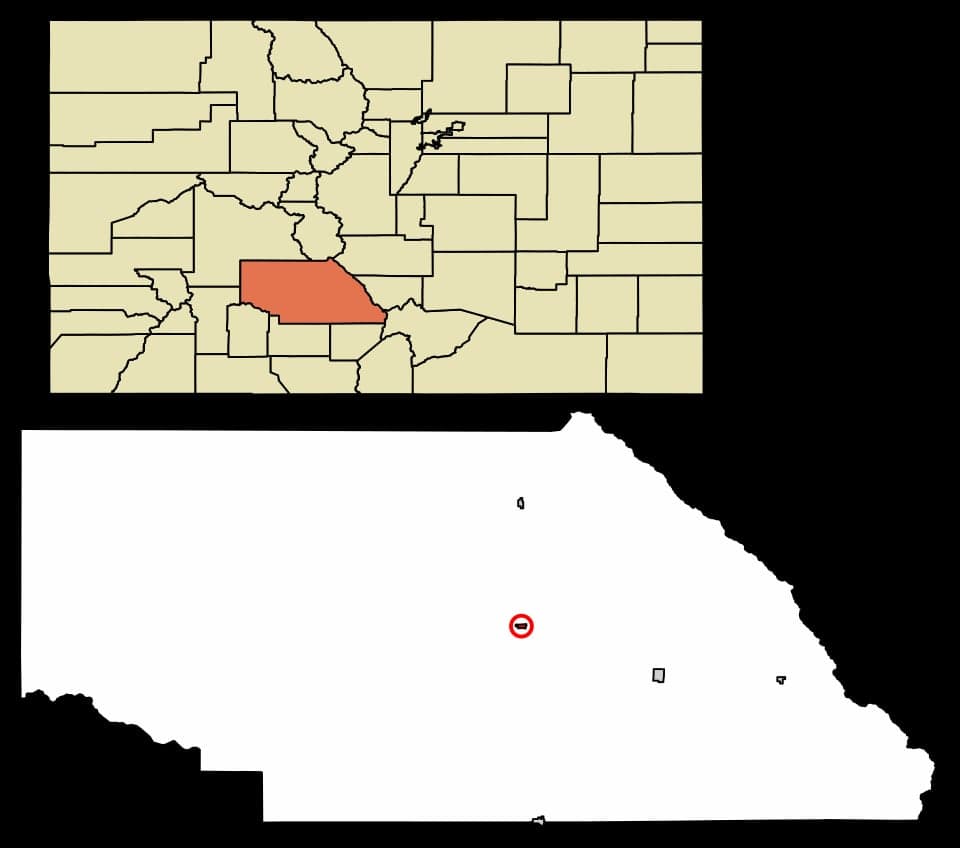
The people of Saguache, Colorado, today number just 554 residents, forming a small, tight-knit community defined by a nearly even split between White (46.2%) and Hispanic (38.6%) populations, with no foreign-born residents and a low college education rate of 18.3%. This is a place where generational roots run deep, and the town’s character is shaped by its rural, high-altitude setting in the San Luis Valley, with a quiet, self-reliant identity that appeals to those seeking a slower pace and strong local ties. Density is low, and the population is overwhelmingly native-born, giving Saguache a distinctly American, land-based feel where family history and local knowledge carry significant weight.
How the city was settled and grew
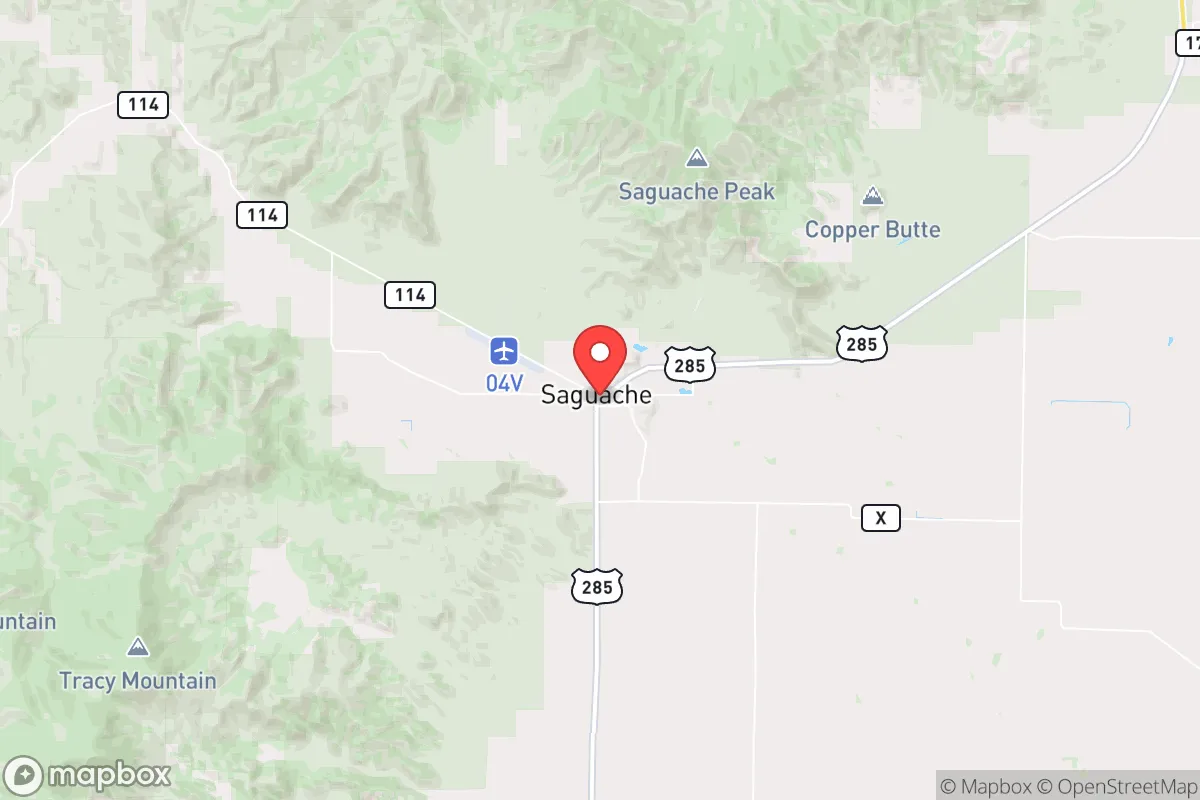
Saguache’s human history begins with the Ute people, who used the area as seasonal hunting grounds before European settlement. The town itself was officially founded in 1866 as a supply hub for miners and ranchers, drawing its first permanent settlers—primarily Anglo-American ranchers and traders—who built the original core around what is now the Historic Downtown District, centered on 4th Street and San Juan Avenue. These early residents established Saguache as a county seat and a stop on the narrow-gauge railroad, with the Old Town neighborhood (bounded roughly by 1st to 5th Streets) housing the merchants, saloon keepers, and lawmen who served the surrounding cattle and hay operations. A second wave arrived in the 1880s and 1890s: Hispanic families from the nearby Spanish land grants of the San Luis Valley, who settled in the South Side area along Colorado Avenue, building adobe homes and working as ranch hands and small-scale farmers. By the early 20th century, the population had stabilized around 600–700, with the West End (west of 7th Street) developing as a modest residential area for railroad workers and their families. No significant immigrant groups from Europe or Asia arrived in this period; the town remained a binary Anglo-Hispanic community, with the Hispanic population concentrated in the South Side and the Anglo population in the Old Town and West End.
Modern era (post-1965)
After the 1965 Hart-Cellar Act, Saguache saw no new foreign-born influx—the foreign-born share remains at 0.0% today—so the modern era is defined by domestic shifts. The 1970s and 1980s brought a slow out-migration of younger Anglo residents seeking jobs in larger Colorado cities, while the Hispanic population remained more stable, anchored by multi-generational families in the South Side and the newer East Saguache subdivision (developed in the 1990s along County Road 14). This trend has gradually shifted the ethnic balance: the Hispanic share rose from roughly 30% in 1970 to 38.6% today, while the White share declined from over 60% to 46.2%. The Northside neighborhood (north of 1st Street) saw some new construction in the 2000s, attracting a few retirees and remote workers, but the overall population has shrunk from a peak of about 800 in 1960 to 554 in 2024. The Black and Asian populations remain negligible (0.0% and 0.2%, respectively), and the Indian subcontinent population is zero—Saguache has not become a destination for any new immigrant group. The town’s character has thus become more Hispanic and more aging, with a median age likely in the mid-40s, as younger adults leave for education and jobs elsewhere.
The future
The population of Saguache is heading toward further homogenization, with the Hispanic share likely to continue rising slowly as the Anglo population ages and declines. The South Side and East Saguache will remain the core Hispanic neighborhoods, while the Old Town and West End may see some in-migration of retirees or second-home buyers drawn by cheap land and mountain views, but this will be a trickle, not a wave. The foreign-born share is expected to stay at or near zero, as the town offers no employment base for immigrant labor—ranching and hay farming are mechanized and shrinking. The next 10–20 years will likely see the population stabilize around 500–550, with a growing elderly cohort and a small number of families in the Northside subdivision. There is no sign of tribalization into distinct enclaves; rather, the community is becoming more uniformly Hispanic and older, with the Anglo presence fading gradually.
For someone moving in now, Saguache is becoming a quieter, more ethnically homogeneous rural town where the past is ever-present. It offers deep community roots and low cost of living, but little economic opportunity or diversity—a place for those who value solitude and tradition over growth and change.

* Values derived from national, state, county, city and local statistics and may differ in a specific area. Last updated: 2026-05-16T10:07:49.000Z
Narrative content on this page is AI-generated and may contain mistakes. Verify any details that matter before acting on them.
ReloMaps may earn a commission from affiliate links at no extra cost to you.

