Photo: Wikipedia
Political ClimatePolitical Climate in Roswell, NM
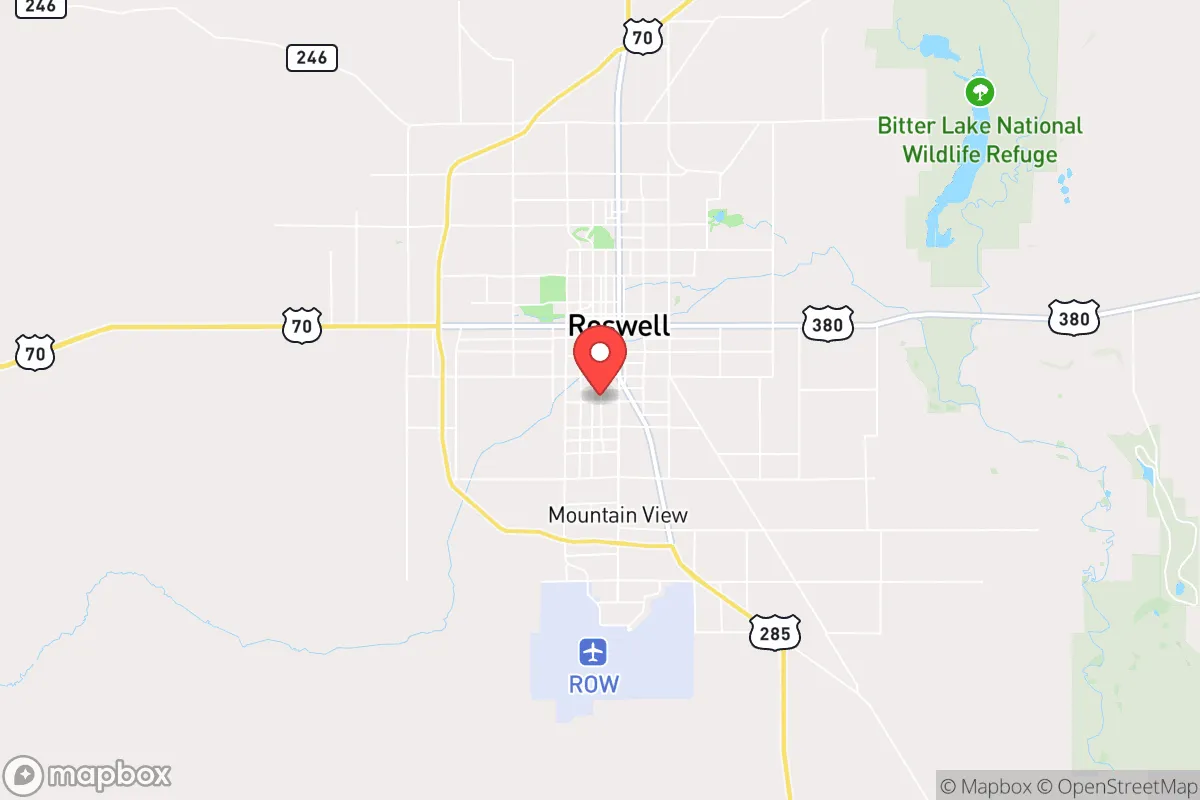
District shown is the primary district for this city’s centroid. Cities may span multiple districts.
Local Political AnalysisPolitical Analysis of Roswell, NM
Roswell, New Mexico, has a Cook PVI of D+3, meaning it leans slightly Democratic in federal elections, but that number doesn’t tell the whole story for those of us who’ve lived here a while. The local political climate is more of a mixed bag than a straight party-line vote, with a strong conservative undercurrent that’s been tested by recent shifts toward progressive policies. If you’re looking at Roswell from a personal-freedom standpoint, you’ll want to keep an eye on how the city balances its traditional roots with the growing influence of outside ideologies.
How it compares
Roswell sits in Chaves County, which has historically voted more Republican than the city itself—think of it as a red island in a blue-leaning state. Drive 40 miles north to Artesia or 30 miles south to Carlsbad, and you’ll find communities that are reliably conservative, with local governments that push back harder on state mandates. In contrast, Roswell’s city council has seen a slow creep of progressive priorities, like zoning changes that favor dense housing over property rights, and a police oversight board that some worry adds bureaucracy without improving safety. The D+3 rating reflects this tension: the city’s federal votes are closer to the national average, but the surrounding towns are a reminder of what Roswell used to be—a place where government kept its nose out of your business.
What this means for residents
For daily life, the political lean here means you’ll see a tug-of-war over things like tax rates and local regulations. The city has flirted with higher minimum wage ordinances and renewable energy mandates, which sound good on paper but often hit small business owners and ranchers hardest. If you value keeping your property taxes low and your gun rights intact, you’ll find allies in the county commission, but the city council can feel like it’s listening more to Santa Fe than to Main Street. The 2024 election cycle saw a spike in turnout among conservatives frustrated with school board decisions and water usage restrictions, so there’s a growing pushback. Long-term, I’d say Roswell is at a crossroads: if the progressive trend continues, expect more red tape on home renovations, farming practices, and even how you run a backyard business.
Cultural and policy distinctions
One thing that sets Roswell apart is its independent streak—it’s not as tied to federal or state handouts as some other New Mexico towns. The local economy leans on agriculture, oilfield services, and the Air Force base, which breeds a self-reliant mindset. You’ll see this in how folks react to state-level gun laws or mask mandates: there’s a quiet but firm resistance, with many choosing to ignore overreach rather than fight it in court. The city’s famous alien tourism brings in money, but it also attracts a transient crowd that doesn’t always share local values. If you’re moving here, expect a community that’s friendly but wary of change—especially change that comes with a government stamp. The near future looks like more of the same: a slow drift leftward in city hall, balanced by a stubborn conservative base that votes with their feet and their wallets.

State Political ClimatePolitical Climate in New Mexico
State Political AnalysisPolitical Environment in the State
New Mexico has been a reliably blue state in presidential elections for two decades, voting Democratic by margins of 8 to 11 points since 2008, but the picture is far more complicated than a simple partisan label. The state’s political engine is driven by a powerful coalition of urban progressives in Albuquerque and Santa Fe, combined with a large Hispanic and Native American voting bloc that has historically leaned Democratic, though that loyalty is fraying in rural areas. Over the last 10-20 years, the state has shifted leftward on social and cultural issues, but a growing conservative backlash in the eastern plains and southern counties is creating a sharper urban-rural divide than many outsiders realize.
Urban vs. rural divide
The political map of New Mexico is a tale of two worlds. Albuquerque (Bernalillo County) and Santa Fe (Santa Fe County) are the Democratic strongholds, delivering 60-70% of their votes to Democratic candidates and dominating statewide elections. Las Cruces (Doña Ana County) leans blue but is more moderate, while Rio Rancho (Sandoval County) is a purple suburb that has been trending redder as families flee Albuquerque’s crime and taxes. Meanwhile, the eastern plains—Clovis, Portales, Hobbs, and Roswell—vote Republican by 30-40 point margins, driven by oil and gas workers, ranchers, and a strong evangelical presence. Farmington in the northwest is another red bastion, anchored by the energy industry. The rural-urban split is so stark that in 2024, Donald Trump won 28 of New Mexico’s 33 counties, but lost the state because Bernalillo and Santa Fe counties alone produced a 100,000-vote Democratic margin. This geographic polarization means your vote literally depends on which side of the Sandia Mountains you live on.
Policy environment
New Mexico’s policy environment is a mixed bag that will give a conservative pause. The state has a progressive income tax with rates up to 5.9%, and a gross receipts tax (essentially a sales tax on services) that can push 8-9% in some cities. Property taxes are low by national standards, but the state’s regulatory posture is heavy—especially on oil and gas, which is the lifeblood of the economy. In 2023, Governor Michelle Lujan Grisham signed a package of gun control laws including a 7-day waiting period and a ban on carrying firearms in public parks and schools, which sparked outrage in rural counties. Education policy is a sore spot: the state ranks near the bottom nationally in K-12 outcomes, and the 2023 passage of a universal free school meals program was popular, but parents are increasingly frustrated by the lack of school choice and the influence of teachers unions. Healthcare is heavily Medicaid-dependent, with the state expanding the program aggressively. Election laws are moderately restrictive—voter ID is not required, and same-day registration is allowed, which conservatives view as a vulnerability. The state also has a sanctuary policy (the 2019 New Mexico Law Enforcement Protection Act) that limits local police cooperation with federal immigration authorities, a flashpoint in border-adjacent areas like Deming and Las Cruces.
Trajectory & freedom
On the freedom front, New Mexico is moving in a concerning direction for conservatives. The 2021 repeal of the state’s pre-1972 abortion ban and the 2023 codification of abortion rights into state law (House Bill 7) removed any local restrictions, making it a destination for late-term procedures. Gun rights have been steadily eroded: the 2023 law banning firearms at polling places and government buildings, plus the 7-day waiting period, were seen by Second Amendment advocates as a direct attack on constitutional carry. Parental rights took a hit in 2023 when the state passed a law requiring schools to adopt policies that affirm a student’s “gender identity” without parental notification—a move that has led to lawsuits and school board battles in Los Alamos and Corrales. Property rights are under pressure from the state’s 2022 “Housing First” initiative, which preempts local zoning to force high-density development in suburban areas. On the tax front, the 2023 personal income tax cut was modest (from 5.9% to 5.9% for top earners, with a slight reduction for middle brackets), but the overall tax burden remains high. The state’s reliance on oil and gas revenue (40% of the budget) means that any green energy push could crater the economy—a risk that the governor’s 2024 executive order on methane emissions only heightens.
Civil unrest & political movements
New Mexico has seen its share of political flashpoints. The 2020 protests in Albuquerque over the death of George Floyd turned violent, with the city’s downtown boarded up for weeks and the police department under federal consent decree. The “Abolish ICE” movement has a strong presence in Santa Fe, where the city council declared itself a “sanctuary city” in 2019. On the right, the “New Mexico Patriots” and “Otero County Commission” have been vocal about election integrity, with Otero County refusing to certify the 2022 primary results over concerns about Dominion voting machines—a standoff that ended with a court order. Immigration politics are raw: the 2023 surge at the border has overwhelmed Sunland Park and Santa Teresa, with the state’s sanctuary policies creating tension between local law enforcement and Border Patrol. The 2024 “Second Amendment Sanctuary” movement has seen 12 counties pass resolutions declaring they won’t enforce the new gun laws, though the state has threatened to withhold funding. A new resident will notice the political activism is loud but localized—Albuquerque and Santa Fe are progressive bubbles, while the rest of the state feels like a different country.
Projection
Over the next 5-10 years, New Mexico is likely to become more polarized, not less. The demographic trends favor Democrats: the state’s Hispanic population (50% of the total) is growing, and younger voters in Albuquerque and Las Cruces are solidly progressive. However, the in-migration of conservatives from Texas and Colorado into the eastern plains and southern counties (especially around Hobbs and Carlsbad) is slowly shifting the rural vote even redder. The oil and gas boom in the Permian Basin is bringing in workers who are culturally conservative, but they are outnumbered by the urban vote. The state’s fiscal health is precarious—the 2024 budget surplus from oil revenue is masking structural deficits, and if a green energy transition accelerates, the state could face a fiscal crisis that forces tax hikes. The most likely scenario is a continued blue lock on statewide offices, with the governor’s mansion and legislature staying Democratic, while rural counties become increasingly rebellious and resistant to Santa Fe’s mandates. For a conservative moving in, expect to live in a red county with blue state laws—a constant tension that will require vigilance on local elections and school boards.
For a new resident, the bottom line is this: New Mexico offers low property taxes, stunning landscapes, and a slower pace of life, but you will be living under a state government that is actively expanding its reach into your personal choices—from what you can carry to how you raise your kids. If you’re moving to Rio Rancho or Los Lunas, you’ll find like-minded neighbors and a growing conservative infrastructure. If you’re in Santa Fe or Albuquerque, you’ll be in the minority. The key is to pick your county wisely, get involved in local politics, and be prepared for a state that is culturally diverse but politically divided. It’s not Texas, and it’s not Colorado—it’s a unique battleground where your vote matters more than you think.
* Values derived from national, state, county, city and local statistics and may differ in a specific area. Last updated: 2026-05-01T06:11:45.000Z
Narrative content on this page is AI-generated and may contain mistakes. Verify any details that matter before acting on them.
ReloMaps may earn a commission from affiliate links at no extra cost to you.

