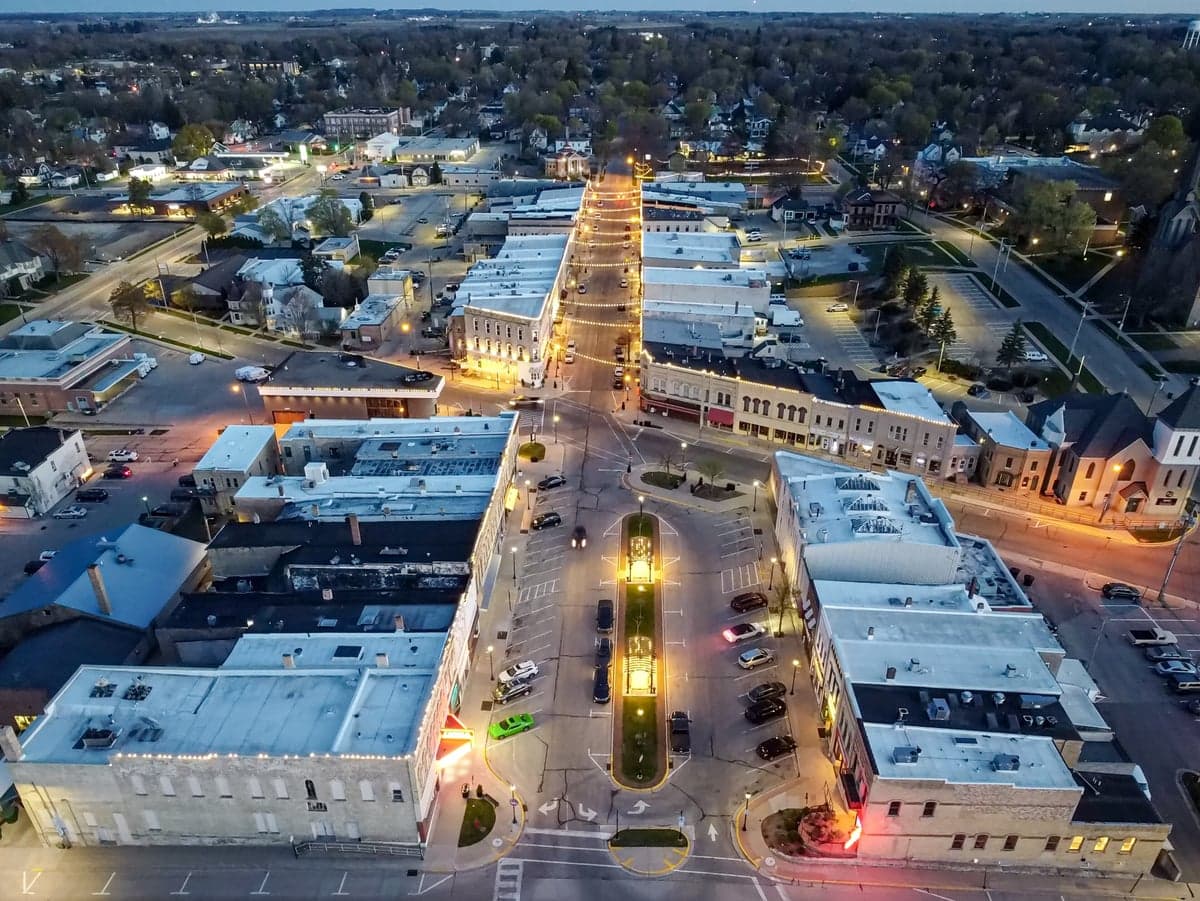
Photo: Wikipedia
Strategic Assessment of Ripon, WI
Meaningful friction. Expect exposure to either population pressure, blast zones, or natural disaster risk. Consider buying a retreat property.
What does the Strategic Assessment tell us?
Our Strategic Assessment grades tactical survivability of an area. Major population centers, military targets, fallout zones, natural disasters, and border exposure all drive risk — lower exposure means a more defensible position in a crisis.
This is heavily inspired by Joel Skousen's Strategic Relocation book. Highly recommended you checkout the book ($)What does this tell us?
Our Strategic Assessment grades tactical survivability of an area. Major population centers, military targets, fallout zones, natural disasters, and border exposure all drive risk — lower exposure means a more defensible position in a crisis.
This is heavily inspired by Joel Skousen's Strategic Relocation book. Highly recommended you checkout the book ($)Strategic Pillars

Key Distances
Regional Safe Places
Below is our recommended "safe zones" in Wisconsin and the surrounding area based on our strategic heuristics. For most people, it's unrealistic to live in a “safe zone” full-time due to work, family or other personal reasons. They tend to be more rural. However, many of these areas are perfect for second homes and retreat properties that double as a vacation home or even a short-term rental.
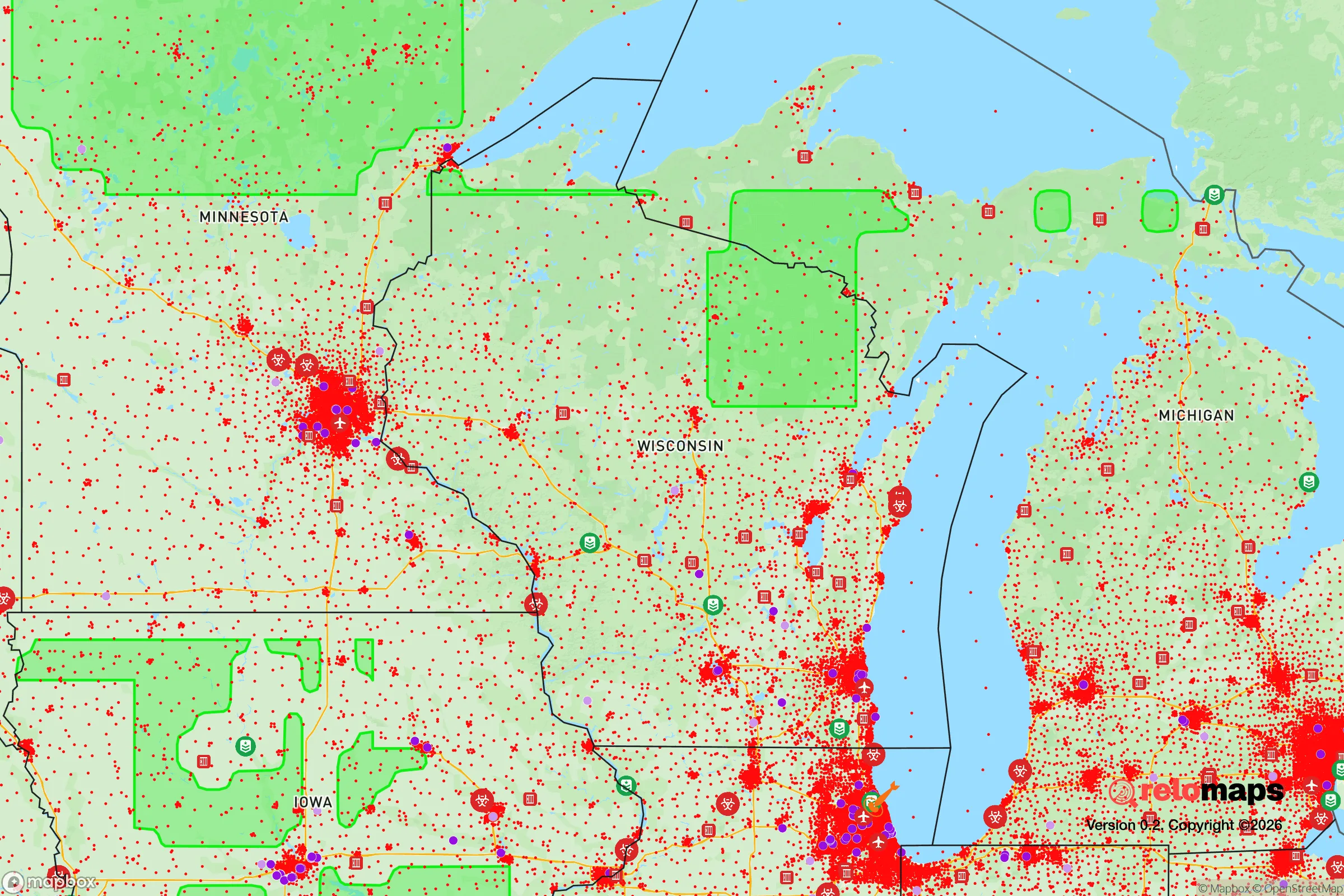
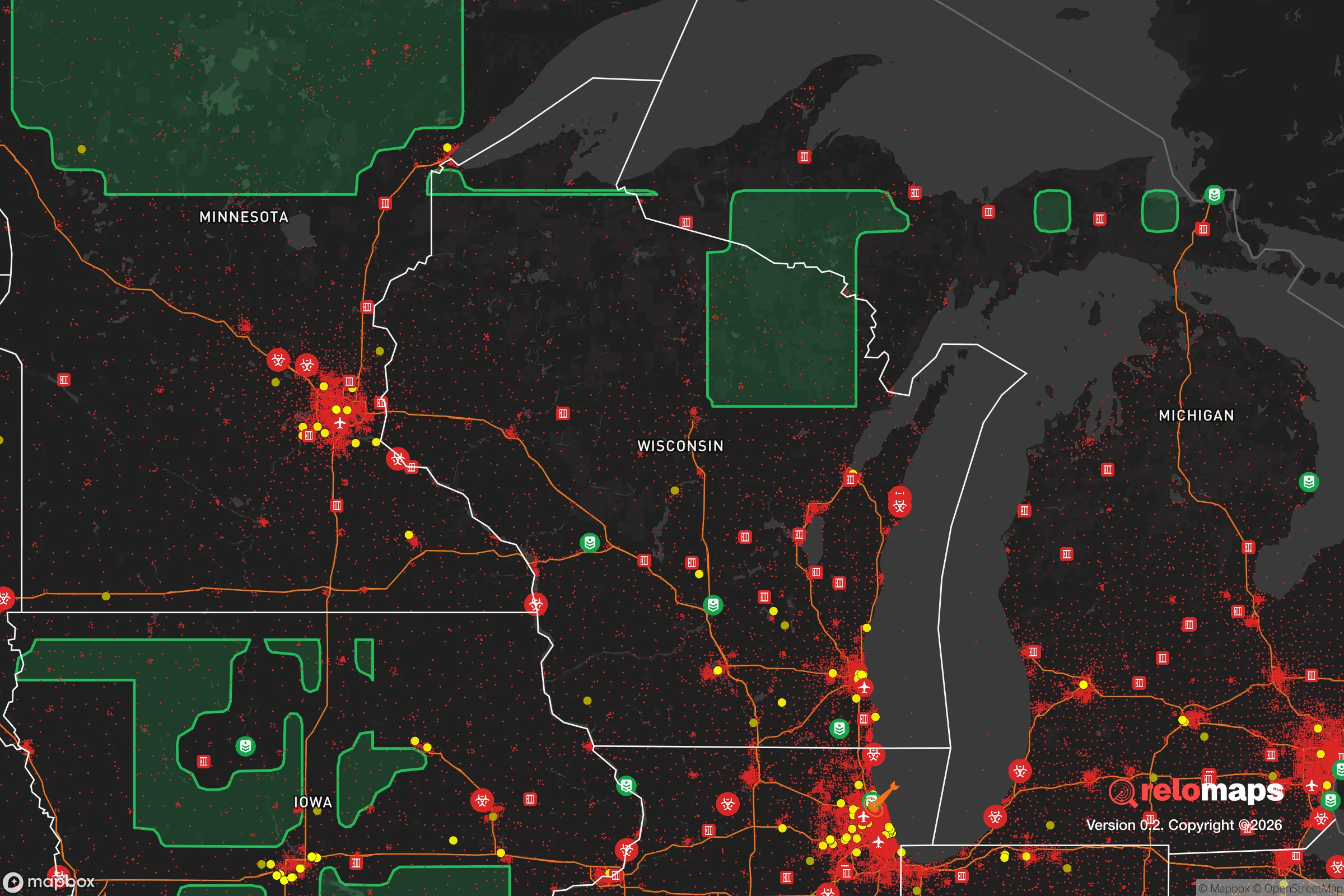


Important Note: For informational purposes only. This does not mean nothing bad ever happens in the green zones. Please use common sense. This is based on public data and modeled with AI. We tried to take a conservative approach but mistakes happen. We update this regularly as new information becomes available.
Solar Generator Recommendations
Backup power matters more here than in safer locations. We've picked three solar generators across budgets and capacity tiers — start with the budget unit if you only need a few essentials, or step up if you want to run a fridge and HVAC for days at a time.

Jackery Portable Power Station Explorer 300
Budget OptionPower on the Go: Weighing only 11 lbs, it's convenient to set up and store with book-sized foldable solar panels

BLUETTI Portable Power Station AC180
Designed for both indoor and outdoor scenarios, AC180 is highly capable as it has a robost capacity and continuous output power.

EF ECOFLOW DELTA Pro Ultra Power Station
Upgraded PickEcoFlow DELTA Pro Ultra is a whole-home energy system designed to grow with your family. Integrated with the Smart Home Panel 2, it scales to meet your evolving energy needs — keeping your home powered, intelligent, and secure through every stage of life.
We earn a commission, at no additional cost to you.
Strategic Assessment Analysis
Ripon, Wisconsin, offers a compelling strategic profile for the relocation-minded reader focused on resilience and self-sufficiency, balancing a strong agricultural base with a location that is close enough to major urban centers for access but far enough to avoid their immediate vulnerabilities. The city sits in the heart of the Fox River Valley, a region known for its fertile soils and established farming infrastructure, which provides a tangible advantage for food security. While not a remote mountain redoubt, Ripon’s position in east-central Wisconsin places it outside the direct blast and fallout zones of major metropolitan targets like Chicago or Milwaukee, offering a realistic middle-ground for those seeking a defensible, productive, and community-oriented base of operations.
Geographic position and natural advantages for long-term stability
Ripon’s primary strategic asset is its location within the Green Lake County and Fond du Lac County agricultural corridor, an area with some of the most productive non-irrigated farmland in the upper Midwest. The surrounding landscape is a mosaic of small family farms, woodlots, and the headwaters of the Fox River, which provides a reliable surface water source. The local topography is gently rolling, offering natural drainage and some defensible high ground without the isolation of mountainous terrain. The city itself is situated roughly 20 miles southwest of Lake Winnebago, the largest inland lake in Wisconsin, which serves as a massive freshwater reservoir and a moderating influence on local climate, reducing the risk of extreme temperature swings that can stress crops and infrastructure. For a relocator, this means a lower risk of catastrophic drought compared to the western US, and a growing season long enough to support a wide variety of staple crops, from corn and soybeans to apples and squash. The region’s history as a dairy and grain hub means that local knowledge and infrastructure for food production are deeply embedded, not something that would need to be built from scratch.
Risk exposure, fallout proximity, and man-made threat assessment
The most significant strategic drawback of Ripon is its proximity to potential man-made threats, specifically the Chicago-Milwaukee-Madison triangle. While Ripon itself is not a primary target, it lies roughly 90 miles northwest of Milwaukee and 150 miles north of Chicago. In a major conflict scenario involving nuclear exchange, the prevailing westerly winds would carry fallout from Chicago and Milwaukee directly over the Ripon area. This is a non-trivial risk that must be factored into any serious preparedness plan. The city is also within 60 miles of the Fort McCoy military installation near Sparta, a major training and mobilization center that could become a secondary target or a focal point for military traffic during a crisis. On the natural disaster front, the area is relatively low-risk. Tornadoes are a seasonal concern, but the region lacks the severe seismic, wildfire, or hurricane threats found in other parts of the country. The primary natural risks are winter storms and occasional flooding along the Fox River, both of which are manageable with proper preparation. The overall threat profile is moderate: low natural disaster risk, but a real and calculable man-made risk due to downwind proximity to major population centers and military infrastructure.
Practical resilience for a relocator: food, water, energy, and defensibility
For the individual or family serious about self-sufficiency, Ripon’s practical resilience metrics are strong. Food security is the standout advantage. The surrounding counties are among the most productive agricultural regions in the state, with a high density of small-scale farms, farmers' markets, and U-pick operations. The local soil is rich loam, and the growing season, while not long, is reliable. A motivated household could realistically produce a significant portion of its own calories on a few acres, and the local culture is supportive of gardening, canning, and livestock raising. Water availability is excellent. The Fox River runs through the city, and the underlying aquifer is part of the Cambrian-Ordovician sandstone system, which provides abundant, high-quality groundwater at relatively shallow depths. Most rural properties in the area have private wells, and the water table is stable. Energy resilience is moderate. The local grid is served by Alliant Energy, and while there are no major hydroelectric or nuclear plants in the immediate vicinity, the region has a growing number of small-scale solar installations and a strong tradition of wood heating. A relocator would be wise to invest in a backup generator and a wood stove, as winter ice storms can cause multi-day outages. Defensibility is a mixed picture. Ripon is a small city of roughly 7,800 people, with a walkable downtown and a grid-like street layout that is not inherently defensible. However, the surrounding rural areas offer numerous properties with good fields of fire, natural tree lines, and limited road access. The local culture is heavily oriented toward hunting and outdoor skills, meaning that a significant portion of the population is already familiar with firearms, land navigation, and basic survival skills. The Fond du Lac County Sheriff’s Office and local police are professional and responsive, but in a prolonged crisis, the community would likely rely on mutual aid and neighborhood cooperation rather than external support.
The overall strategic picture for Ripon is that of a high-potential secondary relocation node for those who want agricultural self-sufficiency and a strong community fabric, but who are willing to accept a moderate risk from downwind fallout and the logistical challenges of a northern climate. It is not a remote bug-out location, but it is a place where a prepared family can build a genuinely resilient lifestyle, with access to fertile land, abundant water, and a population that understands the value of hard work and neighborly cooperation. The key is to treat the proximity to Milwaukee and Chicago as a vulnerability to be mitigated through pre-positioned supplies, a fallout shelter plan, and a network of trusted local contacts. For the reader who wants to be part of a functioning community rather than a lone survivalist, Ripon offers a realistic and grounded option in the upper Midwest.

* Values derived from national, state, county, city and local statistics and may differ in a specific area. Last updated: 2026-08-23T00:49:15.000Z
Narrative content on this page is AI-generated and may contain mistakes. Verify any details that matter before acting on them.
ReloMaps may earn a commission from affiliate links at no extra cost to you.

