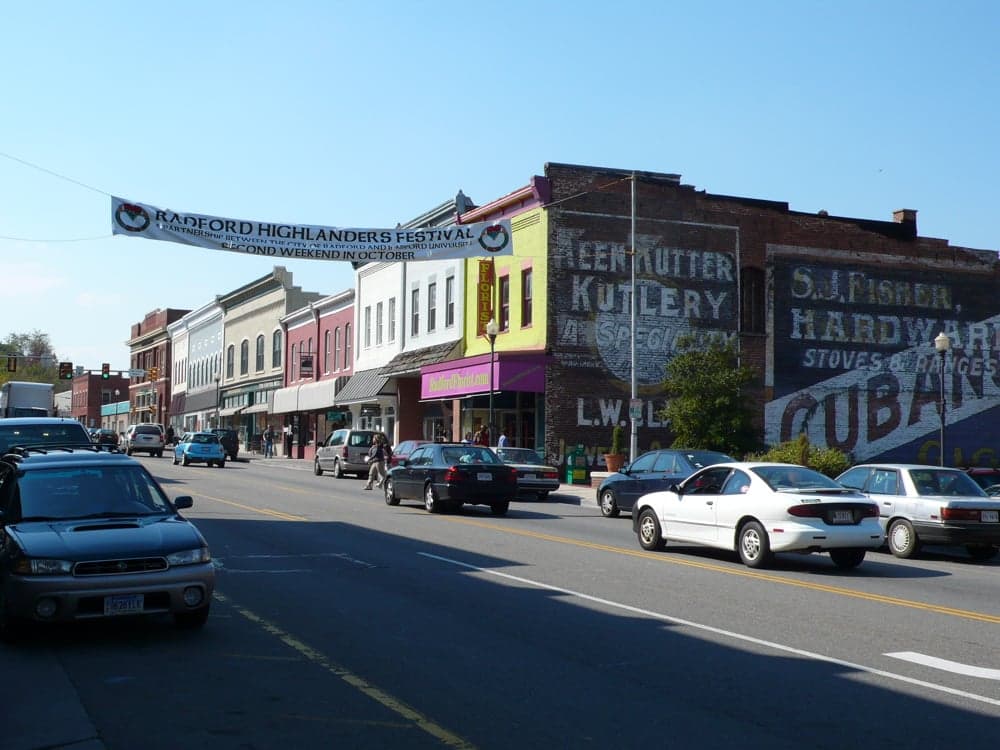

Photo: Wikipedia
Political ClimatePolitical Climate in Radford, VA
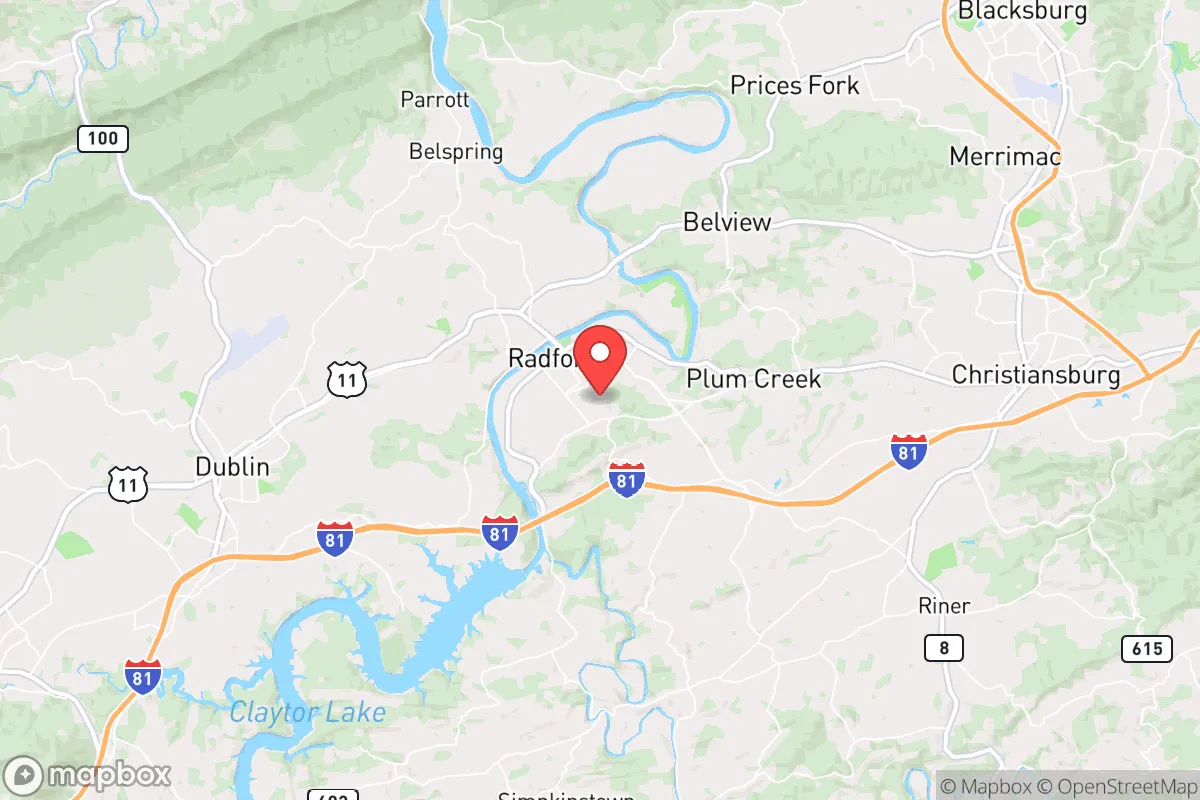
District shown is the primary district for this city’s centroid. Cities may span multiple districts.
Local Political AnalysisPolitical Analysis of Radford, VA
Radford’s political climate has long been a quiet, steady conservative stronghold, and the numbers back that up with a Cook PVI of R+22. That means the city and its surrounding area vote about 22 points more Republican than the national average, which puts it squarely in the deep-red camp alongside places like Pulaski and Wytheville. But if you’ve lived here a while, you’ve noticed the winds shifting—not a full-blown storm, but enough to make you pay attention. The old guard of small-business owners, retired military folks, and families who’ve been here for generations still hold the line, but there’s a creeping influence from Virginia Tech and Radford University that’s nudging things left, especially on social issues. It’s not a crisis yet, but it’s something to keep an eye on if you value personal freedoms and local control.
How it compares
Radford sits in a bit of a political bubble compared to its neighbors. Drive 15 minutes east to Blacksburg, and you’re in a college town that leans blue, with a Cook PVI closer to D+5—a stark contrast that feels like a different world. Head west to Pulaski or north to Christiansburg, and you’re back in solidly red territory, where folks are more skeptical of government overreach and progressive experiments. Radford itself is a mix: the university brings in younger, more liberal voters, but the permanent residents—the ones who remember when the city was a railroad hub—tend to vote conservative. That R+22 rating masks a growing divide; in the 2024 election, the city proper actually voted slightly more Republican than the county, but the margin is shrinking as new arrivals from Northern Virginia and out-of-state transplants settle in. If you’re looking for a place where your voice on taxes, gun rights, and school choice still carries weight, Radford is still that place—for now.
What this means for residents
For the average family or retiree here, the political climate translates into a few concrete realities. Property taxes remain among the lowest in the New River Valley, and there’s no city income tax, which is a big deal if you’re on a fixed income or running a small business. The local government has historically been hands-off on zoning and business regulations, letting folks operate without a ton of red tape. But there’s been a push in recent years to adopt more progressive policies—like diversity, equity, and inclusion initiatives in the schools and a proposed “green” building code that would have jacked up construction costs. That code was voted down in 2023 after a grassroots pushback, but it shows the direction some council members want to go. If you’re concerned about government overreach into your personal life—whether it’s mask mandates, vaccine passports, or restrictions on what you can do with your property—Radford still feels safer than Blacksburg or Roanoke, but the trend line is worth watching.
One thing that sets Radford apart culturally is its stubborn independence. The city has its own police force and school system, separate from the county, which gives residents more direct control over local issues. You’ll still see “Don’t Tread on Me” flags on pickup trucks and yard signs for conservative candidates outnumbering the other side by a wide margin. But the university’s influence is growing, and with it, a push for things like “sanctuary city” status for undocumented immigrants—a proposal that got shot down in 2022 but keeps resurfacing. Long-term, if you’re looking to settle somewhere that respects your rights and doesn’t try to micromanage your life, Radford is still a solid bet. Just keep an eye on city council elections and school board meetings, because that’s where the real battles are fought. It’s not a lost cause yet, but it’s a place where staying informed and showing up matters more than ever.

State Political ClimatePolitical Climate in Virginia
State Political AnalysisPolitical Environment in the State
Virginia is a purple state that has been trending blue for nearly two decades, but it’s a far more complex picture than the simple “blue state” label suggests. The commonwealth’s political lean is defined by a stark urban-rural split, with the densely populated Northern Virginia suburbs of Washington, D.C., and the Hampton Roads area pulling the state leftward, while the rest of the state—from the Shenandoah Valley to Southside and Southwest Virginia—remains reliably red. Over the last 20 years, Virginia has shifted from a reliably Republican state (it voted for George W. Bush in 2004) to a state that has voted for Democrats in every presidential election since 2008, and Democrats have controlled the governorship and both legislative chambers for much of the last decade. However, the 2021 election of Governor Glenn Youngkin, a Republican, and the 2023 statehouse elections that saw Republicans flip the House of Delegates while Democrats held the Senate, show the state is still competitive and far from a one-party lock.
Urban vs. rural divide
The political map of Virginia is a textbook example of the urban-rural divide. The Democratic stronghold is Northern Virginia, specifically the counties of Fairfax, Loudoun, Prince William, and Arlington, along with the cities of Alexandria and Falls Church. This region alone accounts for roughly one-third of the state’s population and delivers massive Democratic margins—often 60-70% of the vote. Richmond, the capital, and Norfolk and Virginia Beach in Hampton Roads also lean blue, though Virginia Beach is more of a swing city. In contrast, the rural and exurban areas are deeply Republican. Roanoke and the surrounding Roanoke Valley are a mix, but the rest of Southwest Virginia—places like Bristol, Abingdon, and Wytheville—vote Republican by margins of 70% or more. The Shenandoah Valley, including Harrisonburg and Staunton, is also reliably red, though Harrisonburg’s growing immigrant population is slowly shifting it. The key battleground counties are the exurban and suburban ones like Loudoun and Prince William, which flipped from red to blue in the 2010s and now determine statewide elections. In 2024, Loudoun County voted for Kamala Harris by about 20 points, while rural Lee County voted for Donald Trump by over 70 points.
Policy environment
Virginia’s policy environment is a mixed bag that reflects its purple status. On taxes, the state has a flat income tax rate of 5.75% and a state sales tax of 4.3% (plus local add-ons), which is moderate compared to neighboring Maryland and D.C. but higher than Tennessee or Florida. Governor Youngkin pushed through a $1 billion tax cut in 2022, including a standard deduction increase and a one-time rebate, but the Democratic-controlled Senate blocked further cuts. On education, Virginia has seen a major battle over parental rights. In 2022, Youngkin signed an executive order banning “critical race theory” in K-12 schools, and the state’s model policies on transgender students—which require parental notification for pronoun changes and restrict bathroom access—have been a flashpoint. The state also has a right-to-work law, which keeps union power in check, but it’s not a “constitutional carry” state for firearms—you still need a permit to carry a concealed handgun. Election laws are relatively secure: Virginia requires a photo ID to vote, has no same-day registration, and purges non-citizens from voter rolls, though Democrats have tried to weaken these protections. The state also has a strong regulatory environment for businesses, but it’s not a low-regulation haven like Texas or Florida.
Trajectory & freedom
Virginia’s trajectory on personal freedom is concerning for conservatives, but there are signs of a fightback. The biggest expansion of government overreach came in 2020-2021, when Democrats controlled the governorship and both legislative chambers. They passed a slew of progressive laws: a ban on assault weapons (later struck down by a court), a “red flag” law allowing police to seize guns without due process, a repeal of the death penalty, and a law that made it a crime to “discriminate” based on sexual orientation or gender identity in housing and employment—which has been used to target religious business owners. They also legalized marijuana, but the retail market is still not operational due to regulatory delays. On the positive side for freedom, Youngkin signed a law in 2022 that expanded school choice by creating a “lab school” program and increased funding for charter schools. He also signed a law in 2023 that banned the use of “mask mandates” in schools, giving parents control over their children’s health decisions. However, the state’s gun laws remain restrictive compared to free states like Texas or Arizona. The biggest threat to freedom is the growing power of Northern Virginia’s progressive machine, which is pushing for more gun control, higher taxes, and a “sanctuary” status for illegal immigrants. In 2024, Fairfax County declared itself a “safe haven” for transgender youth, effectively nullifying state law.
Civil unrest & political movements
Virginia has been a hotbed of political activism and civil unrest in recent years. The most infamous event was the 2017 “Unite the Right” rally in Charlottesville, which turned violent and led to the death of a counter-protester. That event still shapes the state’s political discourse, with Democrats using it to paint all conservatives as extremists. On the left, groups like the Virginia chapter of the NAACP and the ACLU are very active, pushing for criminal justice reform and voting rights expansion. On the right, the “Virginia Citizens Defense League” is a powerful gun rights group that holds annual rallies at the state capitol. Immigration politics are a major flashpoint: Northern Virginia has a large immigrant population, and some localities like Alexandria and Arlington have “sanctuary” policies that limit cooperation with ICE. In 2023, a bill to ban sanctuary cities passed the House but died in the Senate. Election integrity is a hot topic: in 2020, Virginia’s mail-in voting system was expanded by the Democratic-controlled legislature, leading to concerns about ballot harvesting and voter fraud, though no major scandals have been proven. The 2021 gubernatorial election was seen as a referendum on these issues, and Youngkin’s win was fueled by suburban parents angry about school closures and critical race theory.
Projection
Over the next 5-10 years, Virginia is likely to continue its slow drift leftward, but not without a fight. The key demographic driver is the continued growth of Northern Virginia, which is becoming more diverse and more progressive. The region’s population is projected to grow by another 10-15% by 2030, driven by high-paying tech and government jobs. This will make it harder for Republicans to win statewide races, though the party can still compete by focusing on the exurbs and rural areas. The 2025 gubernatorial election will be a bellwether: if a Republican can win again, it will show the state is still competitive. However, the long-term trend is clear: Virginia is becoming more like Maryland—a blue state with a few red pockets. For a conservative moving in now, expect to see more gun control, higher taxes, and more progressive social policies in the next decade, especially if Democrats retake full control of the legislature. The best bet for freedom-loving residents is to live in the red counties—like Augusta, Rockingham, or Bedford—where local governments are more aligned with conservative values.
For a new resident, the bottom line is this: Virginia offers a decent quality of life with good schools, a strong economy, and beautiful natural scenery, but it is not a conservative paradise. If you value low taxes, gun rights, and minimal government interference, you’ll want to live in the rural or exurban parts of the state and be prepared to fight for your values at the ballot box. The state is still winnable for conservatives, but it requires active engagement. If you’re looking for a place where your freedoms are secure without constant political battles, you might be happier in Tennessee or the Carolinas. But if you’re willing to put down roots and push back against the progressive tide, Virginia can still be a good home.
* Values derived from national, state, county, city and local statistics and may differ in a specific area. Last updated: 2026-05-01T09:30:54.000Z
Narrative content on this page is AI-generated and may contain mistakes. Verify any details that matter before acting on them.
ReloMaps may earn a commission from affiliate links at no extra cost to you.

