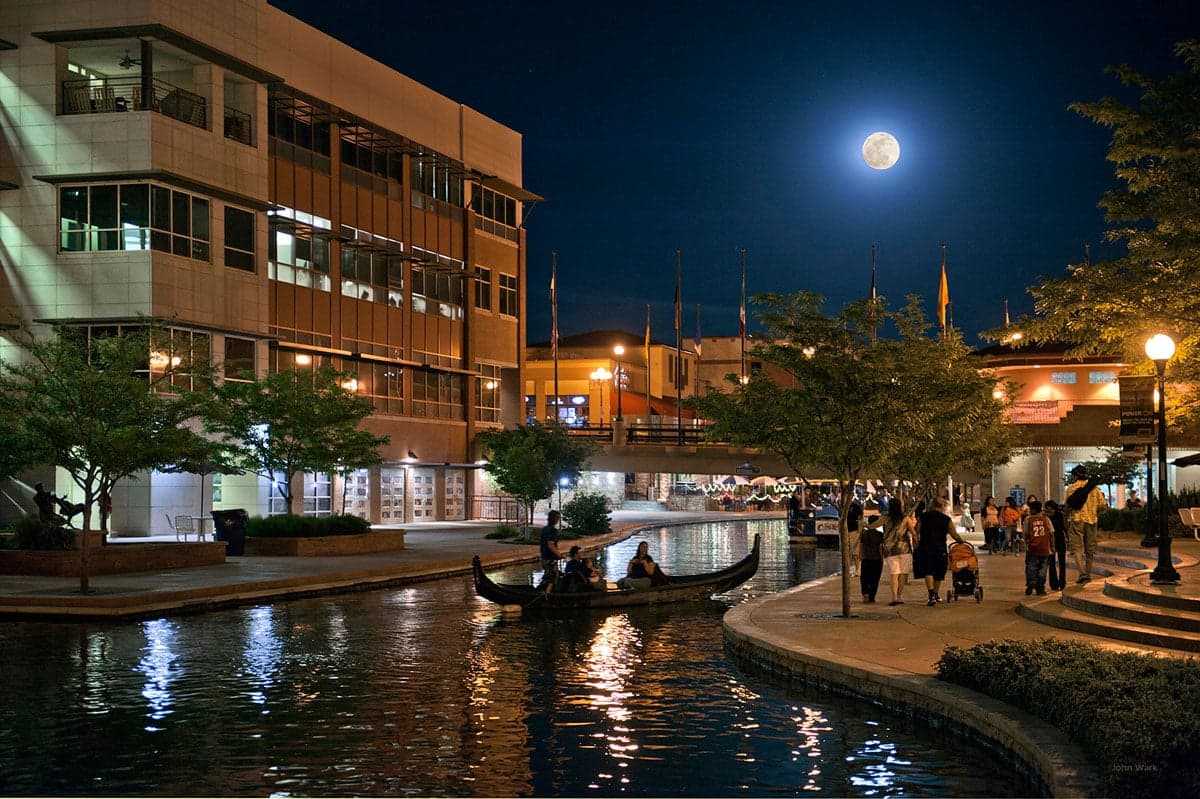
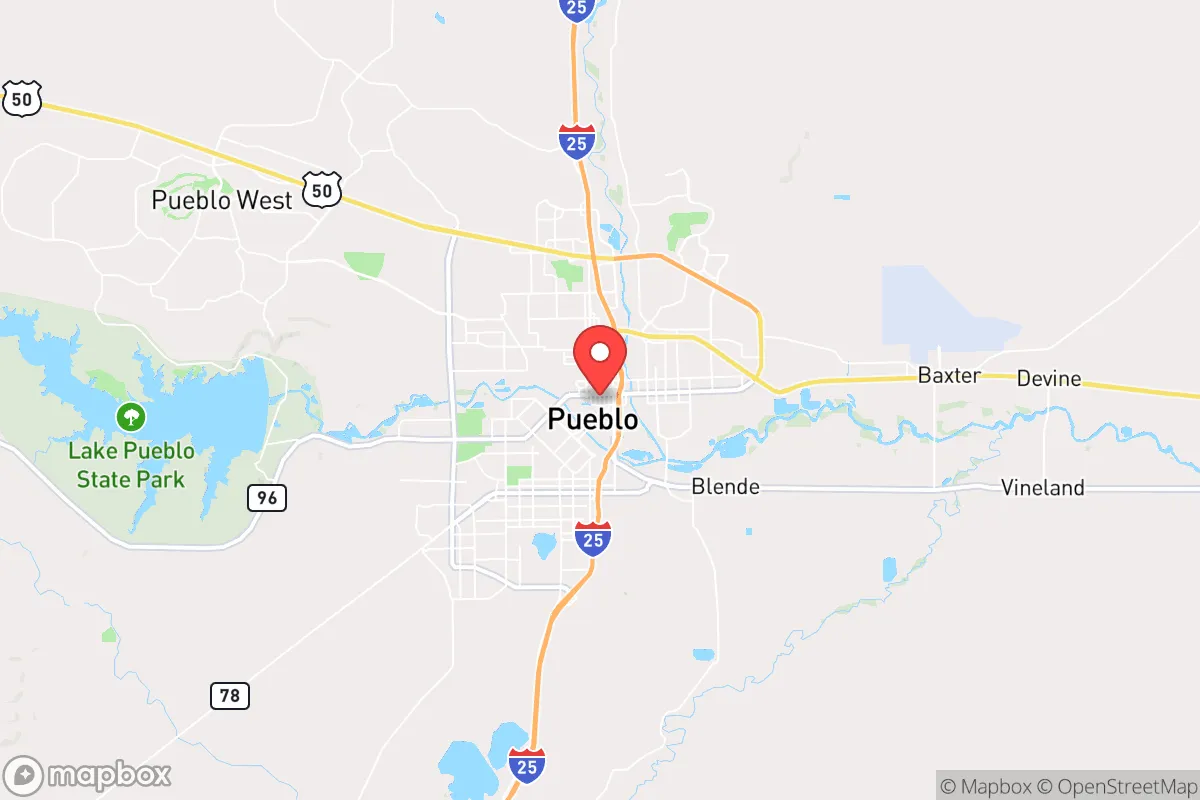
Photo: Wikipedia
Demographics of Pueblo, CO
Affluence Level in Pueblo, CO
A below-average socioeconomic profile. Incomes, home values, and educational attainment trail the U.S., with higher poverty and unemployment.
People of Pueblo, CO
The people of Pueblo, Colorado today form a community defined by its working-class roots and a nearly even demographic split between Hispanic and White residents, with a notably low foreign-born share of just 2.5%. At 111,514 residents, the city is denser and more ethnically balanced than much of the surrounding region, carrying a distinctive identity as a historic industrial hub where Mexican-American culture is deeply woven into daily life. The city’s population is older and less college-educated than the state average—only 22.8% hold a bachelor’s degree—reflecting a blue-collar character that has persisted through economic booms and busts.
How the city was settled and grew
Pueblo’s population history begins not with Spanish colonists but with the 1842 trading post El Pueblo, built by trappers and traders of mixed European and Native ancestry. The city’s real growth came after the 1870s, when the Denver and Rio Grande Railroad arrived and the Colorado Fuel and Iron Company (CF&I) established its massive steel mill. This drew a first wave of immigrants: German, Irish, Italian, and Eastern European laborers settled in the Bessemer neighborhood, a dense working-class district south of the Arkansas River built around the mill. By 1900, Pueblo was a classic industrial boomtown, with ethnic enclaves like Grove Street (Italian) and East Side (German and Irish) forming around the steel plant.
A second, larger wave arrived between 1910 and 1930, when the Mexican Revolution and labor demand at CF&I drew Mexican immigrants and Mexican-American migrants from the Southwest. They settled primarily in Salt Creek, a neighborhood directly adjacent to the mill, and in the East Side near the rail yards. These communities built the city’s enduring Hispanic character, establishing churches, mutual aid societies, and a distinct cultural identity that remains central to Pueblo today. By 1950, Pueblo was roughly 30% Hispanic, with the rest predominantly White and a small Black population (under 3%) concentrated near the mill.
Modern era (post-1965)
The post-1965 period saw two major shifts. First, the 1970s and 1980s brought deindustrialization: CF&I’s decline and eventual closure in the 1990s triggered out-migration of White and Black families, particularly from Bessemer and Salt Creek, as jobs vanished. Second, domestic in-migration of Hispanic families from rural Colorado, New Mexico, and Texas accelerated, filling the void. By 2000, Pueblo had become a majority-minority city, with Hispanics surpassing Whites in population share. Today, the city is 48.4% Hispanic and 44.5% White, with the Hispanic population concentrated in the East Side, Salt Creek, and Bessemer, while Whites are more dispersed across the North Side and newer subdivisions like Pueblo West (an unincorporated suburb). The Black population remains small at 2.3%, largely in the East Side and central neighborhoods. East/Southeast Asian communities (0.7%) and Indian-subcontinent residents (0.1%) are tiny and scattered, with no distinct ethnic enclave. The foreign-born share is very low at 2.5%, indicating that nearly all Hispanic growth comes from native-born families, not new immigration.
The future
Pueblo’s population is trending toward further Hispanicization, but not through immigration—rather through higher birth rates among Hispanic families and continued domestic migration from other parts of the Southwest. The White population is aging and declining, while the Hispanic population is younger and growing. The city is not tribalizing into distinct enclaves; instead, neighborhoods like the East Side and Bessemer are becoming more uniformly Hispanic, while the North Side and Pueblo West remain predominantly White. The small Black and Asian populations are likely to remain stable or shrink slightly, as Pueblo lacks the economic draw for new immigrant groups. Over the next 10-20 years, the city will likely become majority-Hispanic, with a shrinking White minority and a very small, stable Black and Asian presence. The low college attainment rate (22.8%) and aging industrial base suggest continued economic challenges, though recent investments in healthcare and logistics may slow population decline.
For someone moving in now, Pueblo is a city becoming more Hispanic, older, and less diverse in terms of immigrant origins—a place where working-class identity and family ties matter more than new arrivals. The population is homogenizing around its Hispanic core, with White residents increasingly concentrated in suburban-style neighborhoods outside the historic urban core. This is not a city of rapid change or new diversity, but one where long-established communities are slowly shifting in composition.

* Values derived from national, state, county, city and local statistics and may differ in a specific area. Last updated: 2026-04-23T06:21:31.000Z
Narrative content on this page is AI-generated and may contain mistakes. Verify any details that matter before acting on them.
ReloMaps may earn a commission from affiliate links at no extra cost to you.

