
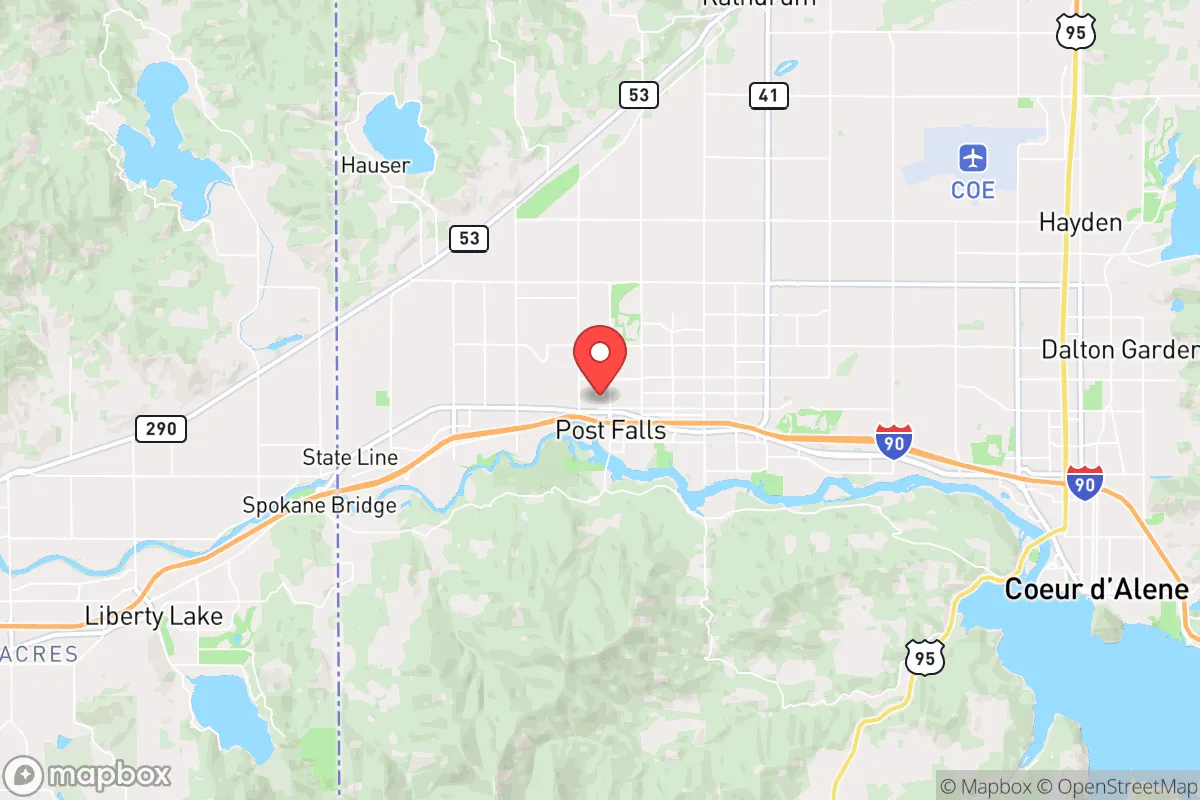
Photo: Wikipedia
Personal Sovereignty in Post Falls, ID
Viable for self-reliance. Generally workable, though some barriers may limit total independence.
What does Personal Sovereignty tell us?
Personal Sovereignty measures your capacity for self-reliance and independence with minimal government friction. Higher scores mean fewer barriers between you and the way you want to live... but it assumes you have the space you need and good neighbors.
What does this tell us?
Personal Sovereignty measures your capacity for self-reliance and independence with minimal government friction. Higher scores mean fewer barriers between you and the way you want to live... but it assumes you have the space you need and good neighbors.
State Policy
Energy independence: Importer (25% of energy produced in-state)
Personal Liberty
Homesteading

Personal Liberty Analysis
Post Falls, Idaho offers one of the strongest personal sovereignty environments in the Pacific Northwest, largely because it sits in a state that has deliberately pushed back against federal overreach and coastal regulatory models. For a single individual or parent operating from a survivalist or prepper mindset, the key question isn't whether the government will leave you alone—it's whether the local infrastructure and legal climate will support your ability to live on your own terms. The answer here is more favorable than in most of the region, but specific trade-offs exist that a strategic relocation requires understanding before making a move.
Tax burden and regulatory posture: how Idaho compares to neighboring states
Idaho's tax structure is a major draw for those seeking to minimize government extraction from their labor and assets. The state levies a flat income tax of 5.8% as of 2025, down from a progressive rate in prior years, and Kootenai County's property tax rates are among the lowest in the state—typically around 0.7% to 0.9% of assessed value for residential property. There is no state-level estate or inheritance tax, which matters for anyone building multigenerational self-sufficiency. Sales tax is a flat 6% statewide, with no local add-ons in Post Falls, and groceries are exempt. Compared to Washington, which has no income tax but imposes a capital gains tax and significantly higher property taxes in many areas, or Oregon, which has a high income tax and no sales tax but heavy land-use regulation, Idaho's posture is clearly more aligned with keeping government's hand out of your wallet. The regulatory environment at the state level is also notably light: Idaho has right-to-work laws, minimal occupational licensing burdens relative to coastal states, and a state government that has actively resisted federal EPA and BLM overreach on land use. However, Post Falls itself is a growing city, and city-level zoning and building codes are more restrictive than in unincorporated Kootenai County—something to factor in if you plan to build or modify structures without bureaucratic delays.
Self-defense and gun law specifics: what the Second Sanctuary means in practice
Idaho is one of the strongest Second Amendment states in the country, and Post Falls sits in Kootenai County, which has declared itself a Second Amendment Sanctuary. This means local law enforcement is instructed not to enforce federal gun laws they deem unconstitutional—a meaningful layer of protection if federal overreach escalates. The state allows constitutional carry for anyone 18 or older who can legally possess a firearm, with no permit required for open or concealed carry. There is no state-level magazine capacity restriction, no assault weapon ban, and no universal background check requirement beyond federal law. Stand-your-ground laws are in effect, with no duty to retreat in any place you are lawfully present. For a prepper, this legal framework means you can maintain a full armory without worrying about state-level confiscation schemes or registration databases. The practical reality in Post Falls is that gun ownership is culturally normalized—you will not face social stigma for carrying openly, and most local gun shops and ranges are well-stocked. The only caveat is that Idaho does have a permit system for those who want reciprocity with other states, and the application process through the Kootenai County Sheriff's Office is straightforward and typically processed within 30 days.
Self-reliance and homesteading viability: lot sizes, zoning, and off-grid feasibility
Post Falls itself is increasingly suburban, which limits some homesteading options within city limits. Standard residential lots in newer subdivisions are typically 0.15 to 0.25 acres, and city zoning restricts keeping livestock, building detached workshops beyond certain sizes, and installing alternative energy systems without permits. However, the surrounding unincorporated areas of Kootenai County—particularly north toward Rathdrum or east toward Coeur d'Alene—offer 5- to 20-acre parcels at prices still reasonable by West Coast standards, often under $100,000 for raw land. County zoning allows for agricultural use, including chickens, goats, and even small-scale cattle, and there are no county-level bans on rainwater collection or composting toilets. Off-grid feasibility is high: Idaho has no state law prohibiting solar panel installation or battery storage, though you will need to coordinate with your local utility (Kootenai Electric Cooperative or Avista) if you want to remain grid-tied. Well water is common in rural areas, and septic systems are permitted with standard health department approval. The main regulatory hurdle is that Kootenai County requires building permits for any structure over 200 square feet, and they enforce the International Residential Code—so you cannot simply throw up a shed and call it a home without inspections. For a serious prepper, the play is to buy land outside city limits, build a pole barn or shop first as a permitted structure, and then develop living quarters within that framework, staying within code but maximizing self-sufficiency.
Personal liberties: parental rights, medical autonomy, speech, and property
Idaho has been at the forefront of protecting parental rights in education and healthcare. The state's Parental Rights in Education Act (2023) requires schools to obtain parental consent before administering any mental health or medical questionnaire, and parents have the right to review all instructional materials. This matters for parents who want to shield their children from ideological curricula or medical interventions without their knowledge. Medical autonomy is also strong: Idaho has banned vaccine passports and prohibits discrimination based on vaccination status, and the state does not mandate COVID-19 or other childhood vaccines for school attendance beyond the standard schedule (which includes exemptions for religious and philosophical reasons). On speech, Idaho has no hate speech laws that could be used to prosecute politically incorrect expression, and the state has passed legislation protecting free speech on college campuses. Property rights are robust: Idaho is a "right to exclude" state, meaning you can deny entry to government officials without a warrant, and the state has a strong eminent domain reform law that limits takings for private economic development. The one area where personal sovereignty is weaker is in the realm of medical marijuana—Idaho remains one of the few states with no legal access whatsoever, even for medical use, and possession of any amount is a criminal offense. For a prepper, this means you need to be comfortable with zero tolerance on cannabis, or you need to factor in the risk of traveling to Washington or Montana.
Overall, Post Falls and its surrounding area offer a level of personal sovereignty that is rare in the modern United States, particularly when compared to the West Coast states that many relocating individuals are fleeing. The combination of low taxes, strong gun rights, permissive land-use regulations outside city limits, and robust parental and medical autonomy creates an environment where a determined individual or family can build a self-reliant life with minimal government interference. The trade-offs are real—growing suburbanization in Post Falls proper, the lack of medical cannabis access, and the need to navigate building codes—but for someone willing to buy land in the county and work within the existing legal framework, this area ranks among the top choices in the country for those prioritizing freedom over convenience.

* Values derived from national, state, county, city and local statistics and may differ in a specific area. Last updated: 2026-04-19T05:23:42.000Z
Narrative content on this page is AI-generated and may contain mistakes. Verify any details that matter before acting on them.
ReloMaps may earn a commission from affiliate links at no extra cost to you.

