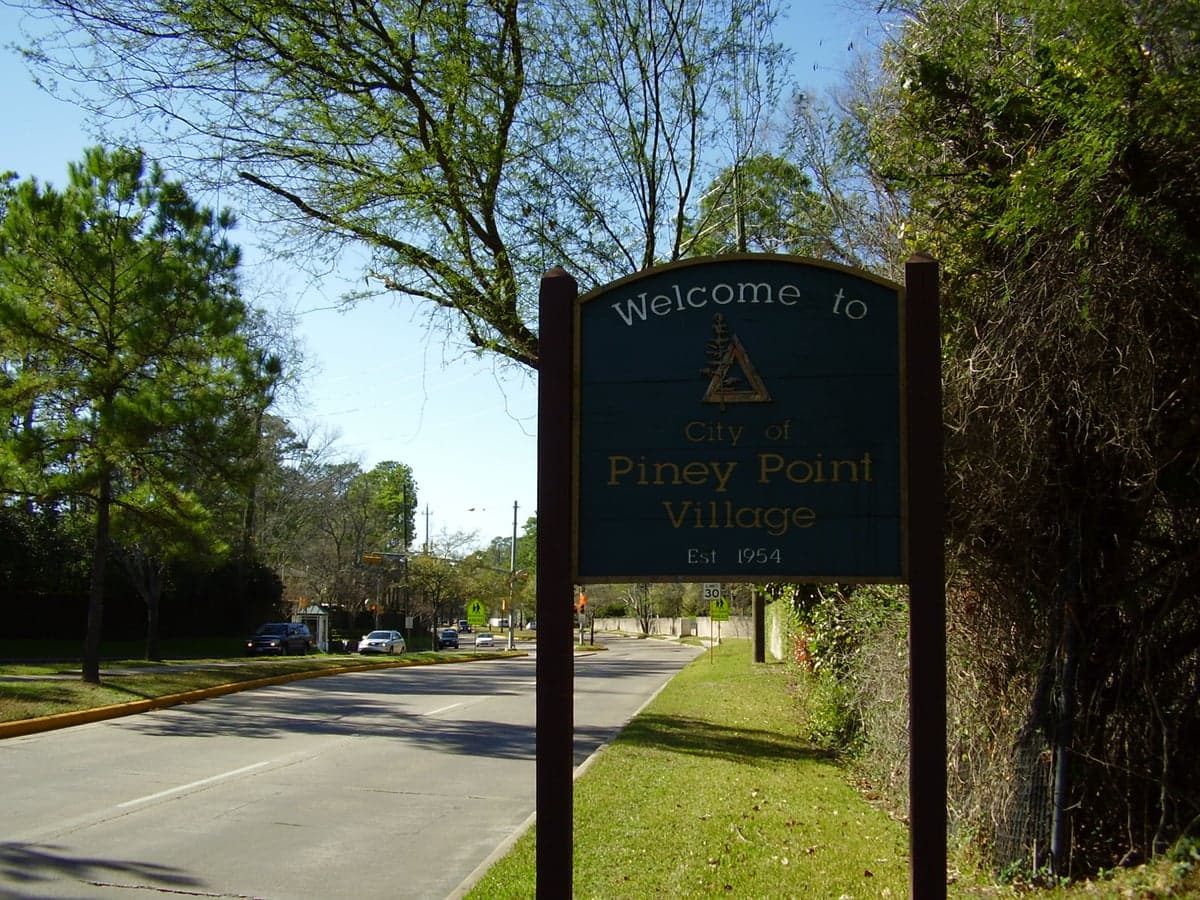
Photo: Wikipedia
Demographics of Piney Point Village, TX
Affluence Level in Piney Point Village, TX
An elite concentration of wealth — high incomes, strong home values, advanced degrees, and minimal poverty signal a top-tier socioeconomic profile.
Census doesn't track above $250K
People of Piney Point Village, TX
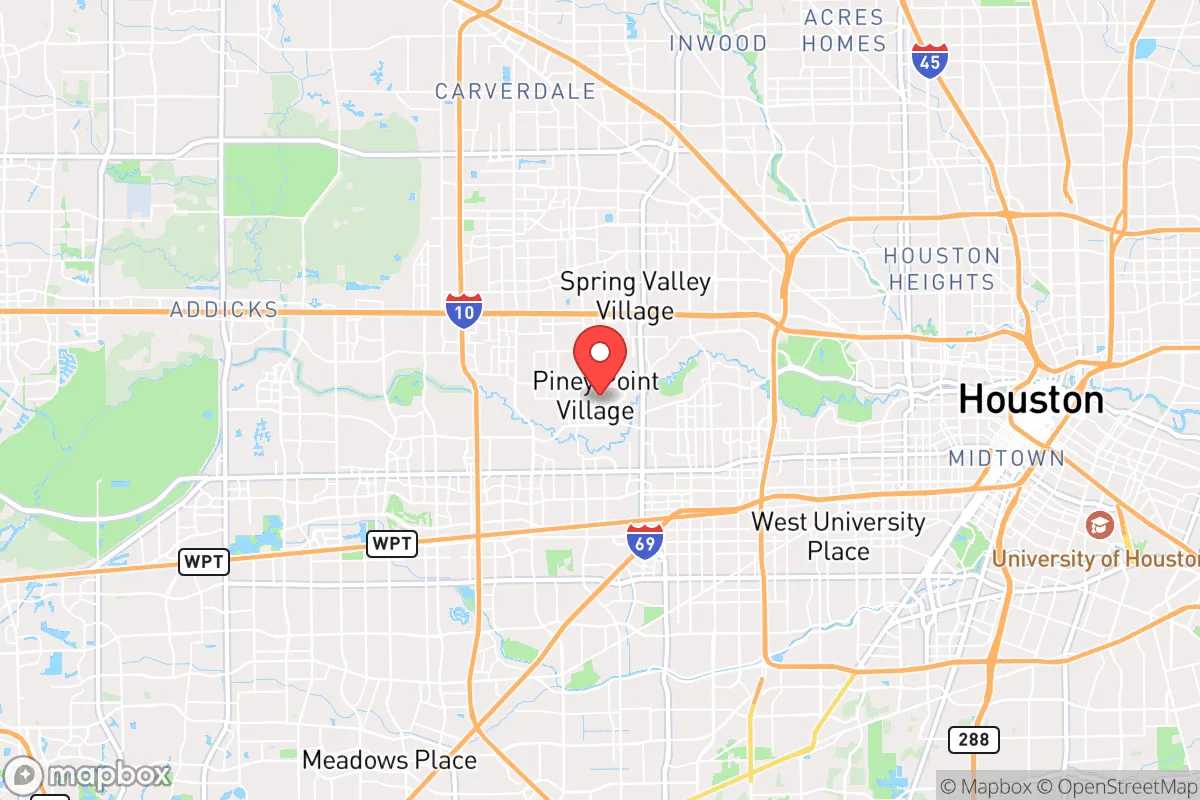
Piney Point Village, Texas, is a small, affluent enclave of roughly 3,090 residents in the heart of Houston’s Memorial area, characterized by its exceptionally high concentration of college-educated professionals (82.2%) and a predominantly White population (83.3%). The city is known for its large, custom-built homes on wooded lots, low crime rates, and a strong sense of privacy and exclusivity, attracting families and executives who prioritize top-rated schools and proximity to Houston’s Energy Corridor. Its population is notably less diverse than the surrounding region, with a small but visible East/Southeast Asian community (7.9%) and a separate Indian-subcontinent cohort (3.3%), while Hispanic (2.7%) and Black (0.6%) residents remain minimal.
How the city was settled and grew
Piney Point Village was incorporated in 1956, making it a post-World War II planned suburb rather than a historic settlement. The land was originally part of the vast Stephen F. Austin colony, but remained sparsely populated ranchland and piney woods into the early 20th century. The city’s founding population was almost entirely White, drawn by the post-war housing boom and the construction of the nearby Memorial Drive corridor. The original neighborhoods—Piney Point Village proper, Hunters Creek, and Bunker Hill Village (the latter two also incorporated separately)—were developed in the 1950s and 1960s as exclusive subdivisions for Houston’s growing professional class. These areas were marketed as “country living within the city,” attracting oil and gas executives, doctors, and lawyers who wanted large lots and a rural feel while commuting to downtown Houston. No significant immigrant or minority populations settled here during this era; the city was deliberately designed as a homogenous, upper-middle-class White enclave.
Modern era (post-1965)
The 1965 Hart-Cellar Act and subsequent waves of immigration had a muted effect on Piney Point Village compared to Houston as a whole. The city’s high property values and lack of rental housing created a natural barrier to large-scale demographic change. The most notable shift began in the 1980s and accelerated through the 2000s, as Houston’s Energy Corridor boomed and attracted highly skilled professionals from around the world. East/Southeast Asian families—particularly Chinese and Korean—began moving into neighborhoods like Memorial Hills and Nottingham Forest (the latter straddling the city’s border), drawn by the Memorial High School attendance zone and the area’s reputation for safety and academic excellence. A smaller but distinct Indian-subcontinent community also established itself, concentrated in the Piney Point Estates section, where newer, larger homes were built on former ranchland. These groups remain modest in share (7.9% East/Southeast Asian, 3.3% Indian) but are highly visible in the city’s top-tier schools and community organizations. The Hispanic and Black populations have remained negligible, reflecting the city’s continued economic exclusivity and lack of affordable housing stock.
The future
Piney Point Village’s population is likely to remain stable in size but slowly diversify at the upper end of the income spectrum. The city’s housing stock—almost entirely single-family homes on half-acre to one-acre lots—limits new construction and keeps prices high, filtering for buyers with significant capital. The East/Southeast Asian and Indian communities are expected to grow gradually, as second-generation professionals from these groups seek the same school districts and safety that drew their parents. However, the city is not trending toward rapid diversification; the White share (83.3%) is likely to remain dominant for the foreseeable future. The Hispanic and Black populations are unlikely to increase significantly without a change in housing policy or the construction of multi-family units, which the city’s zoning strongly opposes. The next 10-20 years will likely see a slow, steady replacement of aging White homeowners with younger, equally affluent families—some White, some East/Southeast Asian, and some Indian—who value the same core attributes: privacy, low taxes, and top-ranked public schools.
For someone moving in now, Piney Point Village offers a stable, low-density, high-amenity lifestyle with a population that is becoming slightly more diverse at the top but remains overwhelmingly White and wealthy. It is not a melting pot or a rapidly changing community; it is a carefully preserved enclave where demographic shifts happen slowly and only for those who can afford the entry price. The city’s future is one of continuity, not transformation.

* Values derived from national, state, county, city and local statistics and may differ in a specific area. Last updated: 2026-04-27T14:34:32.000Z
Narrative content on this page is AI-generated and may contain mistakes. Verify any details that matter before acting on them.
ReloMaps may earn a commission from affiliate links at no extra cost to you.

