Photo: Wikipedia
Demographics of Philadelphia, PA
Affluence Level in Philadelphia, PA
A below-average socioeconomic profile. Incomes, home values, and educational attainment trail the U.S., with higher poverty and unemployment.
People of Philadelphia, PA
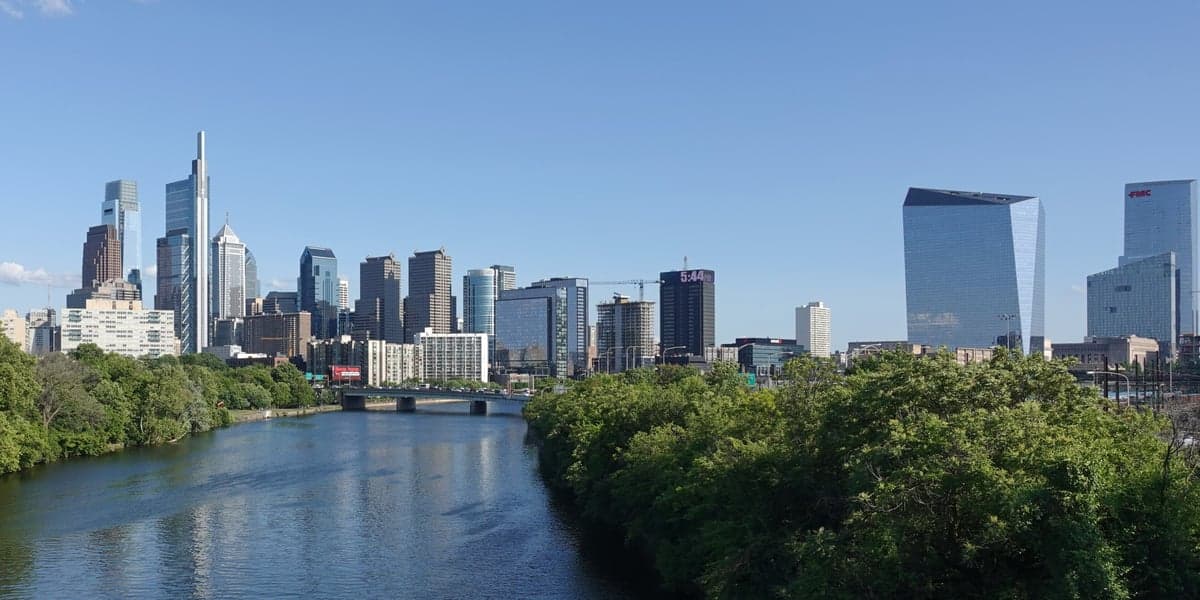
Philadelphia’s 1.58 million residents form one of the densest, most historically layered urban populations in the United States. The city is majority-minority, with a Black population of 38.9%, a Hispanic share of 15.2%, and a White non-Hispanic population of 33.6%. Despite its deep history as a destination for European immigrants, Philadelphia today is defined by its African American majority, a growing Hispanic presence, and a modest but visible East/Southeast Asian community (5.8%) alongside a separate Indian-subcontinent population (1.9%). The foreign-born share sits at just 7.1%, well below the national average, giving the city a distinctly American-born character compared to gateway cities like New York or Los Angeles.
How the city was settled and grew
Philadelphia was founded in 1682 by William Penn as a haven for religious tolerance, drawing Quakers, Germans, and Scots-Irish in the colonial era. The city’s grid plan and location on the Delaware River made it a commercial hub, and by the early 19th century it was the largest city in the United States. The first major wave of European immigrants were Irish fleeing the Great Famine in the 1840s and 1850s, settling in Kensington and Fishtown, neighborhoods along the Delaware that became working-class Irish strongholds. Germans followed, concentrating in Germantown and Northern Liberties, where they built breweries, churches, and mutual-aid societies. By the late 19th century, Italians arrived in force, establishing South Philadelphia as the city’s Italian heartland, a neighborhood still marked by the Italian Market and row houses built by immigrant labor. Eastern European Jews, fleeing pogroms, settled in Strawberry Mansion and later Oxford Circle, creating a dense Yiddish-speaking corridor. The Great Migration of Black Americans from the rural South began during World War I and accelerated through the 1940s, with newcomers settling in North Philadelphia and Point Breeze, transforming the city’s racial composition. By 1950, Philadelphia was roughly 80% White and 18% Black, with the Black population concentrated in a narrow band north and south of Center City.
Modern era (post-1965)
The 1965 Hart-Cellar Act opened immigration from Asia and Latin America, but Philadelphia’s foreign-born share remained low compared to coastal cities. The most dramatic post-1965 shift was domestic: White flight to suburbs accelerated after the 1964 race riots, and the city’s population fell from a peak of 2.07 million in 1950 to 1.52 million by 2000. Black residents became the largest single group, with West Philadelphia and Germantown emerging as predominantly Black middle-class neighborhoods. Hispanic immigration, primarily from Puerto Rico and later the Dominican Republic and Mexico, reshaped North Philadelphia and Kensington, where the Hispanic share now exceeds 50% in some census tracts. East/Southeast Asian communities, mostly Vietnamese and Chinese, established a small but stable presence in South Philadelphia around the Italian Market area, creating a multiethnic corridor. The Indian-subcontinent population (1.9%) is newer and more dispersed, with clusters in University City and Northeast Philadelphia, often tied to professional and tech jobs. The White population, now 33.6%, has stabilized and even grown slightly in Center City and adjacent neighborhoods like Fairmount and Northern Liberties, driven by young professionals and empty-nesters. The college-educated share is 34.6%, concentrated in these gentrifying areas, while large swaths of North and West Philadelphia remain below 15% college attainment.
The future
Philadelphia’s population is slowly growing again—up about 5% since 2010—but the growth is uneven. Center City and the river wards are attracting affluent newcomers, while the Black population in North and West Philadelphia is declining slightly as families move to suburbs like Cheltenham and Lower Merion. The Hispanic population is the fastest-growing segment, projected to reach 20-22% by 2040, driven by both immigration and high birth rates. The East/Southeast Asian population is growing modestly, with new Chinese immigrants settling in Northeast Philadelphia near the growing Chinatown satellite. The Indian-subcontinent population is small but growing, concentrated in professional corridors near universities and hospitals. The city is not homogenizing; instead, it is tribalizing into distinct enclaves: affluent, White-majority Center City; working-class Hispanic North Philadelphia; middle-class Black Germantown; and multiethnic, gentrifying South Philadelphia. The foreign-born share is rising slowly but will likely remain below 12% for the next decade, meaning Philadelphia will stay a predominantly native-born city with deep racial and economic divides.
For someone moving in now, Philadelphia offers a dense, walkable urban experience with a strong sense of neighborhood identity, but the city’s future is one of increasing economic and racial stratification. The growing Hispanic population and stable Black majority mean the city will remain majority-minority, while the White population is concentrated in the most prosperous areas. New arrivals should expect a city where neighborhood choice is the primary determinant of daily life, with Center City and its surroundings offering amenities and safety, while many other areas continue to struggle with poverty and disinvestment.

* Values derived from national, state, county, city and local statistics and may differ in a specific area. Last updated: 2026-05-01T21:36:02.000Z
Narrative content on this page is AI-generated and may contain mistakes. Verify any details that matter before acting on them.
ReloMaps may earn a commission from affiliate links at no extra cost to you.

