
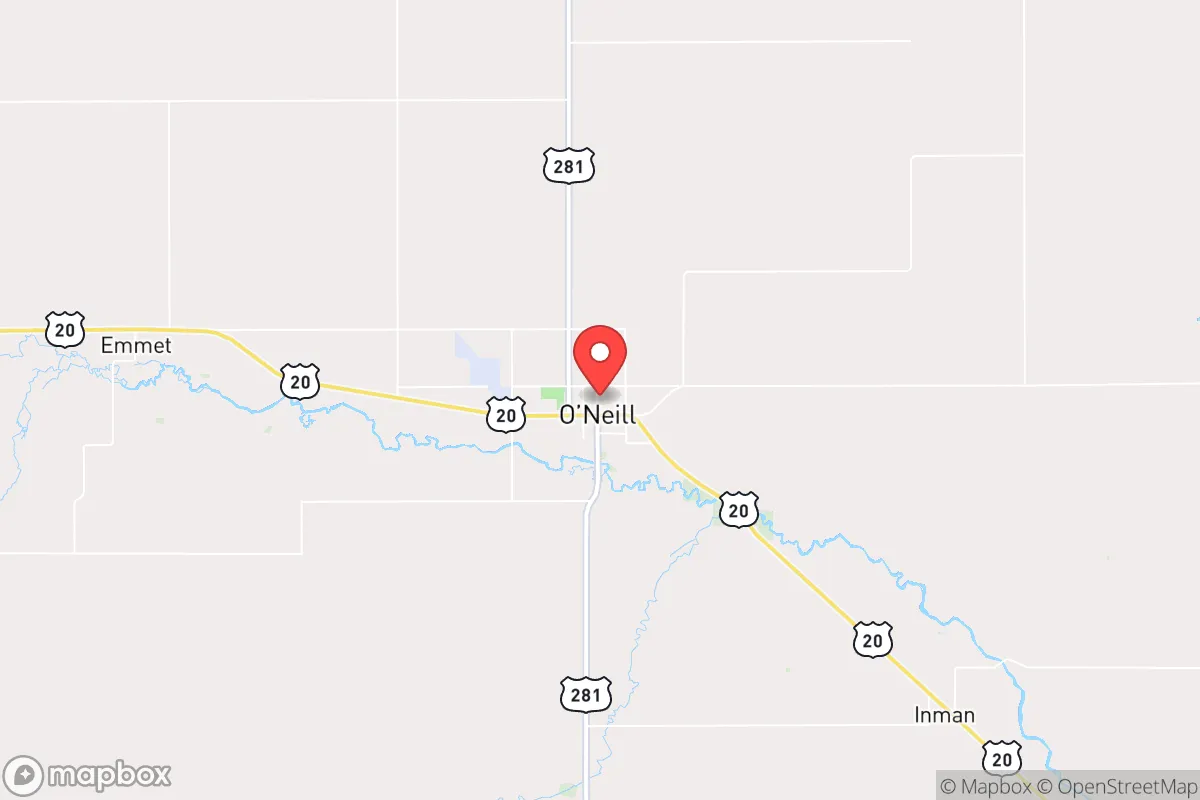
Photo by Jakob Rosen on Unsplash
Demographics of Oneill, NE
Affluence Level in Oneill, NE
A middle-class area roughly in line with national averages across income, home values, education, and employment.
People of Oneill, NE
The people of O’Neill, Nebraska, today number 3,574, forming a community that is overwhelmingly white (87.7%) with a growing Hispanic minority (8.5%) and a small foreign-born population (2.6%). The city’s identity is rooted in its Irish Catholic founding and its role as a regional trade and healthcare hub for north-central Nebraska, giving it a conservative, family-oriented character. With a college attainment rate of 20.3%, the workforce is heavily blue-collar, centered on agriculture, manufacturing, and the local hospital. O’Neill is known as the “Irish Capital of Nebraska,” a label that still shapes its annual St. Patrick’s Day celebrations and the civic pride of its residents.
How the city was settled and grew
O’Neill was founded in 1874 by General John O’Neill, a leader of the Irish Catholic Colonization Association, who sought to create a refuge for Irish immigrants fleeing urban poverty and discrimination in the East. The first wave of settlers—primarily Irish Catholic families—arrived via the Fremont, Elkhorn and Missouri Valley Railroad, which reached the site in 1881. These early residents built the original town around Douglas Street and Fourth Street, an area now known as Old Town O’Neill, where the first churches, saloons, and general stores clustered. The town’s growth was fueled by the 1862 Homestead Act, which granted 160-acre plots to settlers, and later by the expansion of the railroad, which made O’Neill a shipping point for cattle and grain. By 1900, the population had reached roughly 1,200, almost entirely of Irish descent, with a smattering of German and Czech families who settled in the South Hill neighborhood, just south of the railroad tracks. The city’s early economy depended on agriculture—wheat, corn, and livestock—and the establishment of St. Anthony’s Hospital in 1915 drew Irish Catholic nurses and doctors, cementing the town’s ethnic and religious character.
Modern era (post-1965)
After the 1965 Immigration and Nationality Act, O’Neill saw little direct immigration from new source countries, as the city lacked the industrial jobs or ethnic networks that drew newcomers to larger Nebraska cities like Omaha or Grand Island. Instead, the post-1965 period was marked by domestic in-migration from rural Holt County and neighboring counties, as family farms consolidated and younger residents moved to town for jobs at the hospital, the O’Neill Public Schools, and manufacturing plants like Becton Dickinson (a medical device factory that opened in 1979). The Westwood Addition, a subdivision developed in the 1970s and 1980s west of Highway 281, absorbed many of these new residents—mostly white, middle-class families seeking newer homes on larger lots. The Hispanic population began to grow slowly in the 1990s, driven by work at the local meatpacking plant (Cargill, now closed) and in agricultural labor. These families initially settled in rental housing along East Douglas Street and in the Park Avenue area, near the old stockyards. Today, the Hispanic share (8.5%) is concentrated in these older, more affordable neighborhoods, while the white population (87.7%) is spread across all areas, with a slight tilt toward the newer subdivisions. The Black (0.8%) and East/Southeast Asian (0.8%) populations remain tiny, mostly consisting of professionals—doctors, teachers, or engineers—who moved to town for specific jobs and live scattered throughout the city, with no distinct ethnic enclave.
The future
O’Neill’s population is slowly aging and shrinking, mirroring the broader rural Nebraska trend. The 2020 census showed a decline of about 4% from 2010, driven by out-migration of young adults seeking college or urban jobs. The Hispanic population is the only segment showing clear growth, rising from roughly 5% in 2010 to 8.5% today, and this trend is likely to continue as families in the Park Avenue and East Douglas areas have higher birth rates and attract new arrivals from Texas and California via agricultural networks. However, the overall population is projected to remain flat or decline slightly over the next decade, as the white, older cohort passes away faster than new residents arrive. The city is not tribalizing into distinct enclaves—Hispanic families are increasingly moving into Westwood Addition and other newer subdivisions as they gain economic stability, suggesting assimilation rather than segregation. The foreign-born share (2.6%) is likely to plateau, as O’Neill lacks the large employers or refugee resettlement programs that drive immigration in larger cities. The college-educated share (20.3%) is below the state average (32%), and without a major university or tech sector, the city will continue to attract residents for practical, family-oriented reasons—affordable housing, safe streets, and proximity to outdoor recreation—rather than for career opportunities in knowledge industries.
For someone moving in now, O’Neill is becoming a more stable, slightly more diverse version of its historic self: still overwhelmingly white and Irish-identified, but with a growing Hispanic presence that is integrating into the community rather than forming a separate enclave. The city offers a low-cost, low-crime environment for families who value traditional community structures and are comfortable in a setting where nearly nine out of ten neighbors share the same racial background. The trade-off is limited economic dynamism and a shrinking tax base, which will challenge the school system and infrastructure in the coming decades.

* Values derived from national, state, county, city and local statistics and may differ in a specific area. Last updated: 2026-05-01T05:25:59.000Z
Narrative content on this page is AI-generated and may contain mistakes. Verify any details that matter before acting on them.
ReloMaps may earn a commission from affiliate links at no extra cost to you.

