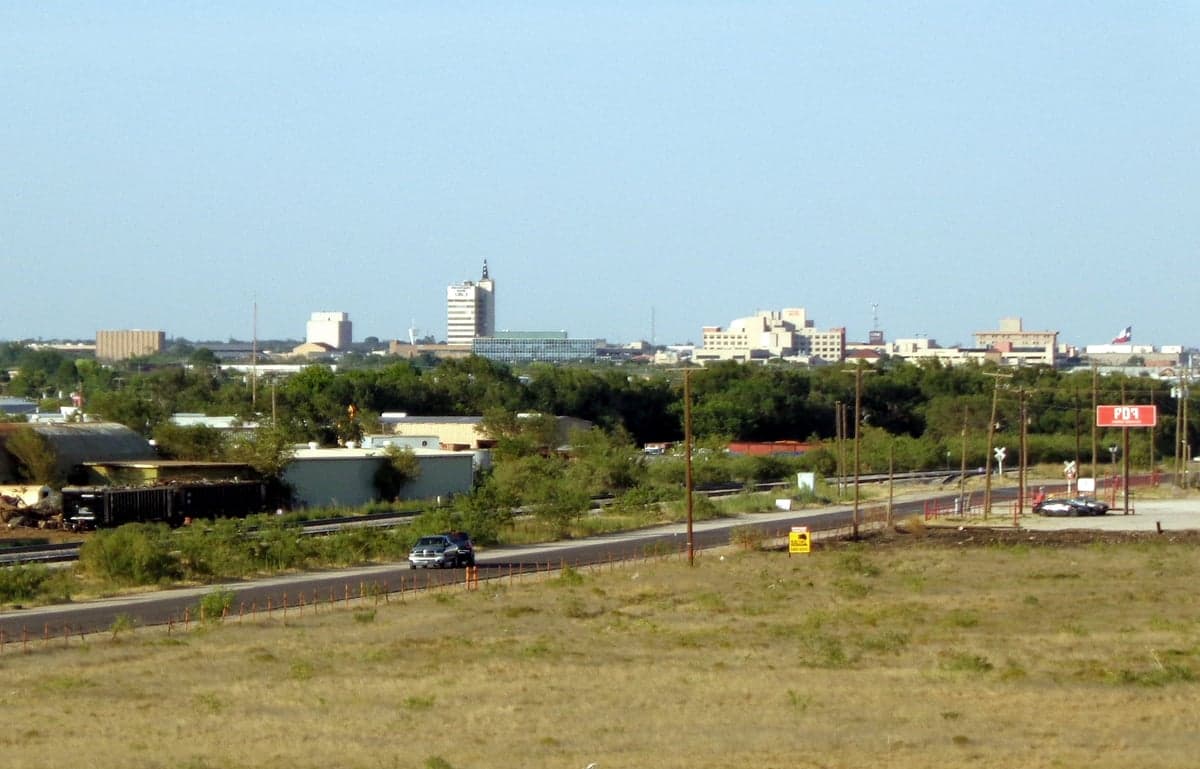
Photo: Wikipedia
Demographics of Odessa, TX
Affluence Level in Odessa, TX
A middle-class area roughly in line with national averages across income, home values, education, and employment.
People of Odessa, TX
The people of Odessa, Texas today form a predominantly Hispanic (61.2%) and working-class city of 114,080, shaped by a century of oil booms and cross-border migration. White residents make up 28.9% of the population, Black residents 6.2%, and East/Southeast Asian communities 1.2%, with Indian-subcontinent residents at 0.5%. The city’s identity is rooted in the Permian Basin’s extractive economy, producing a population that is younger, less college-educated (18.3%), and more transient than the Texas average, with a strong sense of local pride and a conservative political tilt.
How the city was settled and grew
Odessa was founded in 1881 as a railroad stop on the Texas and Pacific Railway, but its population remained sparse until the 1920s oil boom. The first major wave of settlers were Anglo-American farmers and ranchers from the South and Midwest, drawn by land grants and the promise of cotton farming. The discovery of oil in 1926 at the nearby Yates Field transformed Odessa almost overnight. The original Anglo settlers built homes in the Sherwood Addition and North Park neighborhoods, which remain predominantly white and older today. During the 1930s and 1940s, Mexican-American laborers arrived to work the oil fields and railroads, settling in the South Side and East Odessa areas, where they established a tight-knit community around St. Mary’s Catholic Church. A smaller wave of Black families came during the 1940s and 1950s, largely for oil-field and service jobs, and concentrated in the West Odessa unincorporated area and the Heights neighborhood near downtown. By 1960, Odessa’s population had reached 80,000, with a white majority of roughly 85% and a Hispanic minority of about 12%.
Modern era (post-1965)
The 1965 Hart-Cellar Immigration Act opened the door for larger-scale immigration from Latin America, and Odessa’s Hispanic population grew steadily through the 1970s and 1980s. The 1980s oil bust caused a sharp population decline—from 90,000 in 1982 to 85,000 by 1990—but the Hispanic share continued rising as Anglo families left for Houston and Dallas. The 2000s shale boom reversed the decline, drawing a new wave of domestic migrants from other Texas cities and the Rust Belt. These newcomers, mostly white and Hispanic, settled in newer subdivisions like Westridge and Mission Ranch on the city’s western edge. The Hispanic population became the majority by 2010, driven by both immigration and higher birth rates. Today, the foreign-born share is 8.6%, lower than the Texas average of 17%, indicating that most Hispanic residents are U.S.-born. The Black population has remained stable at around 6%, concentrated in the Heights and South Side. East/Southeast Asian communities, primarily Vietnamese and Filipino, are small (1.2%) and clustered near the University of Texas Permian Basin campus. Indian-subcontinent residents (0.5%) are a recent, professional addition, often working in oil-field engineering and healthcare.
The future
Odessa’s population is projected to grow modestly, reaching roughly 120,000 by 2035, driven by continued oil and gas activity and a steady influx of Hispanic families from the Rio Grande Valley and northern Mexico. The city is not homogenizing; rather, it is tribalizing into distinct enclaves. The Anglo population is aging and shrinking, concentrated in Sherwood Addition and North Park, while Hispanic families dominate South Side and East Odessa. The small Black community is stable but not growing, and East/Southeast Asian and Indian communities are likely to remain niche professional groups. The foreign-born share may rise slightly as oil-field service companies recruit skilled workers from abroad, but overall, Odessa will remain a majority-Hispanic, working-class city with a strong conservative culture. The college-educated share (18.3%) is unlikely to rise dramatically unless the local economy diversifies beyond extraction.
For someone moving in now, Odessa is a place where the oil economy still dictates daily life, and where the population is becoming more Hispanic and younger. The city offers affordable housing and a strong sense of community, but limited cultural diversity and a thin professional class. New arrivals should expect a population that is deeply rooted in the Permian Basin’s boom-and-bust cycle, with a growing Hispanic majority and a stable but aging Anglo minority.

* Values derived from national, state, county, city and local statistics and may differ in a specific area. Last updated: 2026-10-10T16:28:34.000Z
Narrative content on this page is AI-generated and may contain mistakes. Verify any details that matter before acting on them.
ReloMaps may earn a commission from affiliate links at no extra cost to you.

