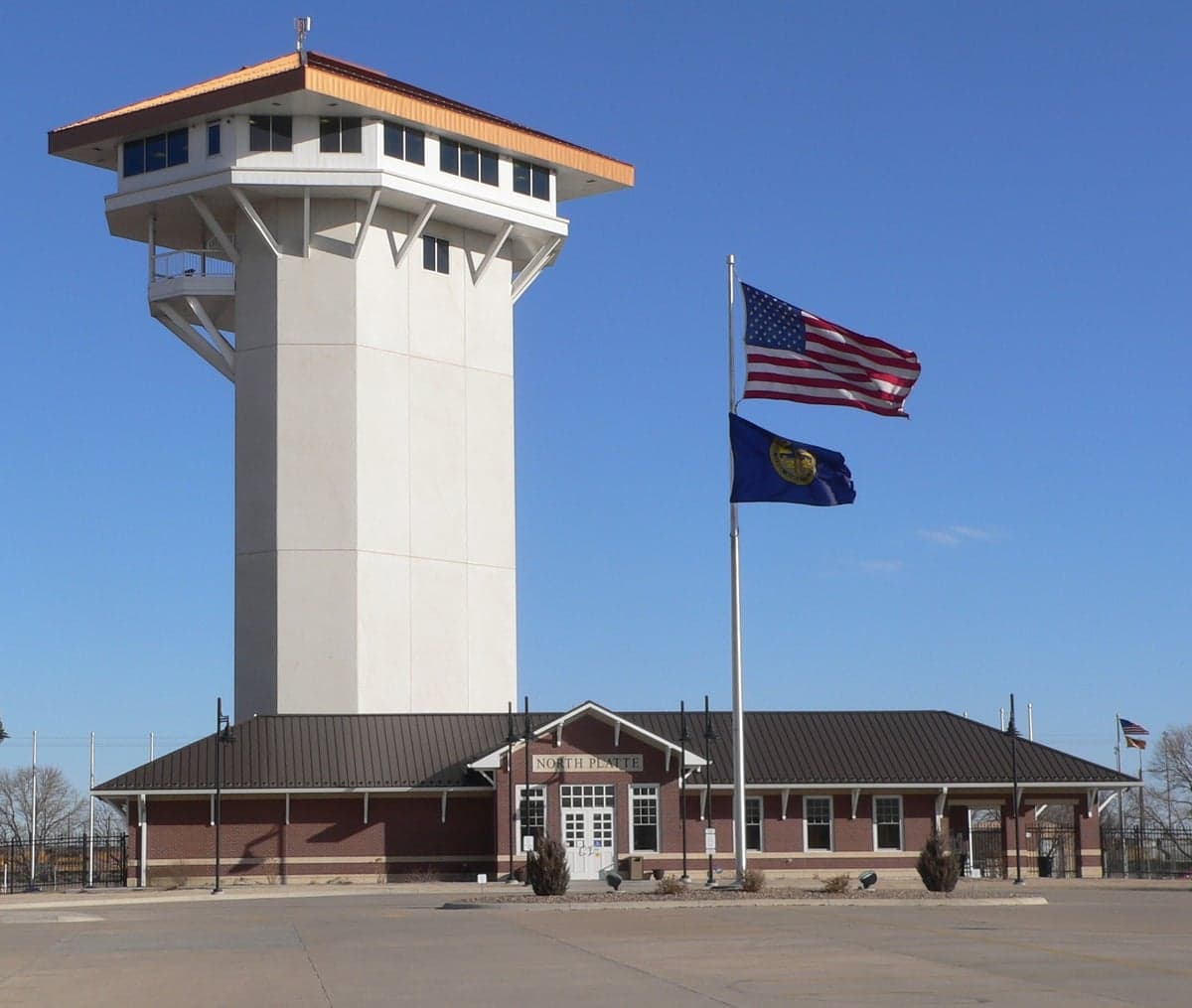
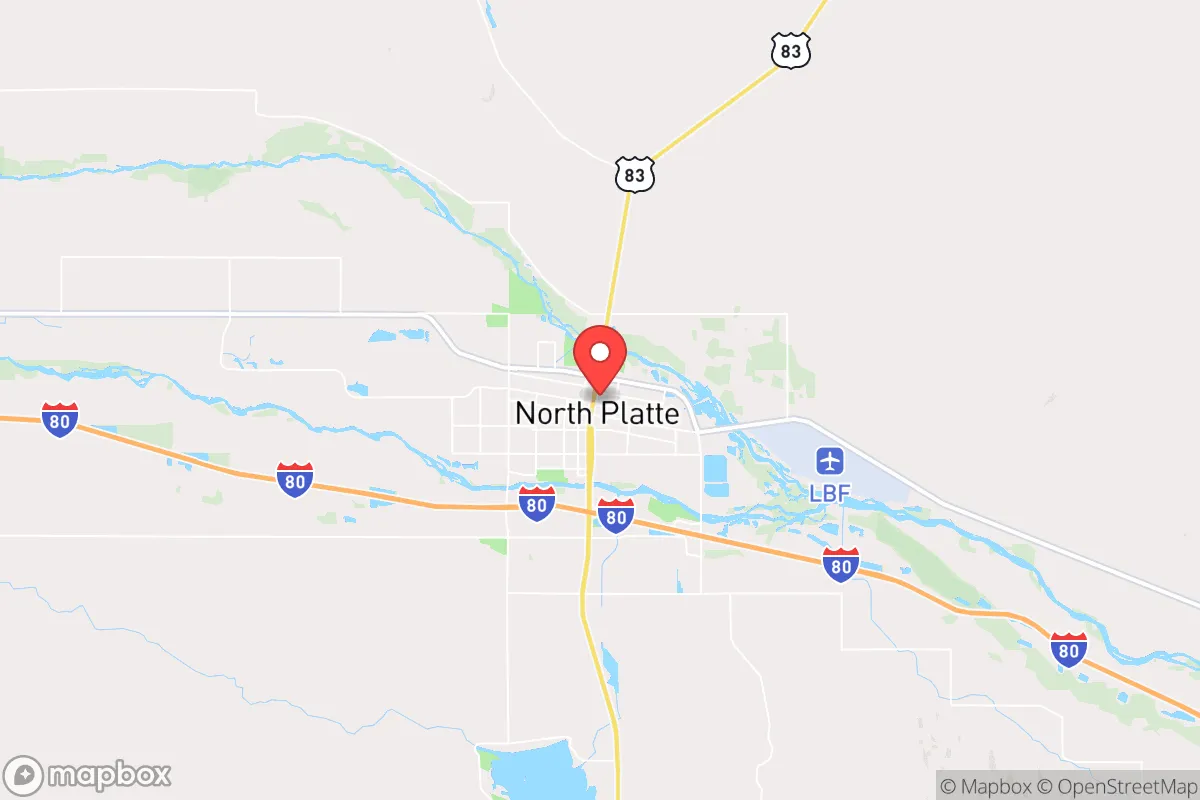
Photo: Wikipedia
Demographics of North Platte, NE
Affluence Level in North Platte, NE
A below-average socioeconomic profile. Incomes, home values, and educational attainment trail the U.S., with higher poverty and unemployment.
People of North Platte, NE
The people of North Platte, Nebraska, today number 23,030 and form a predominantly white (84.9%) community with a notable Hispanic minority (10.3%) and very small Black (1.0%), East/Southeast Asian (0.8%), and Indian subcontinent (0.1%) populations. Only 1.5% of residents are foreign-born, and 18.2% hold a college degree, reflecting a working-class, native-born character rooted in railroad and agricultural history. The city’s identity is shaped by its role as a Union Pacific hub and its location along the Platte River, with a population that has remained stable in recent decades, showing slow growth and modest diversification.
How the city was settled and grew
North Platte was founded in 1866 as a railroad town, with the Union Pacific Railroad selecting the site for a division point and depot. The first major wave of settlers were railroad workers and their families, many of Irish and German descent, who built the original core around the depot in what is now Downtown North Platte. The 1880s saw a second wave of homesteaders drawn by the 1862 Homestead Act, settling on farms surrounding the town and establishing the South Platte area across the river. By the early 20th century, the railroad’s Bailey Yard—the world’s largest rail yard—became the dominant employer, attracting a third wave of workers from the Midwest and Great Plains, including many of Czech and Scandinavian ancestry. These groups built modest homes in neighborhoods like Westfield and Centennial Park, which remain predominantly white and working-class today. The city’s growth peaked around 1950 at roughly 15,000, driven by railroad expansion and the nearby Army Air Base (now North Platte Regional Airport).
Modern era (post-1965)
After the 1965 Hart-Cellar Act, North Platte saw minimal immigration compared to larger Nebraska cities like Omaha or Lincoln. The foreign-born share remains very low at 1.5%, with most newcomers being Hispanic migrants drawn to agricultural and meatpacking jobs in the region. These families have concentrated in the East End neighborhood, near the industrial corridor along Highway 30, where rental housing and mobile home parks are common. The Hispanic population grew from roughly 3% in 1990 to 10.3% today, making it the city’s only significant minority group. Domestic in-migration has been limited, with many young adults leaving for college or urban jobs, while retirees from rural Nebraska have moved into neighborhoods like Lakeview and Willow Creek. The Black population remains tiny (1.0%), concentrated in scattered households rather than a distinct enclave. East/Southeast Asian residents (0.8%) are mostly professionals at Great Plains Health hospital or the University of Nebraska–Lincoln’s West Central Research and Extension Center, living in newer subdivisions like Prairie Hills. The Indian subcontinent population (0.1%) is negligible, typically a few families in professional roles.
The future
The population is slowly homogenizing in terms of race, with the white share declining from 90% in 2000 to 84.9% today, while the Hispanic share continues to grow. This trend is likely to continue, with Hispanic families moving into the East End and South Platte areas, though assimilation into the broader community is occurring as second-generation residents adopt English and local customs. The foreign-born share is expected to remain low, as North Platte lacks the large employers or refugee resettlement programs that drive immigration in larger cities. The city’s population is projected to stay flat or decline slightly over the next decade, as outmigration of young adults offsets modest Hispanic growth. No new immigrant enclaves are forming, and the city is not tribalizing into distinct ethnic neighborhoods—rather, it is slowly becoming more Hispanic in a few areas while remaining overwhelmingly white and native-born elsewhere.
For someone moving in now, North Platte is a stable, predominantly white, working-class community with a small but growing Hispanic presence concentrated in the East End. The city offers low crime, affordable housing, and a strong sense of local identity tied to the railroad and agriculture, but limited diversity and a low college attainment rate (18.2%) mean fewer professional opportunities and cultural amenities. It is becoming slightly more diverse over time, but remains a place where newcomers will find a traditional, family-oriented environment rather than a rapidly changing or cosmopolitan one.

* Values derived from national, state, county, city and local statistics and may differ in a specific area. Last updated: 2026-04-19T07:50:33.000Z
Narrative content on this page is AI-generated and may contain mistakes. Verify any details that matter before acting on them.
ReloMaps may earn a commission from affiliate links at no extra cost to you.

