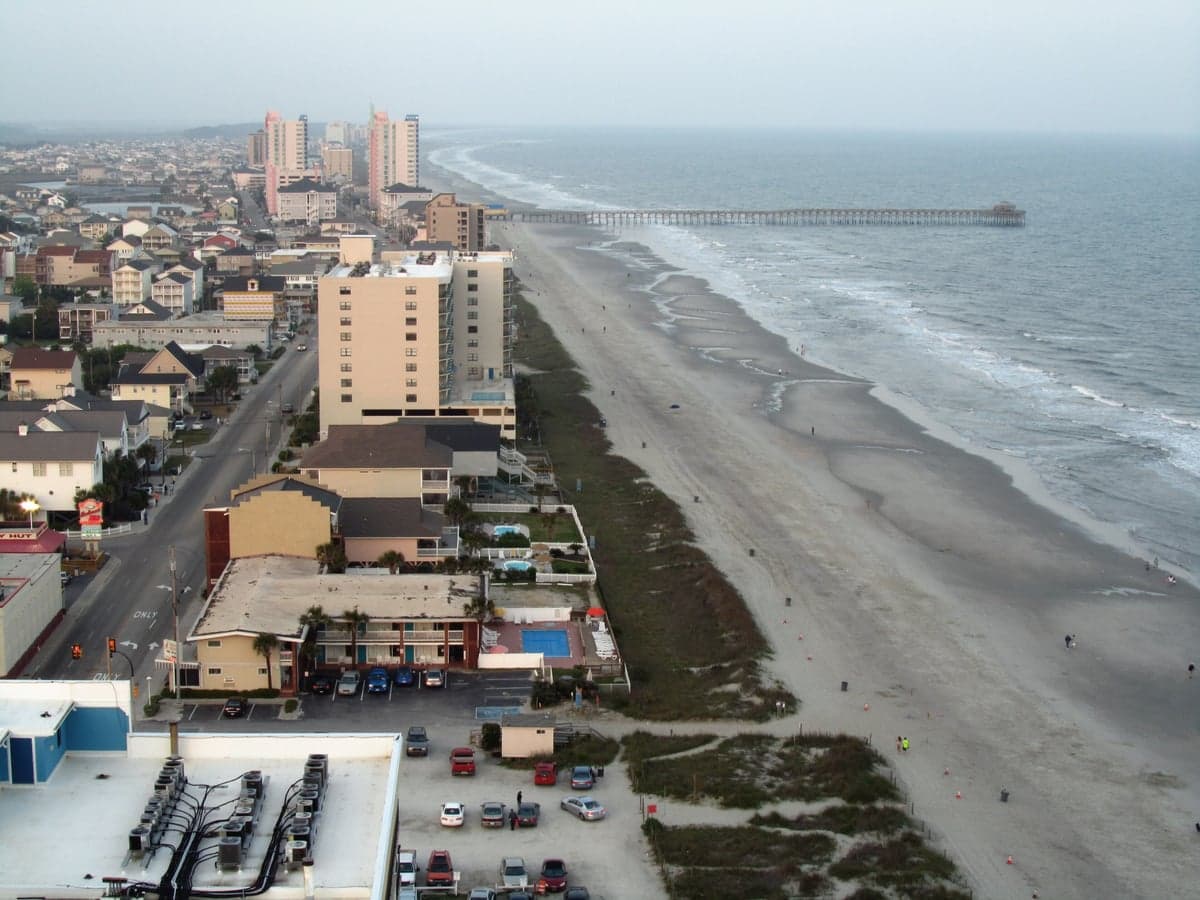
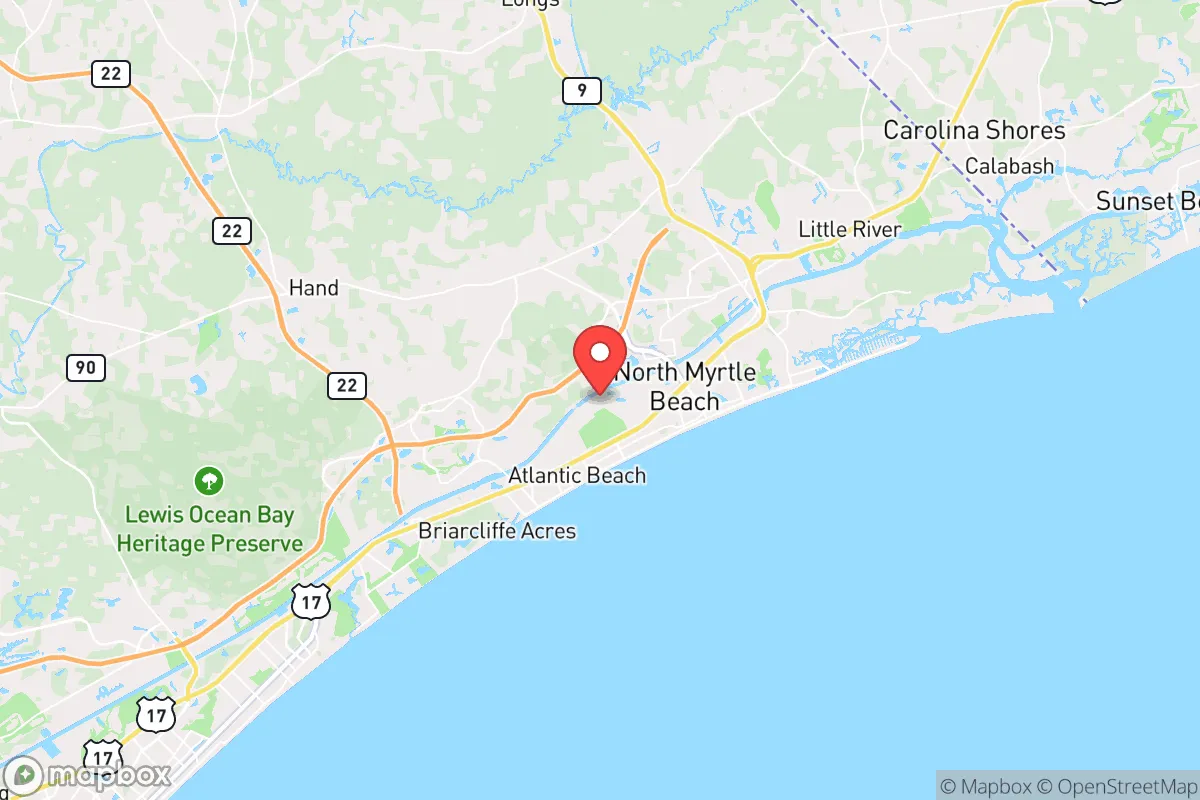
Photo: Wikipedia
Demographics of North Myrtle Beach, SC
Affluence Level in North Myrtle Beach, SC
A middle-class area roughly in line with national averages across income, home values, education, and employment.
People of North Myrtle Beach, SC
The people of North Myrtle Beach, South Carolina, today form a predominantly white (88.1%), college-educated (39.4%) population of 19,343 that is older and more affluent than the national median, shaped by decades of domestic retirement and second-home migration. The city’s identity is distinctly suburban and leisure-oriented, with a low foreign-born share (3.5%) and a Hispanic population (5.7%) that is the largest minority group, followed by Black residents (1.6%), Indian-subcontinent residents (1.0%), and East/Southeast Asian residents (0.9%). Unlike the more transient tourist corridor of Myrtle Beach proper, North Myrtle Beach’s permanent residents are concentrated in planned residential communities and beachfront neighborhoods that have grown steadily since the 1960s.
How the city was settled and grew
North Myrtle Beach is a post-1900 city, incorporated in 1968 from the merger of four smaller beach communities: Cherry Grove Beach, Ocean Drive Beach, Crescent Beach, and Windy Hill Beach. These areas were originally settled in the early 20th century as seasonal fishing and vacation spots, not as agricultural or industrial towns. The first permanent residents were largely white families from inland South Carolina and neighboring states who built modest cottages along the coast. Cherry Grove Beach, the northernmost neighborhood, became the earliest cluster of year-round homes, with a small fishing community that predated the 1920s. Ocean Drive Beach, centered around the Ocean Drive section, grew in the 1930s and 1940s as a summer destination for middle-class families from the Carolinas and Georgia. The area remained sparsely populated through the 1950s, with fewer than 2,000 year-round residents, as the economy relied on seasonal tourism and a handful of seafood packing houses. No significant immigrant or minority settlement occurred during this period; the population was nearly entirely native-born white.
Modern era (post-1965)
The post-1965 period brought the first major demographic shifts, driven by the 1968 incorporation and the construction of the Intracoastal Waterway and Highway 17 bypass, which opened the area to suburban development. Windy Hill Beach and Crescent Beach saw the most rapid growth in the 1970s and 1980s as golf course communities and condominium complexes replaced seasonal cottages. The population more than doubled between 1970 and 1990, fueled by domestic in-migration of retirees from the Northeast and Midwest, particularly from New York, Ohio, and Pennsylvania. These newcomers were overwhelmingly white and middle-to-upper income, drawn by lower taxes, warmer winters, and the absence of state income tax on Social Security benefits. The Dunes Club and Barefoot Resort (developed in the late 1990s) became concentrated enclaves for these affluent retirees, with gated golf-course communities that remain predominantly white today. The Hispanic population began to grow in the 1990s and 2000s, primarily in service-industry roles in hospitality and construction, with clusters forming in the Little River Neck area and along Highway 17 south of the city limits. However, North Myrtle Beach’s Hispanic share (5.7%) remains well below the national average, and the Black population (1.6%) has stayed flat since 2000, reflecting the city’s limited industrial or agricultural base that might have drawn a more diverse workforce. The Indian-subcontinent population (1.0%) and East/Southeast Asian population (0.9%) are small and dispersed, with no distinct ethnic neighborhood, concentrated among professionals in healthcare and hospitality management.
The future
North Myrtle Beach’s population is projected to continue growing at a moderate pace (1–2% annually) through 2040, driven by continued domestic retirement migration and second-home purchases. The city is homogenizing rather than diversifying: the white share has remained above 88% for two decades, and the foreign-born share (3.5%) is roughly half the South Carolina average. The Hispanic population is growing slowly, primarily through births rather than new immigration, and is assimilating into the broader community without forming a distinct ethnic enclave. The Black, Indian-subcontinent, and East/Southeast Asian populations are expected to remain small and stable, as the city’s high housing costs ($400,000+ median home price) and lack of large employers limit in-migration of lower-income or younger households. The most notable demographic trend is aging: the median age (52) is 14 years above the national median, and the share of residents over 65 (32%) is double the U.S. average. This means the city will likely see increased demand for healthcare services, age-restricted housing, and low-crime, walkable neighborhoods like Barefoot Resort and Ocean Creek, while younger families and workers are priced out or pushed to inland communities like Conway or Loris.
For a conservative-leaning individual or family moving in now, North Myrtle Beach offers a stable, predominantly white, older, and affluent community with low crime, strong property values, and a tax-friendly environment. The city is not becoming more diverse or urban; it is solidifying as a retirement and second-home destination where newcomers will find neighbors who share similar life stages and political leanings, but limited ethnic or cultural variety outside the white majority.

* Values derived from national, state, county, city and local statistics and may differ in a specific area. Last updated: 2026-10-10T16:28:32.000Z
Narrative content on this page is AI-generated and may contain mistakes. Verify any details that matter before acting on them.
ReloMaps may earn a commission from affiliate links at no extra cost to you.

