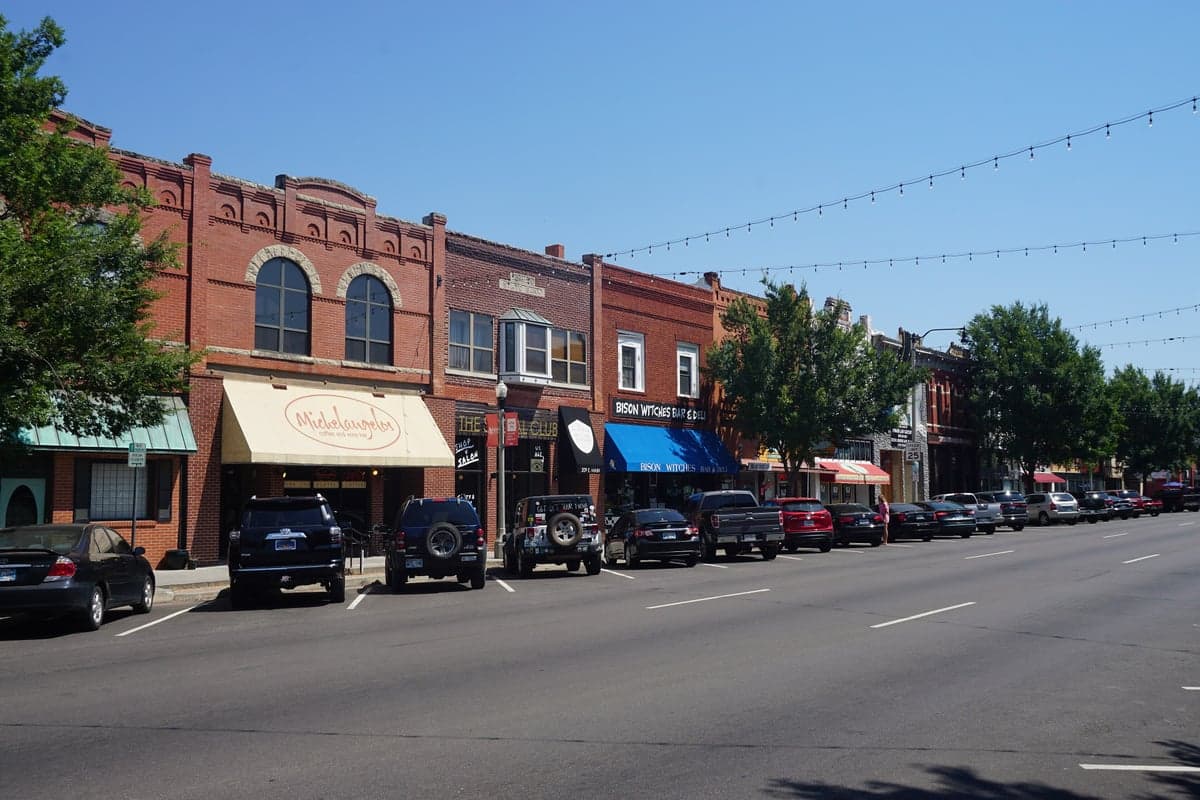
Photo: Wikipedia
Strategic Assessment of Norman, OK
Meaningful friction. Expect exposure to either population pressure, blast zones, or natural disaster risk. Consider buying a retreat property.
What does the Strategic Assessment tell us?
Our Strategic Assessment grades tactical survivability of an area. Major population centers, military targets, fallout zones, natural disasters, and border exposure all drive risk — lower exposure means a more defensible position in a crisis.
This is heavily inspired by Joel Skousen's Strategic Relocation book. Highly recommended you checkout the book ($)What does this tell us?
Our Strategic Assessment grades tactical survivability of an area. Major population centers, military targets, fallout zones, natural disasters, and border exposure all drive risk — lower exposure means a more defensible position in a crisis.
This is heavily inspired by Joel Skousen's Strategic Relocation book. Highly recommended you checkout the book ($)Strategic Pillars

Key Distances
Regional Safe Places
Below is our recommended "safe zones" in Oklahoma and the surrounding area based on our strategic heuristics. For most people, it's unrealistic to live in a “safe zone” full-time due to work, family or other personal reasons. They tend to be more rural. However, many of these areas are perfect for second homes and retreat properties that double as a vacation home or even a short-term rental.
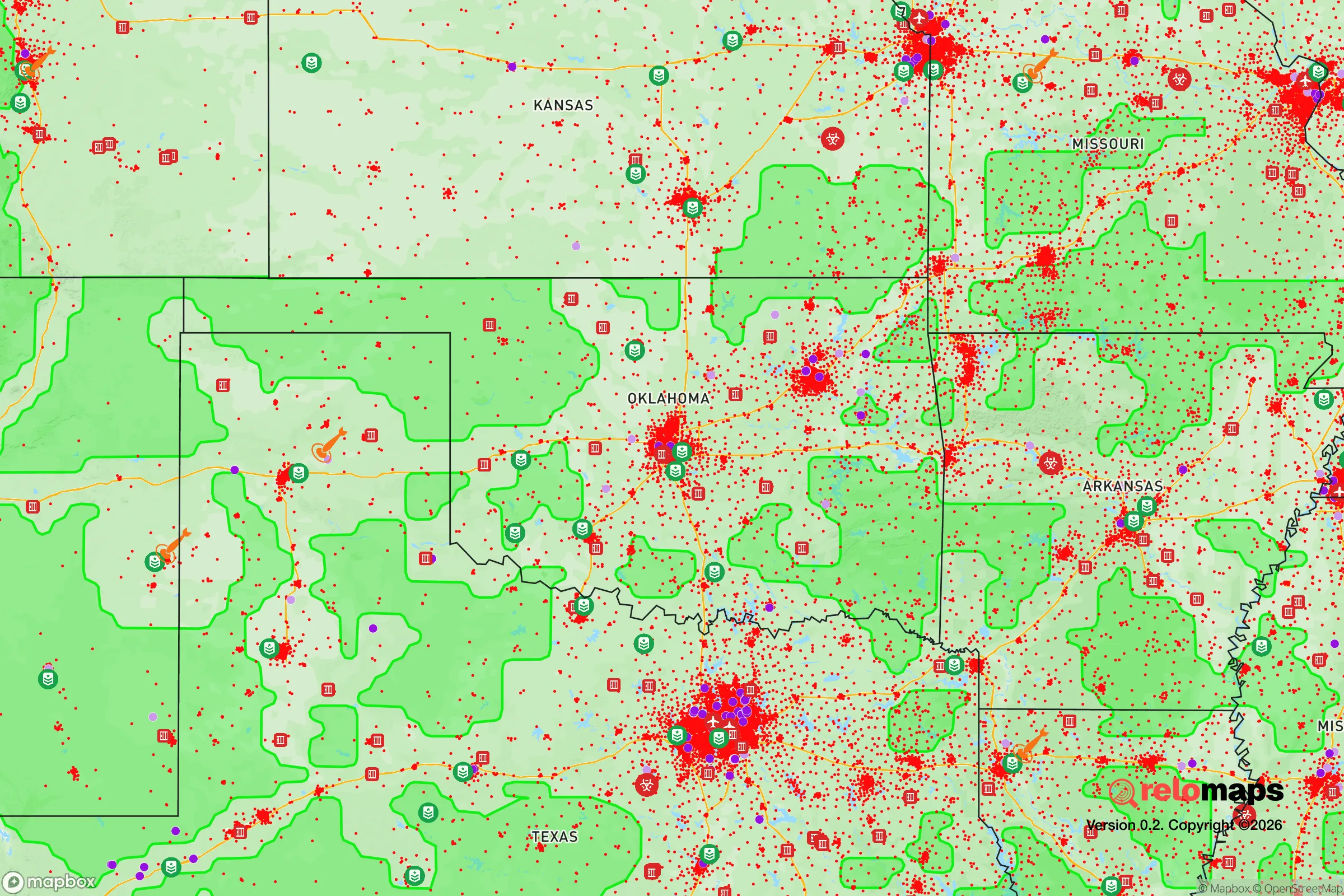
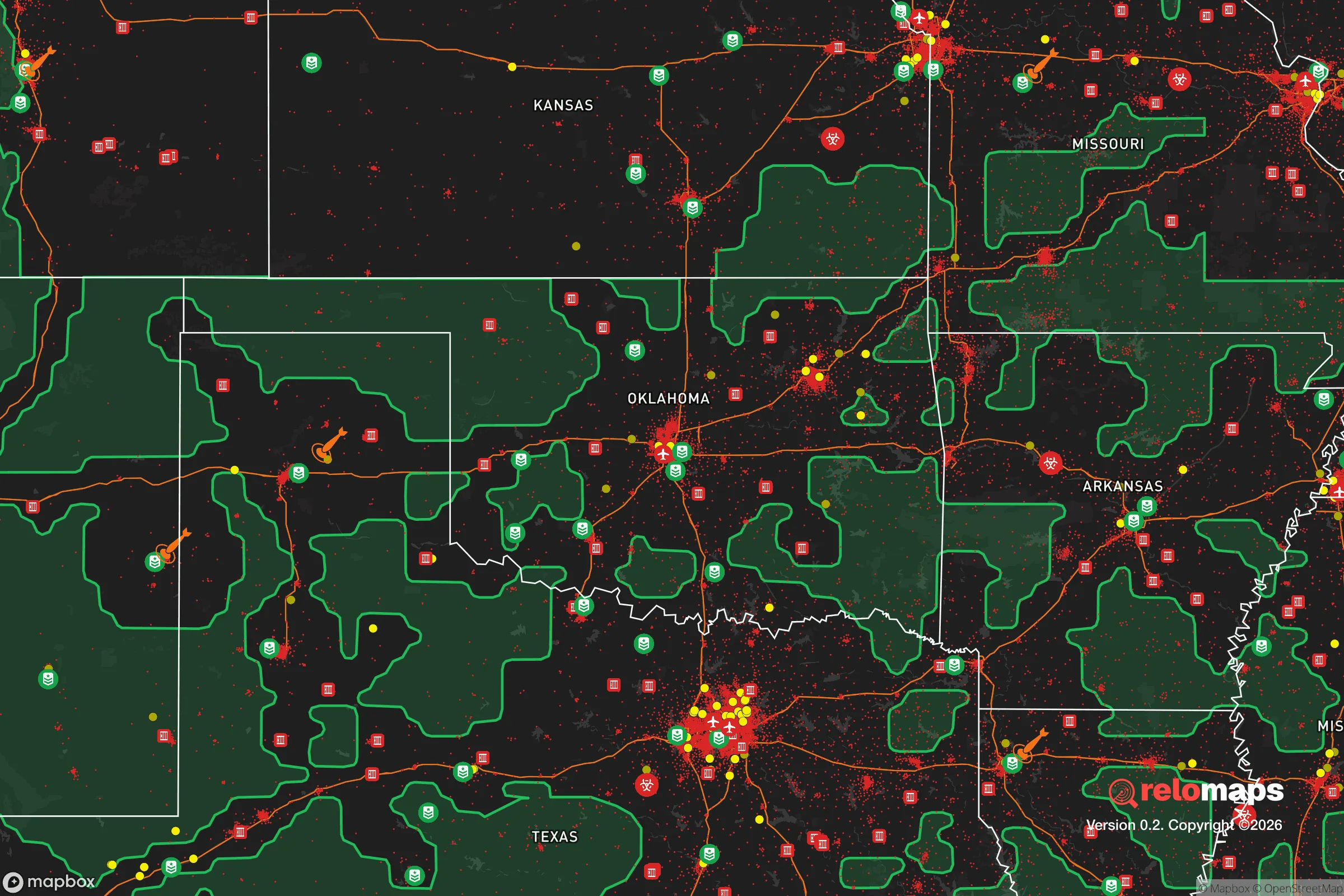


Important Note: For informational purposes only. This does not mean nothing bad ever happens in the green zones. Please use common sense. This is based on public data and modeled with AI. We tried to take a conservative approach but mistakes happen. We update this regularly as new information becomes available.
Solar Generator Recommendations
Backup power matters more here than in safer locations. We've picked three solar generators across budgets and capacity tiers — start with the budget unit if you only need a few essentials, or step up if you want to run a fridge and HVAC for days at a time.

Jackery Portable Power Station Explorer 300
Budget OptionPower on the Go: Weighing only 11 lbs, it's convenient to set up and store with book-sized foldable solar panels

BLUETTI Portable Power Station AC180
Designed for both indoor and outdoor scenarios, AC180 is highly capable as it has a robost capacity and continuous output power.

EF ECOFLOW DELTA Pro Ultra Power Station
Upgraded PickEcoFlow DELTA Pro Ultra is a whole-home energy system designed to grow with your family. Integrated with the Smart Home Panel 2, it scales to meet your evolving energy needs — keeping your home powered, intelligent, and secure through every stage of life.
We earn a commission, at no additional cost to you.
Strategic Assessment Analysis
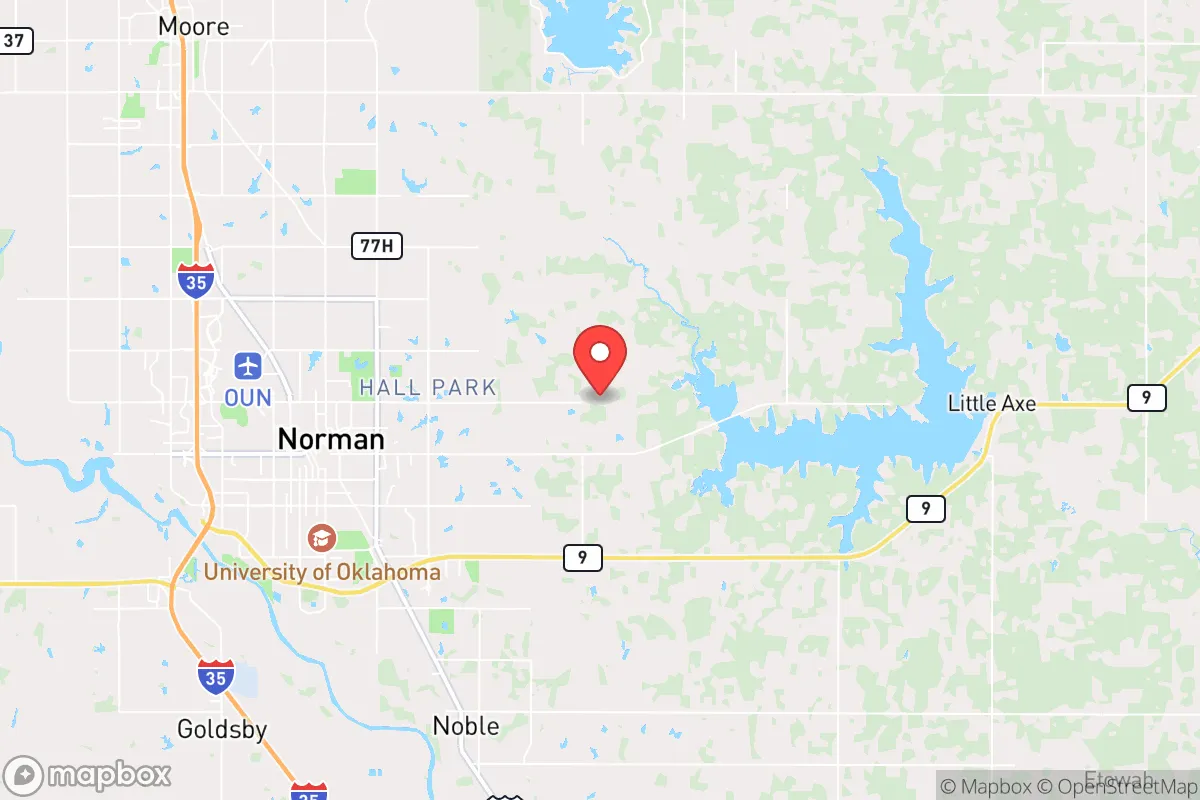
Norman, Oklahoma, sits in a precarious but potentially advantageous position for those serious about strategic relocation. Its location roughly 20 miles south of Oklahoma City places it within the blast radius of a major metropolitan area’s cascading failures, yet far enough to avoid the immediate crush of a mass casualty event or civil unrest. For a conservative-minded prepper, the key question isn’t whether Norman is safe—it’s whether its assets outweigh its liabilities when the grid goes down or the social order frays. The answer depends on how well you can leverage its geographic and infrastructural quirks before trouble arrives.
Geographic position and natural advantages for long-term survival
Norman’s position in the central Oklahoma plains offers a mixed bag for resilience. On the plus side, the area is far from coastal fallout zones, major fault lines, and the dense population corridors of the East and West Coasts. The surrounding landscape is flat to gently rolling, with the Canadian River running just north of the city—a water source that, while seasonal and prone to flash flooding, can be tapped with proper filtration. The region’s aquifer, the Garber-Wellington, provides decent groundwater access, though well drilling is regulated and depth varies. For a relocator, the biggest natural advantage is the sheer amount of open, agricultural land within a 30-minute drive. This means potential for small-scale farming, livestock, and foraging, provided you secure acreage outside city limits. The climate is continental, with hot summers and cold winters, but the growing season runs about 210 days—enough for a solid garden. Tornadoes are the obvious hazard, but with a storm shelter and a weather radio, that risk is manageable compared to the slow-motion collapse of a coastal megacity.
Risks, exposures, and proximity to fallout-relevant landmarks
The biggest red flag for Norman is its proximity to Oklahoma City, a major transportation and logistics hub. In a scenario involving civil unrest or a mass casualty event—say, a coordinated attack on infrastructure or a pandemic-fueled breakdown—Oklahoma City’s population of nearly 700,000 would become a liability. Refugees, looters, and desperate crowds would likely flow south along I-35, the main artery connecting Norman to the metro. That highway is a double-edged sword: it’s your escape route north or south, but it’s also the primary vector for trouble. Norman itself has a population of about 128,000, which is dense enough that a localized disaster could overwhelm local resources. The University of Oklahoma, with its 30,000 students, is a potential flashpoint for ideological clashes or mass gatherings that could turn violent. On the industrial side, there are no nuclear plants or major chemical facilities in Norman, but the nearby Tinker Air Force Base in Midwest City is a strategic military target. If things go hot, that base could draw precision strikes or become a focal point for federal response—neither of which is good for anyone living downwind. The area’s power grid is part of the Southwest Power Pool, which has shown vulnerability to winter storms (see 2021’s blackouts). Natural gas is the primary heating source, but supply disruptions during a crisis are a real concern.
Practical resilience for a relocator: food, water, energy, and defensibility
For a single individual or family looking to hunker down, Norman offers a mixed bag of practical resilience. Water is the first concern: municipal supply comes from Lake Thunderbird and the Canadian River, both of which are vulnerable to contamination or disruption. A 55-gallon drum and a Berkey filter are non-negotiable here. Well water is an option if you buy property outside city limits, but test for salt and selenium—common issues in the region. Food security is better than average. The city has multiple grocery chains, but in a crisis, those shelves empty fast. The real advantage is the local agricultural network: farmers’ markets, co-ops, and direct-from-ranch meat suppliers are plentiful within a 20-mile radius. Building relationships with these producers now is smart. For energy, solar is viable—Oklahoma averages 230 sunny days per year—but grid-tied systems are useless without battery storage. A small propane generator and a 500-gallon tank are a more reliable backup. Defensibility is the weak point. Norman is flat, with few natural chokepoints. A rural property with a long driveway, good sightlines, and a perimeter fence is far more defensible than a suburban subdivision. If you’re in town, consider a home with a basement or storm shelter that can double as a safe room. The local gun culture is strong, and Oklahoma is a constitutional carry state, so firearms and training are accessible. But don’t count on law enforcement in a widespread emergency—Norman PD has about 200 officers, and they’ll be overwhelmed fast.
Overall strategic picture: a calculated gamble for the prepared
Norman is not a survivalist paradise, but it’s a viable option for someone who wants to stay within striking distance of infrastructure while maintaining a low profile. The biggest strategic advantage is the ability to blend in—it’s a college town with a conservative rural fringe, so you can fly under the radar while building your network. The biggest risk is the proximity to Oklahoma City and the I-35 corridor, which could turn into a funnel of chaos during a mass casualty event or civil unrest. For a family, the schools are decent (Norman Public Schools rank above state average), and the cost of living is reasonable—median home prices around $250,000 as of 2025. For a single individual, the social scene is active but not overwhelming, and there’s a strong church and community network for mutual aid. The bottom line: Norman works if you’re willing to invest in off-grid capabilities, secure a defensible property outside the city core, and maintain a low profile. It’s not a bug-out location—it’s a stay-and-prepare location. If you’re looking for a place to ride out the next decade with a solid plan and a few like-minded neighbors, it’s worth a serious look. Just don’t expect to be completely isolated from the fallout of a collapsing world.

* Values derived from national, state, county, city and local statistics and may differ in a specific area. Last updated: 2026-04-28T19:56:41.000Z
Narrative content on this page is AI-generated and may contain mistakes. Verify any details that matter before acting on them.
ReloMaps may earn a commission from affiliate links at no extra cost to you.

