Photo: Wikipedia
Demographics of Nicholasville, KY
Affluence Level in Nicholasville, KY
A middle-class area roughly in line with national averages across income, home values, education, and employment.
People of Nicholasville, KY
Nicholasville, Kentucky, is a predominantly white, family-oriented community of 31,625 residents, where 84.9% of the population identifies as white alone. The city retains a distinctly small-town, conservative character, with a foreign-born population of just 2.3% and a college attainment rate of 27.0%. Its people are largely rooted in multi-generational Appalachian and Southern stock, with a modest but growing Hispanic presence (4.8%) and small Black (4.4%) and East/Southeast Asian (1.7%) communities that have arrived primarily through employment and family networks in recent decades.
How the city was settled and grew
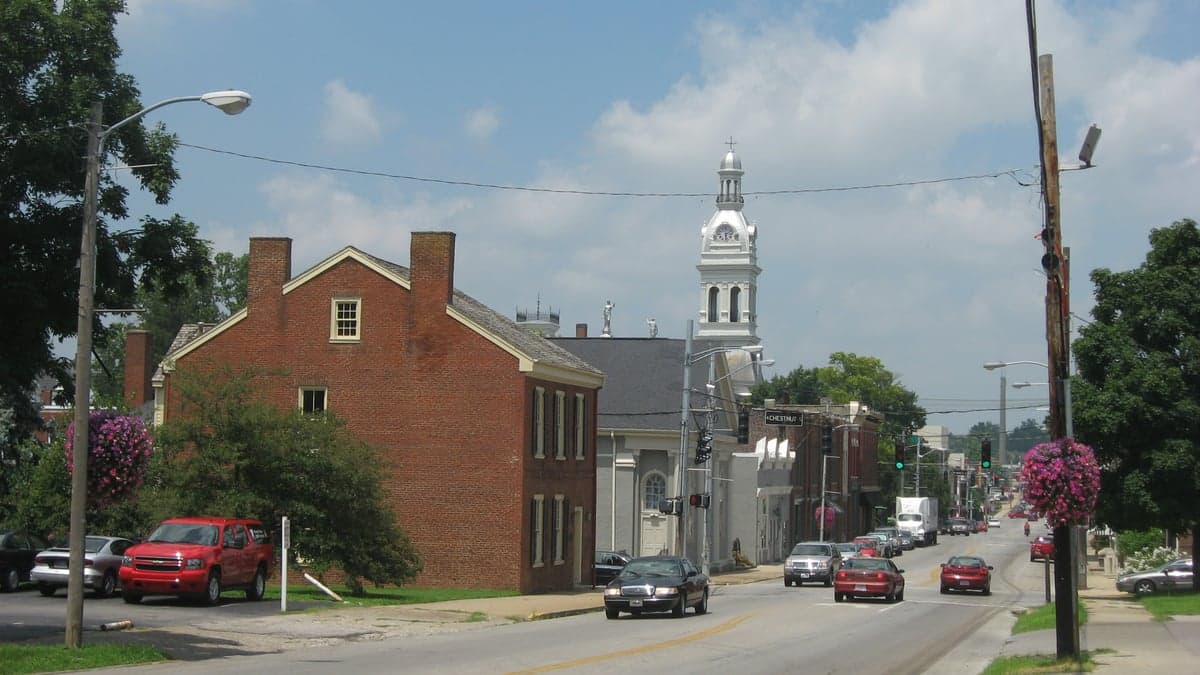
Nicholasville was founded in 1798 as the seat of Jessamine County, named after Colonel George Nicholas, a Virginia-born Revolutionary War officer. The original settlers were predominantly Scots-Irish and English farmers who moved west through the Cumberland Gap, drawn by the fertile limestone soils of the Bluegrass region. These early families—many bearing surnames like Ballard, Bronston, and Hocker—established tobacco and hemp plantations worked by enslaved Black laborers, who by 1860 made up roughly 30% of the county's population. The historic Downtown Nicholasville district, centered on Main Street, was built by these early merchants and tradesmen, with many original Federal-style homes still standing. A second wave of German and Irish immigrants arrived in the 1850s to work on the Louisville & Nashville Railroad, settling in the West End neighborhood near the depot. The city remained a quiet agricultural trading hub through the early 1900s, with population hovering around 2,000 until the post-World War II era.
Modern era (post-1965)
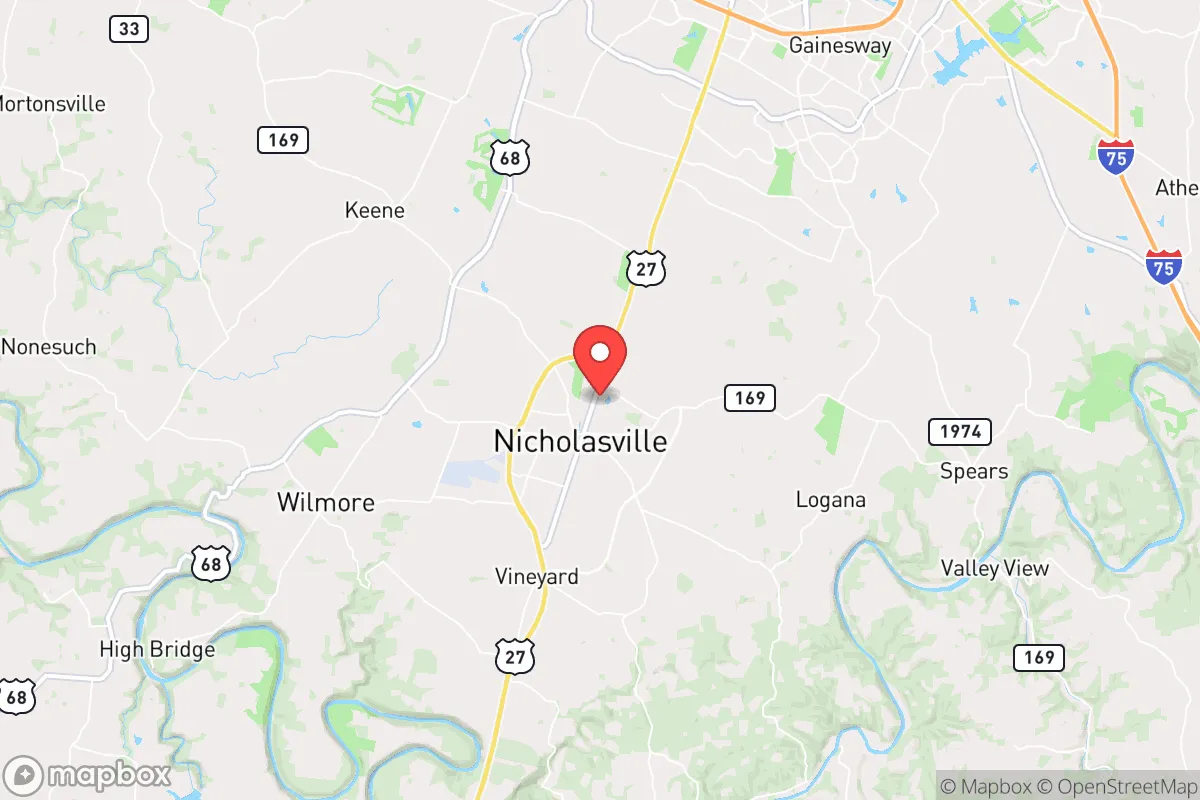
The 1965 Hart-Cellar Act had minimal direct impact on Nicholasville, as the city's foreign-born share remains far below the national average. Instead, the modern population boom came from domestic in-migration: from the 1970s onward, Nicholasville became a bedroom suburb for Lexington, located just 12 miles north. The completion of U.S. 27 and later the Nicholasville Bypass opened large tracts of farmland for subdivision development. The Brannon Crossing area, developed in the 1990s and 2000s, absorbed the bulk of white middle-class families moving from Lexington for lower taxes and newer schools. The Lake Mingo neighborhood, built around a small reservoir, attracted retirees and second-home buyers from the Ohio Valley. The Hispanic community, now 4.8% of the population, began growing in the 1990s, with many families settling in the South Nicholasville corridor near the industrial parks and tobacco warehouses where they found work in manufacturing and agriculture. The Black population, which had declined sharply after the Great Migration (from 30% in 1860 to under 5% by 1970), has stabilized at 4.4%, concentrated in the historic East End neighborhood around the Jessamine County Fairgrounds. The East/Southeast Asian community (1.7%) is largely composed of Vietnamese and Korean families who arrived in the 1980s and 1990s, many settling in the Keene Road corridor near the Toyota Motor Manufacturing Kentucky plant in Georgetown, a major regional employer. The Indian-subcontinent population (0.2%) is negligible, consisting of a handful of medical professionals at Baptist Health Lexington.
The future
Nicholasville's population is projected to continue growing at a moderate pace, driven by Lexington's outward suburban expansion and the city's relatively affordable housing stock. The white share is likely to decline slowly as the Hispanic and East/Southeast Asian communities grow through natural increase and continued in-migration for service-sector and manufacturing jobs. However, the city is not tribalizing into distinct ethnic enclaves; instead, new subdivisions like Ashford Park and Maplewood are attracting a mix of white and Hispanic families, reflecting assimilation patterns common in smaller Southern cities. The foreign-born share is expected to rise to 4-5% by 2035 but will remain well below state and national averages. The college-educated share (27.0%) is likely to increase as more professionals commute to Lexington's healthcare and tech sectors, though Nicholasville will remain more blue-collar than its northern neighbor. No major immigrant gateway is forming, and the city's political and cultural character is expected to stay solidly conservative.
For a mover considering Nicholasville, the bottom line is this: you are choosing a predominantly white, family-oriented suburb with a stable, slow-growing population and minimal ethnic diversity. The city is becoming slightly more Hispanic and more educated, but it is not undergoing rapid demographic transformation. It remains a place where multi-generational Kentuckians live alongside a modest number of newcomers drawn by affordable housing and proximity to Lexington's economy. If you value a homogeneous, low-crime community with strong schools and a conservative ethos, Nicholasville fits that profile today and is likely to maintain it for the next generation.

* Values derived from national, state, county, city and local statistics and may differ in a specific area. Last updated: 2026-04-21T17:17:31.000Z
Narrative content on this page is AI-generated and may contain mistakes. Verify any details that matter before acting on them.
ReloMaps may earn a commission from affiliate links at no extra cost to you.

